Full moon and reunions
Updated: 2011-09-10 15:26
By Zhou Wenting (China Daily)
|
|||||||||


More often than not, family ties suffer slow erosion rather than a sudden break.
For example, Gan left home to study when he was just 16. He started work in Guangdong province after he graduated from a technical secondary school, and moved to Beijing in 2005. Initially, he would phone his family twice a month, but the calls became less and less frequent as their worlds grew further apart and there was nothing in common to talk about anymore.
"I became impatient with my mother's ramblings about trivia things. The longer I was away, the more my world became different from theirs."
It was a hard life in Guangdong, and Gan says he was "beaten by hooligans" and he had to eke out a living as "a cleaner of high-rise buildings". But even when he was in trouble, he did not turn to his family for help.
"I depended on myself to solve my problems. My family could not help because they did not know what was happening in my world. They had nothing to do with it," Gan says.
Liu Wei, a new arrival in Shanghai, shares the same feeling of being disconnected, which he blames on a heavy workload and a demanding relationship with his girlfriend. Liu, 24, comes from Weihai in Shandong, and has worked in a shipping firm for more than a year now.
He says the younger workers these days are a lot more independent compared to past generations.
"People used to take over their parents' jobs when the older generation retired. Now we plot our own paths, even exploring opportunities in new cities or countries," Liu says.
Another obstacle to a closer family network is when large extended family are split into smaller nuclear units, say the experts. The close-knit families where several generations and different branches lived together under one roof are rare now.
"The concept of clan is played down these days, and bigger families have disintegrated. The bonds of the extended family, like uncle and nephew, are now very flimsy," says Gu Xiuqin, secretary-general of the China Association of Social Workers' marriage and family affairs committee.
The market economy has also exacted a toll. There is a conflict of interest as people get richer and lives get more complicated.
"Income didn't use to be that diverse. Lives used to be simpler. They didn't compete or compare so much," Gu says.
But the experts say a traditional time for reunion may trigger the urge to reconnect.
"Modernization has left its impact on families, but this is a day when we need to stop and remind ourselves of family and home. It should give everyone a sense of wanting to go home," says Yang Lihui, a council member of the China Folklore Society and a professor at the School of Chinese Language and Literature at the Beijing Normal University.
"The Mid-Autumn Festival wakes up our love and sense of responsibility for the family. I want to spend some time with my grandmother when I get home," says Gan. "Kinship is the most important part of life."
The Mid-Autumn Festival is second only to the Spring Festival in importance in the Chinese lunar calendar, and both festivals attach great significance to family reunion during celebrations - especially when the full moon shines.
"The moon during this time is said to be the brightest during the year. When people see the full moon, they start thinking of family and that's why this is a time to gather the family together," says Yuan Xuejun, chairman of the Hebei Association of Folk Culture.
Experts say the festival is the only one among the seven major Chinese festivals that purely advocates happiness and reunion with no superstition or ritual involved.
For example, the Dragon Boat Festival, which falls on the fifth day of the fifth lunar month, is a day for expelling evil spirits which gather in the heat of summer. The same applies for the ninth day of the ninth lunar month, a day devoted to avoiding natural disasters and chasing away threats in the countryside.
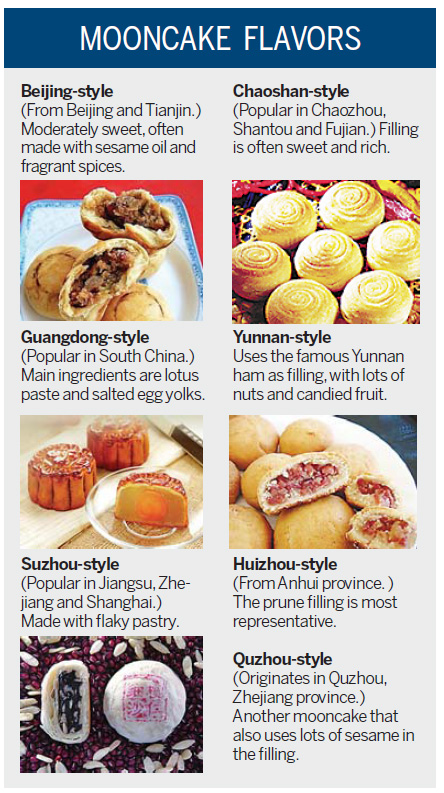
Older people interviewed all agreed that the Mid-Autumn Festival is simply for enjoying a glorious full moon, a fact that is accentuated with the eating of mooncakes.
Qiao Xiaomei, a 63-year old Shanghai native, has four siblings. When she remembered the celebrations of her childhood, her memories are of family gathered around sharing a feast of mooncakes.
"My father would cut a mooncake into seven pieces, and we all gathered in a circle to wait for our slice.
"Then we sat on the balcony eating while enjoying the full moon," Qiao says.
Traditions may have faded in the neon-lit cities, but many customs are very much alive in the northeastern parts, says Song Deyin, an executive director of the China Folklore Society, and a professor at Mudanjiang Normal University in Heilongjiang.
In the country, people would place a table out in the courtyards and load it with mooncakes and other offerings.
"All family members would bow and make a wish, praying for blessings from the Moon," Song says. In the cities, similar tables would be set up on the balcony, nearest the moon.
"The tradition of zou yue still exists. It is said that people who walk under the moonlight can get rid of ills and pains," says Song.
The Mid-Autumn Festival is celebrated in many other Asian countries because of Chinese influence or emigration. Japan and Korea, Vietnam, Thailand, Singapore and Malaysia all observe the festival.
"The way these countries celebrate is very similar to the way we do, and in some places, they light little lanterns to cast light in the night," Song elaborates.
The Chinese has always paid homage to the moon, believing its waxing and waning represent the eternal life cycle.
The origins of the Mid-Autumn Festival are varied, but most folklore experts agree that it is most connected to a legend that started getting popular in the Western Han Dynasty (206 BC-AD 24).
This was the myth of the lady in the moon, Chang'e, who grew light as a feather and floated away to the moon after she stole and ate a magic elixir.
"Our forefathers were filled with fantasies when they looked at the moon, and the tradition of worshipping the moon began," Song says.
In the Tang Dynasty (AD 618 - AD 907), the emperor issued an edict that the 15th day of the eighth lunar month was to be declared a holiday for nationwide celebration.
Yue Tan, or the Temple of the Moon, was a place where emperors in Ming Dynasty (1368-1644) and Qing Dynasty (1644-1911) worshipped the moon and other gods in the heavens.
The tradition of the gifting and eating of mooncakes began in the Song Dynasty (960-1279).
The cakes were originally created as sacrificial offerings to the moon, but evolved as a gift exchange in a festival that stresses reunion and goodwill.