From the classes to the masses
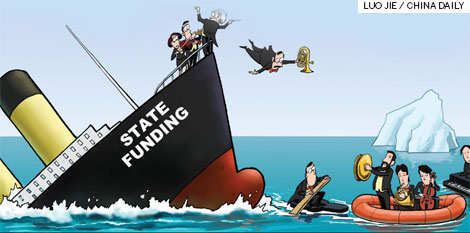
Most symphony orchestras in China are being pushed to fend for themselves in the market, and this could well be a blessing in disguise.
Take a look at a typical audience at a classical music concert in Asia and in Europe, and you will instantly see the difference. In Asia, the average age is around 30, while in Europe it is twice as much.
This could be an apt analogy for something bigger, say, the economy. But like the economic comparison, the prospects for classical music in the developing and developed worlds are not as black and white as they seem.
As Guo Shan, chairwoman of the Alliance of Asia-Pacific Region Orchestras (AAPRO), puts it, Asia may be emerging, but there is still a long way for it to catch up with the best.
That, in a sense, is the raison d'etre for AAPRO, whose mission is to "address the common issues, and exchange ideas, within the global orchestral sphere from our unique perspectives". In fact, the theme of the 8th summit of AAPRO in Moscow, held from Sept 8-11, 2011, was "Share and Prosper: Europe-Asia-Pacific".
Music, especially orchestral music, speaks a common language that transcends borders. However, in an age of 5,000 daily messages a day competing for your attention, classical music seems to be losing ground - ground that has not been big to start with. It serves an upscale audience of about 5 percent of the population, according to some delegates at the summit. It relies mostly on government backing and commercial sponsorship for survival.
During an economic crisis, such support weakens. The famed Philadelphia Orchestra filed for bankruptcy in April. The Pittsburg Symphony Orchestra saw a bitter, six-month long strike that lasted till this June. After John Frank Smith, president of the International Federation of Musicians (IFM), delved into both cases, he showed a video clip of Riccardo Muti conducting the Rome Opera and making an impromptu speech in the middle of thunderous applause for a patriotic aria, pleading for maintaining government support. Then he turned around and conducted the audience in an encore of that emotional aria.
Smith added that the proposed 40 percent cut in state funding by Silvio Berlusconi's conservative government was rescinded in the aftermath of that performance.
Here in China, politics in arts is not played out in such public glare but is, perhaps, more unpredictable. Many Chinese participants at the summit admitted that public funding for symphony orchestras depends to a large extent on local leaders' personal tastes. If the decision-maker happens to like classical music, he or she could turn on the spigot of generous financial support. Otherwise, that money could flow to other channels.
Is a symphony orchestra "some kind of aristocratic bonus" or is it "intrinsic to the identity" of the nation or, in China's case, a province? Conductor Muti raised this question to the Italian press. A Chinese administrator in charge of culture must have grappled with similar questions at some time or another.
More precisely, a symphony orchestra in a Chinese city is often seen as the icing on the cake, or to borrow the oft-repeated phrase from official parlance, "a city's name card", rather than a means to enrich a city's cultural life. Therein lies the problem. "It is as if you do not eat your normal meals, but save up to binge on expensive sea cucumbers," Zhang Guoyong says, drawing a vivid analogy. The president and artistic director of Shanghai Opera House calls on local administrators to "turn music making into part of a city's cultural life instead of major events".
With the sole exception of Hainan, there is at least one symphony orchestra in every one of China's provinces or autonomous regions. Some cities boast two or three. However, of the 50-plus orchestras that are members of the China Symphony Development Foundation, more than 40 are undergoing "structural transformation". To put it bluntly, they are being taken off government-guaranteed life support. They will no longer be government affiliated arts organizations, but corporate entities, reveals Guo Shan, who is also president of the foundation.
Will that spell the demise of these orchestras? Not likely. According to several directors of local orchestras at the summit, this round of reform will change only the name of the funding. When an orchestra is State owned, the funding comes through automatically and covers mostly administrative expenses. When it becomes independent, funding takes the form of grants for specific projects.
The intentions behind such a move seem sound. For example, a province-level orchestra gets a subsidy of 8,000 yuan ($1,253) for a show on a college campus in a program aimed at encouraging music appreciation among college students. But in reality, the sum is so meager no musician would jump at the opportunity. One could easily get paid more for a teaching session. That explains the wealth gap between the musicians, who are doing rather well financially, and the orchestras that are merely scraping by.
Both Chinese and Western participants at the summit agreed that the system is set up in such a way that it inadvertently discourages actual music making. With each show, the cost outruns the revenue by far. "The best way to run a company is to keep the theater dark, so with no performances there'll be no additional expenses," Smith of IFM says.
To prevent a concert hall from going dark, promoters and managers have been floating all kinds of ideas. One of them suggests projecting the image of the conductor onto a giant screen. The audience, he says, usually gets a rear view of the maestro at work and misses out on the most fascinating dynamics at play. He also questions the conventional wisdom of having musicians in tuxedos and bow ties. "That was how audience members dressed 100 years ago, which should be reflected on stage. But things are different now."
Another orchestra has tried color-coding the dresses with the music it was playing.
Such attempts to bring classical music, often seen as elitist, to the masses are being experimented with across the world. While the core audience does not need them and often views them as cheap gimmicks, they help broaden the base and promise a listening adventure.
Geza Kovacs, CEO of Hungarian National Philharmonic Orchestra & Choir and president of Hungarian Orchestras Association, suggests combining music with other arts or entertainment such as dance or fireworks. "Be brave and wise," he admonishes. "Even Arnold Schoenberg can be played to a general public," he says, referring to the notoriously difficult Austrian composer of 12-tone compositions.
Chang Xigang, artistic director of Shanxi Song and Dance Troupe, that includes a symphony orchestra, finds such discussions enlightening. Shanxi does not have the audience size or the familiarity with classical music typical of a metropolis such as Beijing or Shanghai. The road to acceptance, let alone excellence, seems distant. But now, he sees more than one way of going ahead and having good music embraced by more people.
That is exactly what Guo Shan of AAPRO aims to achieve with this unique platform where music directors and managers from East and West can compare notes and learn from each other's experiences. Whether it's boom or bust at the economic level, people need music to enliven their daily existence. We may see orchestras mushrooming in China, but we will have to fine-tune our resources so that good music can be presented in ways accessible to each social segment.
Music can be the candles on a birthday cake, a celebration of anniversaries and other festive occasions; or it can also be more subtle and touch one's heart. Only by making each concert a meaningful experience can classical music managers turn the occasional gawkers and 20-something dilettantes into real enthusiasts.
Creating a Lang Lang is the beginning - not the end - of a vibrant music scene.