Keeping birth rates low and life quality high
Updated: 2011-10-11 11:39
By Huo Yan and Huang Feifei (China Daily)
|
|||||||||


 |
|
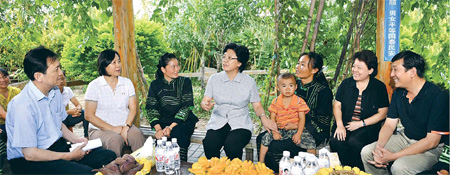
Head of the National Population and Family Planning Commission, Li Bin (center), accompanied by Guangxi's Chairwoman Li Kang (second right) and Guangxi's population and family planning commission head, Huang Dan (second left), in some talks with the people of Tianyang county, concerning maternal health. Photos Provided to China Daily. |
 |
|
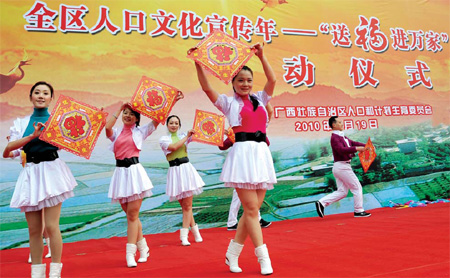
A campaign for the promotion of family planning. |
The region faces serious challenges in rural poverty, education, and health care
For many people, family planning consists of both the dull matter of considering birth and death rates, and the more complicated matter of considering life quality, that is, education, healthcare, social security, and preserving the culture.
But this is especially important for an ethnic autonomous region such as Guangxi, where ethnic people account for 38.8 percent of its 51.52 million people, and 64 percent are farmers. In addition, per capita incomes are lower than the nation's average.
To make matters worse, more than 2.3 million people are still living below the poverty line, and its aging-population figures are about 1.7 percent above the national average. It is almost equal to the densely packed eastern coastal regions.
In addition, per capita revenues for the autonomous region's governments are only about 38 percent of the national average, so government spending on education and healthcare is rather limited. This in turn poses many challenges for the government and its goal of keeping birth rates low while improving life quality.
Nonetheless, the local government has managed to find ways to address these challenges, and work toward rational, sustainable population growth.
Major approaches
The region has a number of programs that place emphasis on birth-related healthcare, one of the most important of which has been to establish 30,000 health service stations at the village level.
By June 30, a total of 75 million yuan had been allocated for this: 60 million of it from the regional government and 15 million yuan from local governments.
Every health-service office is expected to get around 10,000 yuan worth of medical equipment and medicines, as spending increases in the near future.
Another important grassroots facility - the new home culture office - will be used to spread healthcare awareness among farmers.
According to the regional government, each culture station will have various publications and equipment that are worth about 10,000 yuan.
This is especially important because the region has a high occurrence of thalassemia, a hereditary disease that can cause birth defects.
To deal with this, the regional government spent around 12 million yuan this year building laboratories that can monitor the disease and another 6.76 million yuan on running them.
These labs have checked more than 12,000 pregnant women and their husbands, so far, and have advised several hundred of them to either get further treatment or terminate the pregnancy.
Another regional initiative involves the prevention of HIV and other sexually transmitted diseases. Family planning personnel have handed out more than 2.5 million free condoms and materials on disease prevention, through a regional network.
Guangxi has many marriage-counseling and birth information centers at the grassroots level, which provide free check-ups for couples planning on having children.
The regional government has also increased the training of birth-services professionals and has held a number of training sessions this year. For this, it has asked the help of experts from population and family planning commissions and disease prevention organizations to lecture on new technologies and techniques for check-ups, birth-defect prevention, and health laboratory management.