It's a rich man's world
 |
|
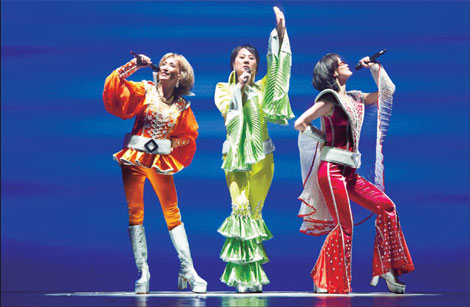
From left, Shen Xiaocen, Tian Shui and Yang Zhuqing play women of a certain age who used to be "dancing queens" in their youth. Photos Provided to China Daily |
 |
|
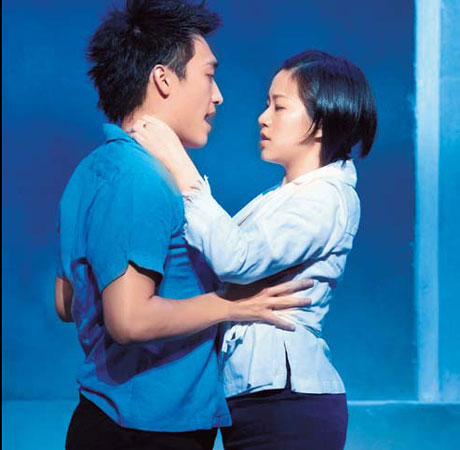
Yu Xiaolin (left) and Zhang Fangyu play the young couple whose love is tested during her search for her birth father. |
The growing success of the Chinese version of Mamma Mia! shows that good productions, with the right touches for local audiences, can be commercially viable.
This week, a milestone was reached in the annals of musical theater in China: The Chinese-language version of Mamma Mia! grossed 100 performances in its first outing.
By Broadway standards, a 100-show continuous run is nothing to brag about. Phantom of the Opera has been on the stage ever since 1988 in New York. (It first opened in the West End of London two years earlier in 1986.) Think about how many performances in total that means, at eight shows a week? And that is not including the multiple and simultaneous productions across the world - 149 cities in 25 countries to be exact, for an audience of over 100 million.
Phantom actually had a very decent run in China - unprecedented for that time - when it played in Shanghai for 97 shows back in 2001. What distinguishes the current Mamma Mia! is that the cast and much of the crew are Chinese.
To borrow an analogy from the automobile industry, this is not like selling German-made Volkswagen in China, but more like selling Shanghai-made Santana, which is a local brand of Volkswagen.
Actually, an authentic production of Mamma Mia! did tour China - in 2007. Its success injected confidence in its producers to create a Chinese adaptation - to bring down the costs and also to enhance its appeal to the local market.
There is nothing revolutionary in having a foreign musical presented in Chinese. In 1998, I bought the rights to The Sound of Music from the Rodgers and Hammerstein Organization and collaborated with the Oriental Song and Dance Ensemble to present a Chinese version. And I was not the first one. I had heard of other shows in Beijing, with at most a couple of performances. Mine lasted two weeks, and we even had to squeeze in a couple of extra performances when Poly Theater was vacant. Still, when I talked about the show running for a year or two, my collaborators looked at me like I was crazy.
It is not the quality of the show, but the length of the run, that is truly revolutionary about Mamma Mia! Live shows in China are characterized by limited engagements even though China has a potential market four times that of the United States.
A city like Beijing or Shanghai should be able to sustain a quality show for at least weeks, if not months and years. Yet, the most economical way to manage a theater is to keep it dark, as the saying goes. Most shows run for a few days, and even for that you'd have to give out piles of complimentary tickets.
Although musical theater, in the narrow sense of the word, is a foreign art form, traditional Chinese operas have a lot in common with musicals. In Hong Kong and Taiwan, there was a big boom of film musicals in the 1950s and 1960s. They borrowed traditional tunes but used Mandarin as the singing dialect.
Had Western musicals been imported into China a century ago, local showgoers would have been quite receptive. It is ironic that the straight play - with spoken words only - arrived in China first. An anecdote from the early 20th century: When spectators in a theater were asked to stop chatting, they replied: "The actors on the stage are still talking. We'll stop when they start the show by singing." It is testament to the potential market of musicals in China.
It is true that the pendulum has swung from singing drama to concert-style revues. Occasionally, some pop stars will infuse their numbers with a dramatic element, but mostly the vogue is to have familiar tunes accompanied by flashy backdrops and costumed dance girls.
Most in China cannot tell a musical from an opera. During my lectures at the National Center of Performing Arts, I always ask the audience - from college students to white-collar workers - to name one opera, and it is invariably Phantom of the Opera, which, of course, is the longest-running musical in history.
Mama Mia! has several things going for it, and many more against it. The melodies are catchy and infectious, but China was not open when ABBA was in its heyday. As a result, Gimme! Gimme! Gimme! is one of the few songs adapted by Chinese pop stars. That explains the tentative mood in the theater. (Now, were it a musical based on Michael Jackson songs, you'd find a rapturous house from start to finish.)
Unlike most musicals from the United States or United Kingdom, Mamma Mia! has Chinese translations that not only convey the meaning of the lyrics but are so idiomatic they are endlessly hummable. The audience can get more out of these lyrics in Chinese than out of many unfamiliar Chinese songs.
Yet, the Mandarin dialect is built on four different tones, which means a word when sung could have a tone different from the one when spoken. The Chinese tell the difference from the context. That is why we always use projected titles for singing - for clarity. That is a point missed by most non-Chinese, including the British creative team overseeing this Chinese production. Besides, the Chinese language - not to mention lyrics - is known for concision so a glance at the translations will not take any meaningful time away from the stage.
A more audacious move is to end the first half of the show with Gimme! Gimme! Gimme! and not Voulez-Vous.
Both are dance numbers, but the former is known to many Chinese and will push the pre-intermission moment to a crescendo.
In line with British and American practice, the Chinese Mamma Mia! does not give out a one-page flyer with information about the cast and the story, or the three encore numbers that are the real climax. And since it does not have title projection, most in the audience do not even know the names of the principals, let alone their background. That effectively deprives the show of a backstory, which is a tried-and-tested marketing ploy in China.
Chinese shows are star-driven. Of course the biggest star of Mamma Mia! is ABBA's music, which, unfortunately, is not a household name in China. Casting big names from the 1980s is like choosing Gloria Swanson for Sunset Boulevard. Shen Xiaocen, who plays a comical supporting role, fits the bill perfectly, yet even many old-timers are not aware of her presence.
Stories about the stars do get out from press coverage, but it is not the same as reading their names and bios while in the theater. Besides, Chinese do not have the habit of buying expensive booklets. And the English-language recording in the lobby does not have the same appeal as a Chinese one.
There are more ways to bring this production closer to the heart of local fans. The male cast needs to be brought up to speed with the female one. The actors who play Sam and Harry would be much more comfortable switching roles. I was surprised that Harry was allowed to reveal his gay status. (Unlike the English original, there is hardly any hint before the big revelation.) The sexual politics in the show has been toned down to accommodate Chinese sensibilities - Donna's line "I have not slept with 100 men" has been changed to "I've just had those three men".
A cultural product may sell by touting its authenticity, but it needs to resonate with the local crowd to achieve commercial viability. Whatever its foibles, Mamma Mia! has taken a giant step forward and has much to recommend to Chinese speakers not acquainted with the original, or Westerners curious about how a quintessentially West End show can survive the inevitable modifications.
Mama Mia! runs till Oct 20 in Beijing at Century Theater and continues in Guangzhou from Oct 28 till Nov 24 at the Guangzhou Opera House. After that, it will tour Wuhan, Xi'an and Chongqing, and returns to Shanghai where it started.