Bad Boy Architects & China's New Face
Updated: 2011-10-17 09:46
By Liu Yujie (China Daily)
|
|||||||||


 |
|
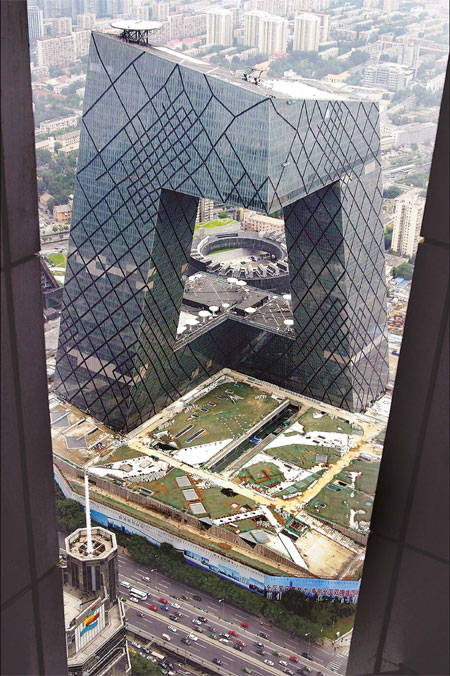
The iconic CCTV Tower in Beijing is the subject of much debate. Provided to China Daily |
 |
|
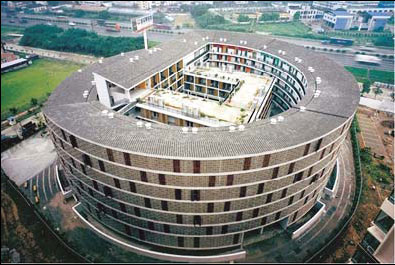
Traditional architecture such as the "earth towers" of the Hakka people in Fujian province has inspired this residential complex in Guangzhou. Provided to China Daily |
They are an unmistakable part of the urban cityscapes. But is China a playground for international architects or an abused testing ground for bad design? Liu Yujie examines the landscape and finds out if these new buildings are towering landmarks or lasting eyesores.
In Beijing, the National Stadium, otherwise known as the Bird's Nest, was designed by Herzog & de Muron from Switzerland. The National Center for the Performing Arts was by French architect Paul Andreu and the landmark China Central Television Headquarters in the heart of the central business district is the work of Rem Koolhaas from the Netherlands, while the Beijing Capital International Airport was designed by Norman Foster from the United Kingdom.
Since the beginning of the millennium, the works of international architects have sprung up like mushrooms in China's cities. These urban gurus not only brought their cutting-edge designs here, but also brought the whole world's attention to what can be built in China. Constant global media coverage has portrayed China as an open stage for ambitious, innovative urban design, a reputation which initially pleased those who were commissioning the building, but later raised doubts and reflections of whether the country was being misused as a testing ground for maverick projects.
It is true that today's China has both money and mind for probably the largest urban construction movement in human history, a major motivation for first-class architects overseas.
Zaha Hadid, the world's foremost female architect, drives it home when she compares China to "a perfect blank canvas" for architects with unlimited creation.
Nevertheless, Peng Peikeng, a senior commentator at Tsinghua University, is angered by the fact that some well-known foreign architects have obviously taken advantage of China's eagerness to build dazzling modern cityscapes. He feels there has been too many architectural experiments here in recent years.
"The Pritzker prize, the Nobel prize in architecture, is awarded to honor those who build works demonstrating 'durability, utility, and beauty'. This is widely accepted as the yardsticks for good building design. Sadly, many of these foreign architects' works in China display none of these."
Peng supports his criticism by pointing out that many of these designs would never be accepted by the architects' home countries because they would have failed city planning concerns, stricter sustainable development demands and tighter budgets.
That is why they come to China, Peng says, a country that is currently open to almost anyone who can contribute "landmark buildings" in whatever forms.
The architects are not solely to blame. More often than not, they are expected to deliver constructions whose only condition is to stand out from the crowd.
A recent plan for a new venue of China's National Museum of Fine Arts, "the world's largest art museum", is the latest target for debate. It will be located near the National Stadium in Beijing's Olympic Park and there are already worries that it may turn out to be another pair of "giant underpants", the nickname for the asymmetrical twin legs of the CCTV Tower in heart of the Chaoyang district.
The desire for the new and eye-catching may be the result of historical baggage.
"China's architectural style was greatly influenced by the Soviet Union for a long time, when the pursuit for charismatic individual design was curbed. It has now led to an outburst of fancy for the avant-garde, chic and novel, a desire made possible by the wealth accumulated during more than 20 years of economic reforms and opening up," says Wu Liangyong, a senior architect and a member of the Chinese Academy of Sciences and Chinese Academy of Engineering.
The desire to be different can lead to some odd experiments in the neighborhood. For instance, Jingya Restaurant, a 12-storey building a few blocks from the Forbidden City has a facade that is supposed to reflect the "awesome power of the ocean".
Raimund Abraham, the late American architect behind the design, once told Chinese media that the owner told him to build the most "impressive" landmark in the capital.
He did it. But did it please everyone?
At least 9 out of 10 residents we asked recounted their initial horror of the facade of the restaurant, and most still found it difficult to like it.
"It just looks so weird, so out of place with the surroundings. I can't even say it is beautiful or ugly," says Zhang Jie, a lady in her 40s who lives across the road.
Perhaps it is time to draw back and look at the landscape more objectively. What kind of architectural achievements are we looking at that best suit China's rapid urbanization?