Monkey see, monkey do
Updated: 2011-12-20 09:38
By Chen Yingqun (China Daily)
|
|||||||||


 |
|
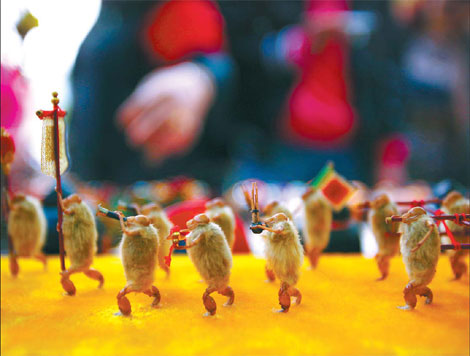
Hairy monkeys are usually modeled on human actions and scenes from everyday life. Yuan Zheng / For China Daily |
Traditional Beijing handicraft that mimics real life continues to delight in modern times. Chen Yingqun reports.
In Yuanmingyuan Park, or the Old Summer Palace, in Beijing, one chilly winter morning, a string of stalls selling Chinese folk handicrafts is mostly empty. But one vendor stands out with brisk sales of one of the capital's specialties - "hairy monkeys". The 2.5-cm-tall figurines, known as maohou, are made of dried cicadas and magnolia bulbs to look like miniature monkeys.
More than a dozen people surround the shop in the park, enthralled by the objects and entertained by its owner Sun Huaizhong's stories about them.
Holding up one figurine he called "Sweet Love", the 55-year-old starts his tale as his wrinkled face breaks into a smile.
"This one is about the secrets behind nabbing a good husband. His height and size of his wallet are not important. It's the talent and moral qualities that matter," Sun says to much laughter.
Wang Peng, a tourist from Nanjing, says he has never heard of hairy monkeys until now. But after listening to Sun's stories for about 20 minutes, he takes out the remaining 200 yuan ($32) he has in his pocket and buys a figurine.
"It's cute and delicate, and the story behind it is funny and full of wisdom. I want to share these with my family," Wang says.
Legend has it that the first hairy monkey was created "by accident". In the late Qing Dynasty (1644-1911), there was a herbal medicine shop called South Qingren Hall in Beijing. One day a bookkeeper scolded an employee for no apparent reason.
As he fiddled with some medicinal herbs that night, the unhappy worker noticed that the dried cicada bodies used in herbal medicine looked like the bookkeeper. To mock his supervisor, the worker stuffed a magnolia bulb into the shell, creating the first hairy monkey.
The art of making hairy monkeys continues to enjoy much popularity but remains limited to a number of craftspeople. The techniques of making them spread by word of mouth, from masters to apprentices, so there are few records about them.
Hairy monkeys are usually modeled on human actions and scenes from everyday life. Through their keen observation, the craftsmen can come up with various patterns, postures and scenes to bring Chinese customs to life.
The variety and complexity of the scenes range from two friends playing chess to a band's performance complete with several musical instruments. Many works also reflect modern life, and such themes are now popular with artists.
The folk artist Qiu Yisheng has been making the monkeys for more than 20 years. He says the charm of this art rests on its ability to "commemorate the past, comment on the present and add pleasure to life itself".
Qiu's inspiration for his novel scenes and images springs from Chinese folklore and stories of everyday life. To add texture to his creations, Qiu also spends a lot of time watching the news, TV programs and reading books.
Hairy monkeys do not have any facial expressions so their messages must rely on their body language and the scenes they are presented in.
"To grasp the essence of the work, one should put oneself in the scene. The closer we approach them, the better we can interact with them. Then we can feel their happiness and sorrows," Qiu says.
Making one hairy monkey is simple, but creating a complete set of figurines is time-consuming. Qiu says a basic object will take him about two nights to make.
Those making the monkeys need to first come up with designs and scenarios before picking the right cicada shell and magnolia bulbs to form the most suitable shapes.
The items then need to be cleaned to make them last longer. Craftsmen must also use special precision tools to work with the figurines.
Innovation is another key and forms the most difficult part of the art.
"The image and the color are unchangeable, so innovation can only be done on accessories," Qiu says.
He adds clothes, bags and even spectacles to his monkeys to reflect the fashions of modern people.
Still, there are no fixed methods of making hairy monkeys, so different artists hold different views on the craft. Some are prone to use their creations to reflect the lives of common people, like peddlers and drivers, while others commemorate great events like the Beijing 2008 Olympic Games.
Sometimes, the difference can be very detailed. Qiu's master, Cao Yijian, gives his hairy monkeys 10 fingers. Qiu's monkeys have no fingers but ears and hair.
The art of making hairy monkeys almost disappeared between the 1940s and 1980s, but it resurfaced through the efforts of some artists.
Qiu says there are about 10 artists in Beijing who are well acquainted with making the monkeys and focus on the art. Retirees who learned the skills when they were young are also taking up the art again as a pastime.
Hairy monkeys are recognized as a souvenir unique to Beijing. They are available at various temple fairs, folk cultural festivals and a number of famous tourist sites, such as Houhai and the Yonghegong Lama Temple. Prices range from 5 yuan to more than 10,000 yuan for exquisite works of art.
Still, the hairy monkey market remains minute.
"Mass production is impossible, as making high quality monkeys is a highly skilled art form," says Lin Bo, the owner of a hairy monkey store near the Yonghegong Lama Temple.
Few people know about the art and not many are willing to spend too much on it, he says.
Qiu says his works have been exhibited overseas, including in the United States, Germany and Britain. His customers have included foreigners, but there has been a marked downturn in patronage from that quarter since the global economic downturn.
But the hairy monkey artists and sellers remain dedicated to the art. Qiu is busy preparing to apply for the art to be classed as an intangible cultural heritage at the national level.
Sun and Lin are also teaching their customers to make the monkeys for free. Similarly, Lin Bo spends three afternoons a week giving classes on hairy monkeys at the Olympic Garden Experimental Primary School of Beijing Normal University.
"High art will definitely be handed down from generation to generation. As long as there are people who can appreciate its charm, the art will find a way to carry on," Qiu says.