Thread of continuity
Updated: 2011-12-28 09:31
By Zhang Yue (China Daily)
|
|||||||||


 |
|
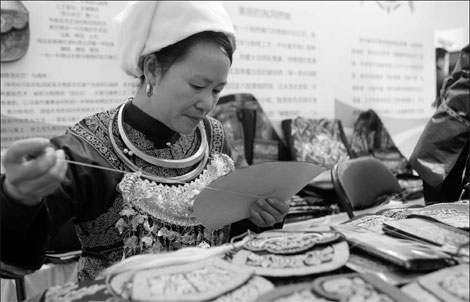
Wei Taohua, 40, of the Shui ethnic group from Guizhou province, demonstrates her horsetail embroidery skills at an art exhibition of Guizhou handicrafts in Beijing. Photos by Feng Yongbin / China Daily |
 |
|
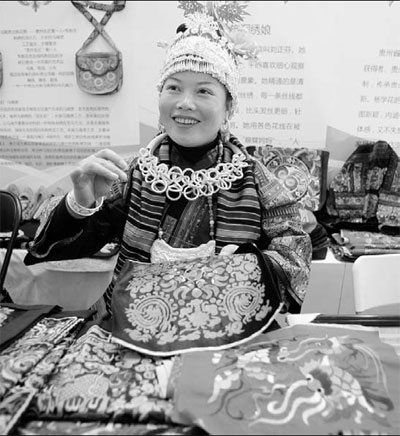
Liu Zhengfen, from the Miao ethnic group, is known for sewing with extremely slender silk threads. |
Horsetail embroidery is a specialty of the Miao and Shui ethnic groups in Guizhou province. Zhang Yue reports.
Wei Taohua, a 40-year-old villager of Guizhou province, sings a folk tune as she sews on a dark blue cotton batik mat. Curious visitors watch as she works. It takes just 30 minutes for the butterfly to take shape.
A closer inspection of the work shows the image has been stitched with horsetail hair, rather than cotton thread.
"I have been doing this all my life," Wei says. "There is no need to paint, draft or even think about the next image. It just comes to my mind as I hold the needle."
Wei is demonstrating her skills at an art exhibition of Guizhou province's handicrafts in Beijing. She and her family represent the handicraft known as "horsetail embroidery".
"This shoe-pad is so exquisite that I will not put it in my shoes," Li Huatian, who bought a pair from Wei during the exhibition on Saturday, says. "I will hang it in my home as a decoration."
Wei says, "I learned this from my mom when I was 13. So did my other five sisters. I did not know how the ideas came to my mothers' mind, but I watched her create many interesting images with a needle and horsetail threads, which was very appealing."
Scenes of nature viewed during childhood inspire Wei and her sisters to come up with images for their own embroidery works.
"We seldom repeat the images," Wei says. "They're a flexible combination of images showing our love of life and nature."
Horsetail embroidery requires three or four horsetail hairs bound together with white cotton, after which the image's shape is delineated. Then the images are filled with silk threads of different colors.
The most popular horsetail embroidery products include tablemats, shoe-pads and wallets. Some wallets take more than one month to finish and fetch up to 1,300 yuan ($205) each.
Wei belongs to the Shui ethnic group, most of which lives in Guizhou province. Both the Miao and Shui ethnic groups in Guizhou have a long and rich history of embroidery. Many women, like Wei, can read and write only with difficulty, but their embroideries are an important way for them to express their feelings.
"Almost all the girls in my home village begin learning embroidery at about 5 or 6 years old," Wei says. "Some of them spend 10 years on a single embroidery piece, which is specially prepared for their wedding."
Wei, who did not finish primary school because her parents did not have the money, says she never expected to become famous.
But in 2006, her horsetail embroidery was included in the national intangible cultural heritage list. This year, she and some other Guizhou needlewomen took their embroideries overseas, when they participated in the Chinese Culture Year in Italy. They spent two weeks demonstrating their embroidery in Milan, Florence and Rome.
"It was my first time to go abroad," Wei says. "People in Italy loved our embroidery so much. I could not understand a word of what they were saying, but I could tell the excitement from their faces when they held the shoe-pad I made."
Other needlework stars include Liu Zhengfen, a 41-year-old woman from the Miao ethnic group, who is famed for sewing with extremely slender silk threads, a representative folk art of the Miao ethnic group. Her embroidery sells up to 10,000 yuan ($1,580) a piece.
Many women in surrounding villages have come to Wei to learn about horsetail embroidery since 2006. Wei and her sisters run a shop in Guizhou's Shandu county and earn 30,000 yuan a month in total.
Wei has three sons but no daughter, so she is teaching her eldest daughter-in-law about the handicraft.
"I have only one son, but the sewing tradition is only passed down to women," Liu says. "So my son is not learning the skill. But I do teach a class of 50 girls about folk arts."
Wei says, "My son and daughter-in-law's generation learn most of their knowledge from school. But I want them to know about how we represent our culture and our love for life. She is enjoying learning very much."