Straight to the source
Updated: 2011-12-31 10:02
By Ye Jun (China Daily)
|
|||||||||


 |
|
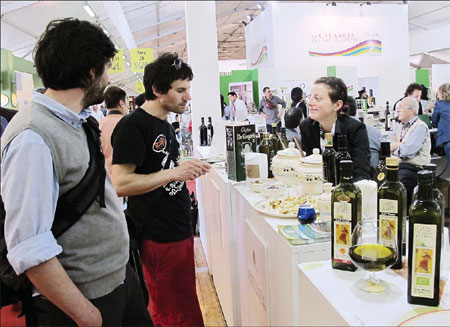
Visitors taste wine and olive oil at Vinitaly, the biggest wine expo in Italy. Photos by Ye Jun / China Daily |
A tour of Italy's olive oil producers illustrated the adage that a clean and natural environment produces the best quality olive oil. Ye Jun reports.
In China, people say "good mountains and good water produce great tea". The same can be said about olive oil in Italy. A clean environment helps the country produce quality olive oil, as I found on a recent tour.
The tour organizers were Veronafiere and the Consortium of Guarantee of Quality Extra Virgin Olive Oil (EVQ) in Italy. Veronafiere holds the annual Vinitaly in Verona. The tour included a visit to Vinitaly, as well as to olive farms and factories in Brindisi, Andria and Spoleto.
The first stop was Verona, known as the home of Romeo and Juliet, to attend Vinitaly, the biggest wine expo in Italy, and which has two other sections - International Exhibition of Quality Extra Virgin Olive Oil (SOL) and Agrifood.
It is difficult to grasp the size and impact of the wine and olive oil industry, if one does not go there and become one of Vinitaly's 153,000 visitors.
Our group of Chinese journalists expected to taste olive oil, but soon found we were also there to taste wine, as many Italian businesses produce both.
An olive oil tasting at SOL in Verona helped us to expand our vocabulary of descriptors. The smell and taste of fresh oil can be described by words such as "cut grass, fresh grass, tomato, almond, nuts" and even "banana".
Tasting olive oil is both similar to and different from tasting wine. Both require shaking of the cup and sniffing. When one sips olive oil, one needs to draw air inside with a "hhss" sound to spread it all over the tongue. Then the taster needs to chew it, and exhale air from the mouth, out of the nose, to fully experience the smell of the oil.
A colored glass is used for olive oil tasting, to prevent color from influencing judgment. While the nose senses different fragrances such as green grass and tomato, the palate notes bitterness or sweetness, and the throat feels pungency. The amount of antioxidants is decided by the bitterness, and polyphenols by the spiciness present in the oil.
Michele Labarile, taster and biologist with Monini, a major Italian oil company, describes a Monini blend with gradually increasing pungency, sweet almonds and a long aftertaste, as "a Champagne". He reveals the company in Umbria makes a different blend of oil each year to keep up quality.
The beautiful and fresh flavors of olive oil come from soil and varietals in good growing environments, such as the organic olive oil farms of Nicola Pantaleo S.p.A, which are beautiful, with daisies and daffodils in the fields below the olive trees.
Owner Liusa Pantaleo of the farm in Brindisi, Puglia, says they believe in biodiversity, which is key to polymerization and fruit growth. The farm has as many as 30 varietals to guarantee a good yield. The olive farms we visited at Monini, Oliveti d'Italia, and the Farchioni Olii companies are all on mountains, covered by green grass.
Many of the Italian enterprises we visited are family businesses with a long history. They are not big, but stress quality. Onofrio Spagnoletti Zeuli, owner of an olive farm and winery at Andria, has been producing for more than 10 generations, since the 17th century. Another company, Copot from Toscana, has been promoting wine in the Chinese market for four years.
Small family businesses usually find it difficult to compete against big corporations, according to Nicola Ruggiero, president of Oliveti d'Italia, the first consortium of Italian olive oil growers set up in 1997, in Andria. Therefore producers in Andria and Puglia set up consortiums to increase their strength.
"People know Italy for its high quality oil, but there are too many small producers, which disperse their strength," he says. "Our aim is to return power to the producers. And our focus is to promote high quality olive oil, and develop the market."
Ruggiero stresses the importance of DOP, the protected designation of origin in Europe, which recognizes quality not just in the product, but also in the whole process, starting from olive picking. He showed off one of the company's star products, Natquid, an olive oil conveniently contained in a dropper bottle, with 42 different flavors, such as lime, garlic, mint and basil.
Many of Italy's olive oil companies tried to enter the Chinese market, a collective effort, in 2007, when Piazza Italia opened in Beijing. But it closed in 2010. So while some companies, like Monini, have entered the Chinese market by themselves, most others are still looking for a good partner to get into China.
Stevie Kim, senior advisor to the CEO of Veronafiere, organizer of Vinitaly, said the organization would use Hong Kong, where Vinitaly was held in November, as a port to get into the Chinese mainland. "We'll consider getting into the mainland market in 2012," she says. "We'll present Italian olive oil along with Italian cuisine, which is popular in China."
Kim's idea was echoed by chef Claudio Sadler, at Sadler Italian Restaurant at Ch'ien Men 23, in Beijing. On a recent visit, the two-star Michelin chef paired Italian olive oil with his foods.
In the media demonstration, Sadler used an olive oil from Tuscany to go with red meats, another bottle of olive oil from Sicily, with herb and artichoke notes, to pair with pasta, salad and fishes. He also used oil from Liguria in northern Italy, which is delicate and light and suitable for vegetables, salads, boar and fish.
During our Italian tour, Monini's executive chef Angelo Maria Franchini showed how olive oil could be used to make some delectable Italian foods. It can be easily sprayed onto diced salad vegetables to make a traditional starter, or used to roast veal rolls with aubergine.
The weeklong tour took us to seaside restaurants, village cafes and mountain top bistros. Like art and natural scenic beauty, good food and wine are innate to the people of Italy.
