Living in the past
Updated: 2012-02-13 10:54
By Guo Jiaxue and Zhang Yu'an (China Daily)
|
|||||||||


|
|
|
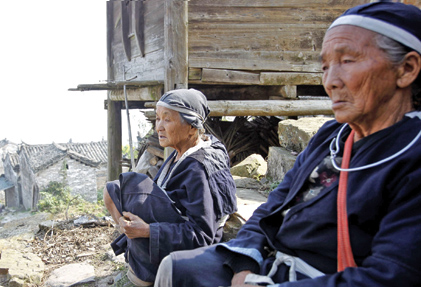
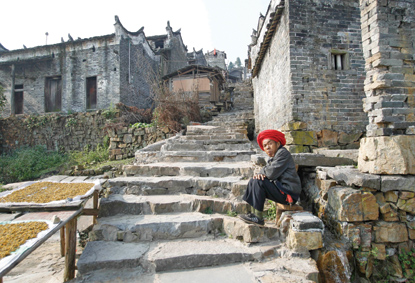
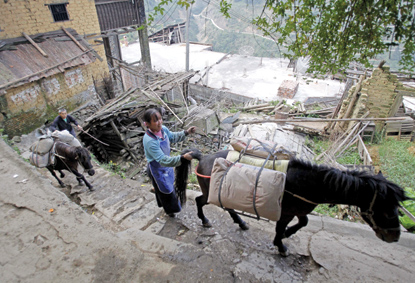
From top: Most residents living in Matouchong are in their twilight years, such as Deng Shalierpo (left), 86. Houses lining the village's main street are mostly empty. Horses are the main form of transportation in the mountainous village. Photos by Zou Zhongpin / China Daily |
An ongoing project moving Yao ethnic group members from their traditional mountain homes to more urban settings leaves just the elderly behind. Guo Jiaxue and Zhang Yu'an report.
Matouchong, one of the country's largest and oldest Yao ethnic villages, is in Liannan Yao autonomous county, 230 km northwest of Guangdong's provincial capital Guangzhou. The 10-hectare village's history dates back 1,000 years and in its heyday comprised about 700 houses and over 7,000 residents. Today, the village has just 300 shabby houses and is home to 100 people. The exodus began in the 1980s and it didn't take long before Matouchong became almost a ghost town. Young people have moved out and most of those remaining are in their twilight years, such as 86-year-old Deng Shalierpo.
When it's warm, Deng usually sits and watches the comings-and-goings on Main Street, built on a ridge, in the heart of the village.
The street is practically deserted most of the time, with just the occasional old woman walking by in clothing that appears ill-suited to the winter temperatures.
Most of the time, Deng just stares at the great vista of mountains spread out in the distance.
Once, Main Street was full of vitality, Deng says. Now the houses lining the street, with black tiles and gray brick walls, are empty.
The age-old water supply system is still in perfect condition, however, and clear water from the mountain trickles through bamboo pipes on either side of the street.
Sometimes young, noisy travelers pass by.
"It's good to have tourists, it's much livelier," Deng says cheerily in the local dialect, her smile revealing the last of her upper front teeth.
Deng lives in a traditional Yao brick house, a single room of about 10 square meters. In the center of the room is a small burner, which has blackened the room's walls.
The firewood piled high outside the house blocks the sunlight, making the room lit by a single light bulb even darker.
Deng seizes a handful of sweet potatoes from the pot on the burner, as she invites her visitors to enter. She hands out the sweet potatoes and begins to tell her story.
She was born and grew up in the village, married and had two sons. They left in the 1980s and 1990s and have families of their own in modern flats at the foot of the mountain.
Deng's husband died nine years ago but she insists she doesn't feel "abandoned".
Deng grows her own vegetables and cooks for herself. "I feel healthy for a woman of my age."
The pain in her left leg has slowed her down in the past two years, but that didn't stop her from walking down the mountain to have cataract surgery a few months ago.
She stayed with her youngest son's family for a short time after the surgery and then returned to the village.
"Kids are noisy," she explains. "I had nothing to do during the daytime when my son and daughter-in-law went to work and the kids went to school."
"I have dozens of old friends in the village, I'm used to life here."
The local government of Liannan Yao autonomous county encourages Yao people to move out from the mountains and live in more urban settings.
Eight new villages have been built that have cozy modern flats and access to medical care, education and well-paid jobs in the town. The homes are offered to eligible Yao people for around 40,000 yuan ($6,400) for a 70-square-meter two-bedroom apartment.
The relocation project, involving 80,000 ethnic Yao people in Liannan, has been ongoing for years.
Yet, old people like Deng choose to stay and hold on to their age-old traditions, such as wearing traditional costumes, cooking with wood and drinking mountain water from bamboo pipes.
For Deng, village life is easy and simple. "I don't want to leave."