Let the blood flow
 |
|
A blood center in Wuhan, Hubei province, is full of blood donors. Sun Xinming / For China Daily |
A blood shortage has led to more perks for donors - for better or for worse. Sun Li reports in Beijing.
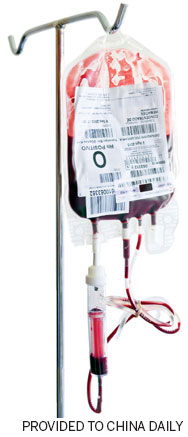
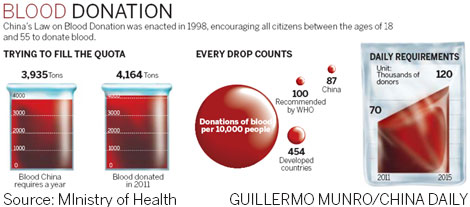
Sweet and persuasive perks are being offered to potential blood donors to overcome a nationwide shortage of blood donations. Earlier in 2012, a blood center in Fuzhou, Fujian province, presented donors with fruit and film tickets, while a blood center in Kaifeng, Henan province, offered donors a free massage at a spa. Time-sensitive incentives were offered on Valentine's Day, when blood centers in Beijing, and Jiangsu, Shandong and Hunan provinces treated those prepared to give blood with chocolates, candy bars and roses. These novel incentives to tackle the blood shortage are a response to what Beijing Red Cross Blood Center director Liu Jiang describes as a "severe shortage" since the beginning of 2012. Blood donations in Beijing have decreased since November 2011, and the Beijing Red Cross Blood Center issued an alert suggesting almost all blood types are critically needed, Liu says. Seasonality is one major reason for the current shortage, Liu explains. Donations reduce in the winter and summer holidays, because most donors are university students and migrant workers.
"Students have gone home for their winter vacations while migrant workers return to their homes for the Spring Festival," he says.
"The recent chill also made people get cold feet about donating blood."
Extra incentives are necessary to boost blood donations, he explains.
In addition to blood centers, universities and companies are offering bonuses to willing blood donors.
Huang Duo, a sophomore studying in the Guangxi Zhuang autonomous region's Nanning Polytechnic College, says his college has been granting blood donors a two grade point average (GPA), which is used to evaluate students' academic performances.
"If you donate your blood, you get a coupon for a free meal in the canteen and a box of yogurt," Huang says. "But that's no big deal compared to the GPA, which helps you get scholarships."
Last month, his class of 31 students was asked to give blood, and more than half applied to do so, though just three donors were chosen in the end, Huang says.
Several of them were tested and found to be ineligible, while the others were chosen according to the time they registered. The first three were chosen.
"I donated my blood - not for GPA but to help others," Huang says. "But I do believe it is quite a boon, as two more GPA points could be decisive to earn a scholarship."
An employee of a State-owned import-export firm based in Nanjing, Jiangsu province, who requested only her surname Yang was used, says her company allows blood donors five days off from work and 1,500 yuan ($238) for donating blood.
"The Law on Blood Donation (enacted in 1998) advocates voluntary blood donations, meaning no one can force you to give blood and you won't be paid for doing so," Yang says.
"However, cities have been assigned the task of collecting a blood quota. To fulfill this, factories, companies and schools in the cities are required to mobilize their staff to donate. Whether these quotas are met or not is linked to the work units' evaluations," Yang continues.
"Considering the number of volunteer donors has decreased recently, my company had to offer rewards to lure more people to give blood. This seems to have a sense of compulsion and appears to contradict the spirit of voluntary blood donation, but it's a tacit thing."
Yang calculates about 5 percent of company employees were required to participate in blood donations in early February. That's about 60 people, but the number of applicants exceeded 300.
"Five days off plus a load of cash is like heaven to staffers working under pressure every day," Yang says. "Donating blood suddenly became popular because of the incentives."
A list of donors was not announced and the principle of "first to register" was likely not followed. Competition was inevitable, she says.
Yang says that once she passed the preliminary physical test, she started working her contact list in the company to see if she could influence the person in charge of coordinating donations.
"Inviting the guy to dinner, letting him get to know me and asking a trusted colleague who knows the guy to speak well of me was my strategy," Yang admits.
"An applicant who did nothing but simply applied to donate blood would almost certainly be ignored."
Ministry of Health expert Sun Dongdong says the fact such incentives exist demonstrates people's unwillingness to voluntarily donate.
"In Chinese, a classical saying goes like this: 'The body, the hair and the skin of a person is given by his parents and shall not be damaged'," Sun says. "This idea is deeply entrenched in Chinese minds, and people would rather keep their body intact, which stops many people from giving blood."
But to Tang Xiao, an employee at a Shanghai-based securities company, the main source of his unwillingness to give blood is safety concern.
"I was initially worried about the sanitation of the needles and dreaded transfusion-transmissible infections, notably HIV," Tang says.
Tang says he had to consult with a doctor friend to make sure there was no risk of infection from donating blood before having a needle placed in his arm.
The company offered blood donors a free trip to Hangzhou, Zhejiang province, which encouraged many employees to roll up their sleeves to give, Tang says.
"Since safety is guaranteed, why not? You can save people and have a nice holiday at the same time."
The needles used for blood donations are disposable, and donors must have a physical examination to ensure their eligibility before donating blood, says Yao Li, vice-director of the blood center in Wuhan, Hubei province.
He adds that donated blood is screened for HIV, hepatitis B, hepatitis C and syphilis.
"Instead of doing harm to people's health, donating blood can enhance the body's ability to produce more blood," Yao says.
"Public concerns about the risk of being infected when donating blood proves we need to further publicize and raise public awareness about its benefits and safety."
Ma Gang, vice-president of the Maternal and Child Health Hospital in Nanning, capital of the Guangxi Zhuang autonomous region, says blood donors from companies and universities have contributed a lot to easing the country's blood supply shortage. "We had surgeries daily that required blood transfusions, but we had to put them off due to low blood reserves," Ma says.
"Blood donations arranged by companies and universities gave us relief. Incentives could bring more people to the blood collection van. That's a good thing," Ma continues.
"Even so, I hope people could really understand the importance and the value of donating blood and not be driven solely by the perks."