Babysitting birds
Updated: 2012-03-13 15:16
By Zhang Xiaomin (China Daily)
|
|||||||||


 |
|
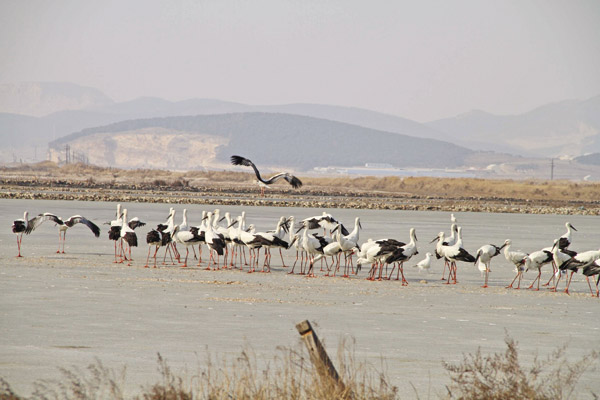
About 80 Oriental White Storks stop and rest in Zhangjiacun village in Dalian, Liaoning province, before flying northward. Photos by Zhang Xiaomin / China Daily |
 |
|
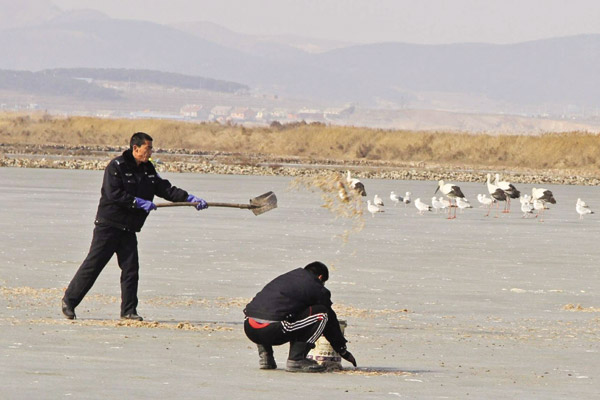
Zhangjiacun's villagers feed the storks every day. |
A village near Dalian has become a home away from home for a flock of rare Oriental White Storks. Zhang Xiaomin reports in Dalian.
Moved by the hospitality of villagers, about 80 Oriental White Storks rest their weary wings at a village in Dalian, Liaoning province, as part of their northward migration. Zhangjiacun village in Lushunkou district has never been so popular. Every day, dozens of visitors arrive to see the "graceful big birds" in a salt field near the sea.
It is the second time the birds have stayed from December to March, village head Leng Wanjun says. Five birds first arrived a year ago.
"They were starving. We scattered fish on the ground to feed them. I think they remembered our treatment and brought their friends and relatives here this time. We won't let them down," Leng says.
He has designated four villagers to look after the birds - feeding them, monitoring their health and preventing them from being disturbed.
The Oriental White Stork (Ciconia boyciana) is a large, white wading bird with black wing feathers and is under first-class State protection.
Huang Wenjuan, an ornithologist at Dalian Natural History Museum, says there are just 2,500 to 3,000 Oriental White Storks, which live in Siberia and Northeast China. They migrate to the wetlands of Central China for winter.
"Lushun, at the southern tip of Liaodong Peninsula, is a transit hub for migrating birds. Usually, they rest here for about 10 days before flying across the Bohai Sea," Huang says.
Zhang Qiang, 38, is one of the birds' baby-sitters. Every day, from 7 am to 6 pm, he accompanies them on the salt pan.
"When it is good weather, they stand still and sunbathe. When it is windy, they hide among the mountains," he says.
Zhang and his fellow villagers feed the storks in the early morning and at noon. They eat about 200 kg of anchovies a day, and the village was given a subsidy of 80,000 yuan ($12,700) by the local agricultural and forestry bureau to pay for the food.
One Saturday in early February, dozens of photographers arrived at the salt field, waiting for the villagers to feed the birds.
At 12:30 pm, Zhang blew a whistle and then, with Wang Yanlin, took a barrel of anchovies down to a frozen pond. They scattered the fish with a spade about 40 meters away from the bank.
Minutes later, a sharp-eyed spectator drew the crowd's attention to the sky where, one after another, the big birds came into view and landed.
Unlike the seagulls and gray herons, the storks show perfect discipline, forming a line and eating just the fish in front of them.
On the bank, the photographers were polite, too, and quietly took photos of the birds without shoving for good positions.
Amateur shutterbug Luan Yuwei says most of the visitors are experienced bird watchers. They know how to keep a safe distance from the birds.
Luan drives about 50 km from downtown Dalian to photograph the birds at the village at least once a week.
The birds have made such an impact in the village that residents invited a choreographer to create a work called Here Come the Oriental White Storks, which will be performed at a Lushunkou district cultural event. The villagers even made costumes patterned on the birds.
Leng believes the storks bring Zhangjiacun village not only more visitors but also good luck.
"They have become our village's name card. We will provide them a better habitat," he says.
As such, Leng wants to preserve the northern part of the village for the birds, while the rest of the village is developed.
"We will probably build a wetland park and open an ecological farm, planting vegetables and fruits," Leng says, adding he thinks "Meiguan" - or "Beautiful Stork" - would be a good brand name for the village's apples.
Huang, however, warns that feeding the wild birds may change their habits and negatively influence the vitality of the species. The birds should fly north in March. It's time to reduce the food for them, she suggests.
Leng agrees. He looks up at the sky. The storks are hovering and rising.
"They are flying higher and higher, preparing for the journey home," he murmurs. "They do not belong here. But I really hope they come back next winter."