Australia appeals to top students
 |
|
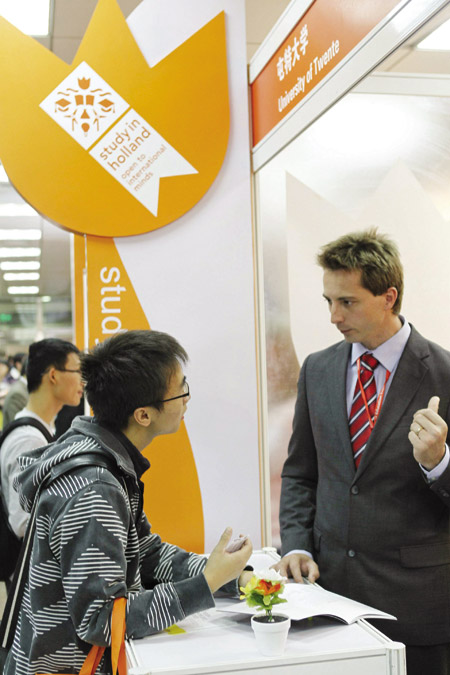
A Chinese student asks questions about studying abroad at an international education exhibition in Beijing. Da Wei / For China Daily |
The University of Sydney says its recent move to accept students from China through the China National College Entrance Examination (gaokao) aims to attract the country's top students.
"We want to attract the cleverest and most motivated students," says professor Tyrone Carlin, acting dean of the Business School at The University of Sydney, who was behind the initiative.
The university's new policy, released on Feb 16, enables students from China to gain direct admission to the university once they pass the China National College Entrance Examination with a Tier-1 result and meet the language requirements (an average IELTS score of 7 for undergraduate study).
The move has aroused heated discussion and was a focus of the Australian Pavilion during the 17th China International Education Exhibition Tour (CIEET) in Beijing on March 10 to 11.
For students hoping to study at The University of Sydney, the new arrangement means they will no longer have to go through the Foundation program (for students with overseas high school qualifications to reach the required academic standard for entry to an Australian university) before they commence their undergraduate studies.
"This year marks the 40th anniversary of Australia-China diplomatic relations, and the strong compact between young people is fundamental in bettering country-to-country relationship," Frances Adamson, ambassador to China, says in an address to the education exhibition.
"Also, please do not forget The University of Sydney is the sixth university in Australia to recognize Entrance Examination results since 2009. This shows our better understanding of the education system in China."
Eliza Chui, education consul at the Australian consulate general in Shanghai, who also attended the exhibition, says it has been more than a decade since the Australia government first thought about recognizing the gaokao.
"In mid-2000, the government noticed the number of Chinese undergraduate students was increasing. Thus, research was done on the best way to accept students from China," Chui says. "The research looks into the Entrance Examination curriculum, what type of exams they take, and how different provinces actually use the Entrance Examination results. So, it's a very in-depth research report with a lot of recommendation schemes."
The research result came out in 2009. Later that year, University of Western Sydney became the first university to accept Chinese high school graduates to its undergraduate program through the Entrance Examination, followed by Monash University in Melbourne and Macquarie University in Sydney.
The University of Sydney initiative had an immediate and positive response from students.
"I noticed the enrollment score for the university was not that high," says Feng Xiao, a 16-year-old who attended the exhibition with her parents.
The university has set different enrollment scores for more than 20 regions and provinces based on local Tier-1 universities' enrollment levels.
Li He, a 17-year-old student studying at the high school affiliated to the Beijing University of Science and Technology, believes the policy suits his circumstances.
"The enrollment score of 524 (for Beijing) is not high for me. I would prefer to study abroad, as foreign education focuses more on practical abilities, while education in China is more about passing exams. I think a chance to study at places, like The University of Sydney will better prepare me for my career."
Li is about to take the Entrance Exam in 2013 and plans to study medicine.
While many students welcome the initiative, some parents argue the university is just trying to make more money.
Ma Hongying, a 46-year-old mother working in a hospital in Hefei, capital of Anhui province, says The University of Sydney program sounds ideal, but the 200,000 yuan ($31,800) fees are prohibitive. And she is concerned about whether her son can look after himself properly in a foreign country.
The number of students planning an overseas education is increasing every year. In 2011, 339,700 students went abroad for further education, a 19.32 percent increase compared to 2010. At the same time, the number of people taking IELTS in China in 2011 increased by 20 percent compared to 2010.
Nearly 20 Australian institutes attended CIEET in Beijing, and the tour will also stop at Shanghai and five other cities. More than 90,000 Chinese students were studying in Australia by the end of 2011 and are the largest population of foreign students in Australia.