Zooming in on LGBT issues
 |
|
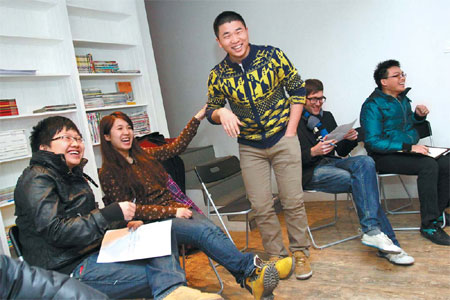
Documentary director Fan Popo (standing) joins in the group discussion at a workshop on making documentaries about the LGBT community. Photos by Jiang Dong / China Daily |
 |
|
Zuo Weiwei embraces her tutor Wei Jiangang at the closing ceremony of the workshop. |
Related readings: At a glance
A program trains lesbian, gay, bisexual and transgender community members to create documentaries about their realities. Liu Wei reports in Beijing.
Yue Jianbo not only discovered he was gay but also that some of his coworkers were, too, when he was working as a coal miner. Still, Yue, who loves rock music and marathons, felt like an outsider at the mine in the small town of Yangquan, Shanxi province.
In March, he traveled to Beijing to join a workshop on making documentaries about the lesbian, gay, bisexual and transgender (LGBT) community.
"There are documentaries about gay people and there are documentaries about coal miners, so why not make one about gay coal miners?" he says.
He applied for the workshop run by the Beijing Gender Health Education Institute, LBGT online video-sharing website Queer Comrades and the China Queer Independent Films, a LBGT rights film tour.
China Queer Independent Films founder and a documentary director Fan Popo explains: "I found when traveling across the country that many LGBT people want to learn how to make documentaries, which possess great power to promote understanding among different groups of people. Perhaps this workshop can help them realize their dreams."
Yue met Fan in a hutong cultural center. Fan is one of 11 tutors, and Yue is one of nine students selected from 29 applicants.
Yue, 32, had never held a video camera before but now knows well how to use it to zoom in on issues.
But participants learn more than filming skills. They also engage in discussions about such issues as gender.
Celebrated women's rights campaigner Lu Ping discusses with students the ways in which media shape gender perceptions.
She uses cases studies, such as a car commercial starring Zhang Ziyi. The ad shows Zhang clad in a revealing outfit playing the role of a car saleswoman. Some male customers express surprise, because the job is traditionally reserved for men. But they're surprised by her excellent driving abilities.
Lu asked for students' opinions of the commercial's portrayal of Zhang. They agreed that although the actress was shown occupying a traditionally male profession, her sexuality remained her primary appeal.
"Their analysis is insightful," Lu says. "While they haven't studied gender issues in school, they remain sensitive to the issue as a minority. So they understand that women are still used as sex symbols in such ads as these."
Lu hopes her students will remain vigilant and avoid such portrayals in their works.
"Although they themselves have been the subject of bias, they can unconsciously possess biased opinions about other underprivileged groups," she explains.
After two days of training, students were divided into four teams, and each team was sent to shoot a five-minute film.
The students could demonstrate what they had learned, and two students would be selected to receive financial and technical aid for their documentary proposals.
Yue teamed up with Yao Yao, a woman who runs a photo studio for lesbians in Shandong province. They chose the theme of transgender issues.
Queer Comrades co-founder Wei Jiangang instructed their team.
Wei interrupts the two when they say they want interviewees to discuss their definitions of transgender people.
"If you pose a dry question, you'll get a boring answer that could be too academic," he says. "Remember, your target audience includes people who aren't LGBT."
Wei suggests they instead make their first question: "Can you name a transgender celebrity? How do you know him or her?"
Wei tells them 20 interviewees are quite enough for a five-minute film, after they said they plan to interview as many people as possible.
"Most students have never used a camera," Wei says. "But that's not a disadvantage. They have freedom and imagination."
One of Yue's interviewees is his classmate Zuo Weiwei, a male-to-female transgendered person from Hubei province.
Zuo looks as if she was born a woman in her thick eyeliner and curly red hair. But her voice reveals her birth sex.
Zuo, who has received breast transplants, has not concealed her transgender identity when competing in talent shows as a belly dancer.
"Why enlarge your breasts when you are a man?" is the question she most frequently gets.
But, sometimes, she is confronted with more embarrassing situations.
One judge told her: "I'd choose you if you had undergone the operation to become a woman, or if you were a man. But I don't know how to describe you now. I'm sorry."
Zuo recalls her feelings. "I felt insulted and humiliated, and knew I should fight back," she says. "But I couldn't put my words together. Today, I would tell the judge: It's my right to lead the life I like."
Zuo made a five-minute film about herself. It was more like a PowerPoint presentation of glamour shots than a documentary video.
But all of the students and teachers responded with applause and encouragement when the film was shown at the workshop's graduation ceremony.
The organizers announced at the ceremony they had selected Yue's proposal of focusing on gay coal miners and Yao's of following a male-to-female transgender person through her sex change operation.
Other proposed topics include the conflict between one's religion and sexuality, and the development of lesbian NGOs in the country.
"We prefer stories never told, such as the two Yao and Yue proposed," Fan says. "And we prioritize the underprivileged minorities among LGBT people, such as low-income and transgender people."
Yue and Yao have returned to their hometowns with high-definition video cameras.
They'll return to Beijing in a month with raw footage and a drafted script. The tutors will help them polish what they have and plan their next steps.
The workshop lasts only seven days, but the LGBT documentaries' influence could prove long-lasting, Lu says.
"Minority groups find it hard to have their voices heard," she says.
"The documentaries offer a chance for a broad audience to learn about LGBT people and their hopes. It's important LGBT people operate the cameras so they can speak for themselves, rather than be edited by others."
The films will be posted on Queer Comrades' website, and Fan and Wei hope they can show at film festivals, too.
"Because documentaries are true to life, they're also archival," Fan says. "They inform future generations of what we've been through."