Fish of the opulent at the bottom of the barrel
Updated: 2012-04-05 13:19
By Yang Yijun (China Daily)
|
|||||||||


 |
|
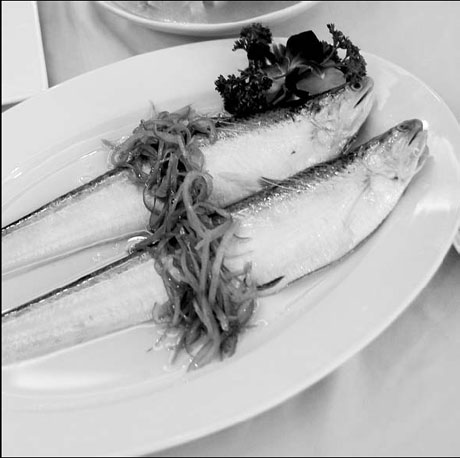
Steaming knife fish is regarded as one of the best ways of preparing it. Provided to China Daily |
As spring takes hold, the booming luxury goods market in China has spread to aquatic products. That means that delicacies such as the sought-after knife fish are fetching sky-high prices - in the case of the fish as much as 1,000 yuan ($158) for a 20cm specimen.
But the demand for the fish, also known as coilia ectenes, or daoyu in Chinese, is not only exacting a high price on consumers, but on the species itself, putting its very existence at risk.
"The price of knife fish hit a record this year," said Fan Shengfu, an aquatic products wholesaler on Chongming Island, Shanghai, near the mouth of the Yangtze River. "The price of some big ones has reached 6,000 yuan for half a kilogram, nearly 1,000 yuan higher than in previous years."
While knife fish, which are long, thin and silver, live in rivers, seas and lakes, it is those from the Yangtze that are highly sought after because of what is regarded as their superior quality.
The season of these coveted fish usually stretches from the Chinese New Year to the end of April, and it is then that Fan makes his way to the fishers to buy from the fresh catches they land every day.
The fish can be divided into three categories by weight, he says. The large ones, more than 100g, usually cost between 4,500 and 4,700 yuan for 500g; medium ones cost about 1,800 yuan for 500g; and small ones cost more than 100 yuan for 500g.
"Every day, prices fluctuate according to the output and number of orders," Fan says. "It's like the stock market: you could have three different prices for the fish in one day."
He says that one day in March the price for 500g of the large fish was 4,000 yuan in the morning, 3,500 yuan in the afternoon and 2,500 in the evening.
"Sometimes I could lose up to 100,000 yuan in a single day. After all, the high price is because of the limited numbers."
Local media have reported that the knife fish catch in the Yangtze was 3,750 metric tons in 1973 and has fallen to less than 100 tons since 2002. Last year the total catch was less than 12 tons.
Fan sells some of the fish to an aquatic products market in Changzhou city, Jiangsu province, the largest market in the Yangtze River Delta. Local restaurants buy the rest.
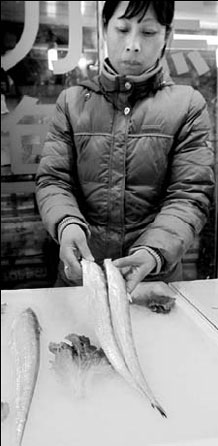
Knife fish at an aquatic product market in Shanghai last week. Yong Kai / For China Daily
Luxury menu
In an outlet of Noblehouse Restaurant near Huaihai Zhonglu, Shanghai, an upmarket restaurant chain featuring fresh fish from rivers, daoyu set menus are on offer from late February until Tomb Sweeping Day, which this year falls on April 4.
"About 20 lots of the set menu, priced at 688 or 888 yuan a person, is sold each day," says Yang Tao, the manager. Average spending per person in the restaurant is said to exceed 500 yuan.
The set menu features six or seven dishes made of the fish and other precious ingredients. Specialty dishes include daoyu boiled with lotus seed pod, bamboo pith and shark fin.
From mid-March until Tomb Sweeping Day, when the fish is said to taste best, steamed daoyu, regarded as the best way to cook the fish to reflect its original taste, is also available at the restaurant. One steamed knife fish of 125g costs about 1,800 yuan. Guests need to reserve at least one day in advance and the prices can fluctuate from day to day.
"Most of our guests invite their business partners here," Yang says. As with top caviar or truffle on a Western dining table, knife fish on a menu automatically moves a business banquet up several notches.
In Jade Garden, a popular restaurant chain featuring Shanghai local cuisine, a dish of two knife fish costs 2,888 yuan. Even the bones are not wasted - they will be fried to be served as a crispy side dish.
"Since the fish is so expensive and cannot be kept for long, we only buy a few every day in the two weeks before Tomb Sweeping Day," says the manager of the restaurant's outlet in Waigaoqiao Free Trade Zone. "But the fish can be sold out every day."
Knife fish is sought after because of its extremely tender texture as well as the fresh and sweet taste.
"The fish is most delicious and expensive in the last two weeks before Tomb Sweeping Day," says Penny Dai, a food writer in Shanghai.
Not surprisingly, many river fish lovers flinch at the high price of the delicacy.
Liang Jing, 57, a retired anesthetist in Shanghai, who used to buy the fish in the market 20 years ago, said she could no longer afford it.
"Twenty years ago, 500g of the fish cost no more than 10 yuan. Now, even though I love the fish, I rarely eat it, unless other people invite me.
"I don't think the fish is worth the price. It's crazy. No fish, no matter how delicious it is, is worth that price."
A local reporter surnamed Xu said she had the fish in a business banquet in Jiangsu province last year.
"We didn't recognize the fish until the waiter told us. In fact, quite a few of the fish were left uneaten. I reckon that with this fixation, diners may be thinking more about the luxury menu than the fish's taste."
Threat of extinction
"Large-scale fishing and water pollution threatens the species, and that has led to the extravagant prices," Dai says.
"But there are thousands of delicious fish out there. I don't think you have to crave for a single type that is on the verge of extinction."
Knife fish is reputed to be one of the three most delicious kinds of fish in the Yangtze, the other two being reeves shad and blowfish. Their numbers, too, have greatly declined in recent years because of over-fishing and pollution, Dai says.
"Most of the reeves shad and blowfish are artificially cultured now, which has greatly affected the flavor. If the massive fishing continues, knife fish will face the same fate."
As a migratory species, knife fish migrate from the sea to the Yangtze River in the breeding season in spring each year and spawn in the middle reaches of the river. Then the baby fish swim down the river to the sea, where they become adults.
But many fishers set up their nets on the migration path and catch the fish before they arrive at the middle reaches to spawn.
Regulations that restrict when and where the knife fish can be caught have been in force for the past 10 years, but because of the huge demands these limits appear to have done little to deter fishers.
Zheng Jinliang, an expert on aquatic products in Jiangsu province, told the Shanghai-based Xinmin Evening News that fishing of the species needed to be banned in the Yangtze to save it from extinction.
"If that were done, the number of the fish would increase significantly in five or six years, which would ultimately benefit both the fishers and the diners. For some diners, the extinction of the fish only means the lack of a kind of delicious food. But for the Yangtze River, it would lose a precious species."