Dutch group is pushing to broaden the right to die
 |
|
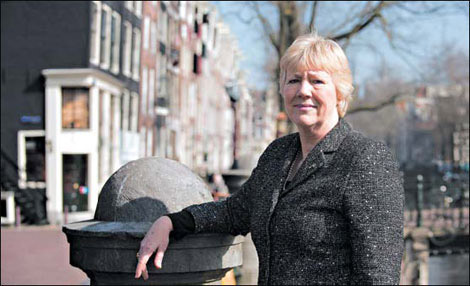
Dr. Petra de Jong leads advocates in the Netherlands trying to make euthanasia more accessible to patients who request it. Herman Wouters for The New York Times |
AMSTERDAM - It was 1989, and Dr. Petra de Jong, a Dutch pulmonologist, was asked for help by a terminally ill patient, a man in great pain with a large cancerous tumor in his trachea. He wanted to end his life.
She gave the man pentobarbital, a powerful barbiturate - but not enough. It took him nine hours to die.
"I realize now that I did things wrong," Dr. de Jong, 58, said in an interview in her office here. "Today you can Google it, but we didn't know."
Her warm and sincere manner belies, or perhaps attests to, her calling. The man was the first of 16 patients whom Dr. de Jong, now the head of the euthanasia advocacy group Right to Die-NL, has helped to achieve what she calls "a dignified death."
Founded in 1973, Right to Die-NL has been at the forefront of the movement to make euthanasia widely available in the Netherlands. Polls find that an overwhelming majority of the Dutch believe euthanasia should be available to suffering patients who want it, and thousands request it every year.
Even in the Netherlands, some think Right to Die-NL may be going too far. The organization is among those pushing to give all people 70 and older the right to assisted death, even when they do not have terminal illnesses. (The conservative government of Prime Minister Mark Rutte has said there will be no changes to the law under its tenure.)
Right to Die-NL, which claims 124,000 members, made headlines in March with the news that it was creating mobile euthanasia teams to help patients die at home.
"Internationally, the Dutch have pushed the conversation on both the wisdom of allowing people to choose how and when they die when they're in great suffering, and on the nature of compassion in dying," said Paul Root Wolpe, director of the Center for Ethics at Emory University in Atlanta.
Under the Netherlands' 2002 Termination of Life on Request and Assisted Suicide Act, doctors may grant patients' requests to die if they observe certain guidelines. The request must be made voluntarily by an informed patient who is enduring suffering that is lasting and unbearable. Doctors must obtain the affirmation of a second physician that the case meets the requirements and must report the death for review.
Dr. de Jong said Dutch physicians typically euthanize patients by injecting a barbiturate to induce sleep, followed by a powerful muscle relaxant to stop the heart. For assisted suicide, the doctor prescribes a drug to prevent vomiting, followed by barbiturates.
Almost 80 percent of all such deaths take place in patients' homes, according to the Royal Dutch Medical Association. In 2010, doctors reported 3,136 notifications cases of "termination of life on request."
Eric van Wijlick, a policy adviser for the association, said euthanasia is typically carried out by general practitioners. He said that the euthanasia law would be difficult to carry out elsewhere, because everyone in the Netherlands has access to health care, an income and housing.
"There are no economic reasons to ask for euthanasia," he said, something that might not be true in the United States, with its for-profit health care system.
But the mobile teams were needed, Dr. de Jong said, because many general practitioners, either for moral reasons or because of uncertainty about the law, refused to help suffering patients to die after it had become too late to find another doctor.
"We think old people can suffer from life," Dr. de Jong said. "Medical technology is so advanced that people live longer and longer, and sometimes they say 'enough is enough.' "
Mr. van Wijlick said the Royal Dutch Medical Association was "uneasy" with the mobile team and opposed euthanasia for those "suffering from life." Still, a doctor could explain to patients how to deny themselves food and drink, he noted, and could assist with any suffering that entailed.
The Dutch patients' organization N.P.V., a Christian group with 66,000 members, criticizes the current application of the law, saying the practice of euthanasia has been extended to encompass patients who may not be competent to request help in dying.
Elise van Hoek-Burgerhart, a spokeswoman for the N.P.V., added in an e-mail that one concern was that mobile-team doctors could not get to know a patient in just a few days.
Dr. Wolpe, the Emory University bioethicist, said he was "generally supportive" of people's right to choose their own death, but that he was troubled by some trends, including the extension of euthanasia to people who were not suffering physically.
"When you switch from purely physiological criteria to a set of psychological criteria, you are opening the door to abuse and error," he said.