Comments()
  Print
Print  Mail
Mail  Large Medium Small
The Yaos, with a population of 2.13 million, live in mountain communities scattered over 130 counties in five south China provinces and one autonomous region. About 70 per cent of them live in the Guangxi Zhuang autonomous region, the rest in Hunan, Yunnan, Guangdong, Guizhou and Jiangxi provinces.
Historically, the Yaos have had at least 30 names based on their ways of production, lifestyles, dresses and adornments. The name "Yao" was officially adopted after the founding of the People's Republic in 1949.
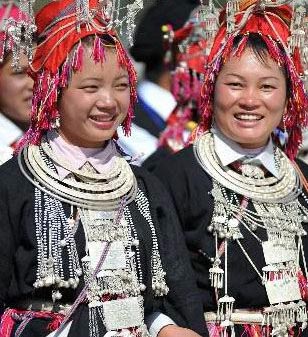
Half of the Yaos speak the Yao language belonging to the Chinese-Tibetan language family, others use Miao or Dong languages. As a result of close contacts with the Hans and Zhuangs, many Yaos also have learned to speak Chinese or Zhuang language.
Before 1949, the Yaos did not have a written language. Ancient Yaos kept records of important affairs by carving notches on wood or bamboo slips. Later they used Chinese characters. Hand-written copies of words of songs are on display in the Jinxiu Yao autonomous county in Guangxi. They are believed to be relics of the Ming Dynasty (1368-1644). Ancient stone tablets engraved with Chinese characters can be found in a lot of Yao communities.
Most Yaos live in beautiful, humid mountain valleys densely covered with pines, firs, Chinese firs, Chinese cinnamons, tung oil trees, bamboos and tea bushes. The thickly forested Jianghua yao autonomous county in Hunan is renowned as the "home of Chinese firs." The places inhabited by the Yaos also abound in indigo, edible funguses, bamboo shoots, sweet grass, mushrooms, honey, dye yam, jute and medical herbs. The forests are teeming with wild animals such as boars, bears, monkeys, muntjacs and masked civets. Rich as they are in natural resources, the Yao mountain areas are ideal for developing a diversified economy.
History
Called the "savage Wuling tribes" some 2,000 years ago, the Yao ancestors lived around Changsha, capital of today's Hunan province. Two or three centuries later, they were renamed the "Moyao." One of China's foremost ancient poets, Du Fu (712-770), once wrote: "The Moyaos shoot wild geese; with bows made from mulberry trees."
As time went on, historical accounts about the Yaos increased, showing growing ties between the Yao and the Han people. In the Song Dynasty (960-1279), agriculture and handicrafts developed considerably in the Yao areas, such that forged iron knives, indigo-dyed cloth and crossbow weaving machines became reputed Yao products. At that time, the Yaos in Hunan were raising cattle and using iron farm tools on fields rented from Han landlords.
During the Ming and Qing dynasties (1368-1911), farm cattle and iron tools spread among the Yaos in Guangxi and Guangdong, who developed paddy fields and planted different kinds of crops on hillsides. They dug ditches and built troughs to draw water from springs for daily use and irrigation. Sideline occupations such as hunting, collecting medical herbs, making charcoal and weaving were pursued side by side with agriculture.



Copyright 1995 - 2010 . All rights reserved. The content (including but not limited to text, photo, multimedia information, etc) published in this site belongs to China Daily Information Co (CDIC). Without written authorization from CDIC, such content shall not be republished or used in any form. Note: Browsers with 1024*768 or higher resolution are suggested for this site.
License for publishing multimedia online 0108263 Registration Number: 20100000002731