Comments()
  Print
Print  Mail
Mail  Large Medium Small
 |
|
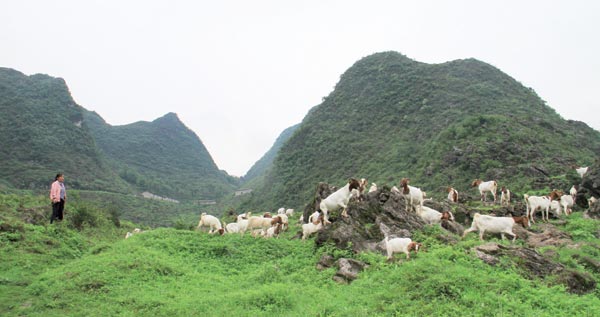
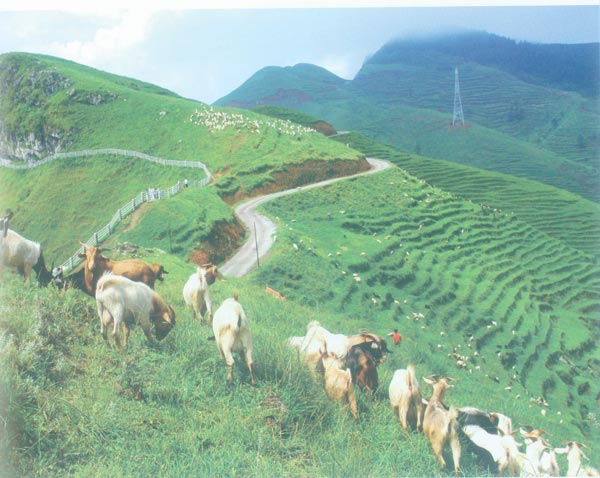
A villager herds sheep and goats on a slope in Qinglong county, Guizhou province. Chen Siwu / For China Daily |
 |
|
Sloping farm fields on Mount Qinglong have been transformed into pastures for livestock. Provided to China Daily |
Related: Cultivating new ways to grow greater wealth
A project to plant grass and raise livestock on eroded karst hills in Guizhou province has brought villagers prosperity. Lin Qi reports in Guizhou.
The scene overlooking Mount Qinglong, which is wrapped in mist and drizzle, resembles a Chinese ink landscape painting. Flocks of sheep and goats leisurely graze on the meadow slopes in Guizhou province. Their bleats and bells resound through the hills.
Among them are Yi Huineng and his more than 200 sheep and goats.
"Raising livestock isn't so labor intensive," the 62-year-old from Caizi village in Guizhou's Qinglong county says.
"I only need to walk them for a couple of hours. After I'm back home, I normally take a casual drink with some side dishes."
Yi's family of four led an arduous life, planting corn on the slopes before beginning animal husbandry in 2002.
They had to toil in the fields all day, fetching water from ponds kilometers away and chopping pigweed to clear room for corn. But the low productivity exacerbated their poverty.
"A local saying goes: 'A tract of field only harvests a basket of corn'," Yi says.
"In those days, we couldn't afford nutritious food, other than corn. So, we had bad physiques and got tired easily."
Yi's family's destitute past is typical of millions of households living below the poverty line in Guizhou's mountain-locked areas, like Qinglong in the Qianxinan autonomous prefecture, which suffer from rocky desertification, also called "cancer of the earth".
These regions' fragile karst environments have endured the severe overuse of land since the 1950s.
Forests and grasslands were excessively burned and transformed into farmland to feed a rapidly expanding population. The process caused devastating soil erosion, exposure of base rocks and drastic land productivity decreases.
Piles of big stones can still be seen on Mount Qinglong, reminding people of the desert-like terrain it used to be.
Official figures show about 68 percent of Qinglong's 1,331 square kilometers are karst areas. More than 46 percent of the county exhibits some degree of rocky desertification.
The soil depth ranges from 5-20 cm, while the annual rainfall reaches 1,500-1,700 mm, Qinglong's county head Jiang Shikun says.
"Because of karsts' features, much of the water drains into the ground through the surface crevices."
He says corn was the only crop that could survive on the thin and parched soil filling the cracks among the rocks. But they couldn't conserve soil, which washed away on rainy days.
The more people planted corn, the thinner the soil became. Increasing labor and fertilizer input actually made the soil even less productive.
"One mu (0.07 hectare) of land harvested no more than 150 kg," he says.
"The land would become barren and rocky in three to five years."
The solution is to replace corn with grass, which better maintains soil and water, and raise livestock. The idea came to county authorities' minds after a news report said that grass grown in Guizhou was sold to feed livestock in Yunnan province.
A government-sponsored grassland and livestock industry development center was founded in 2000. It has promoted the practice throughout the county since 2002.
"We planted five to six kinds of grass that grow better than corn in thin soil," the center's director Zhang Daquan says. "They can reach as high as 30 cm. And they help increase organic matter in the soil by 1-2 percentage points. In return, they nurture the grasslands."
Previously, about 1.26 tons of soil washed away annually on every 0.07 hectare of agricultural land sloping at more than 25 degrees. But there's little erosion today, Zhang says.
"The grass we plant lasts about 20 years and requires little human care," he says.
"Two or three kinds of grass grow every season, feeding livestock for nine months out of the year and swathing the mountains in green year-round."
The center imported Boer goats and Dorper sheep - arguably two of the world's best breeds for meat - and loaned the villagers livestock.
Livestock sales revenues are divided, with 10 percent going to the center and the rest going to the villagers. Previously, the ratio was 20/80.
Zhang says the center uses its share to deploy staff members, train villagers, prevent epidemics and provide veterinary care.
When Fan Xingyuan herded 32 Boers and Dorpers from the center two years ago, the 56-year-old from Qinglong's Yemai village felt lonely in the venture.
"I was the first to try this new business in my village," he says.
"Everyone looked at me like I was a loser."
He now keeps 120-130 animals on a 13-hectare grassland, which brings him an annual income of 50,000 yuan ($7,860).
He has also been accepted as an amateur technician at the center because of his relative expertise at raising livestock.
Fan is also the lead shepherd of a self-organized cooperative that includes his village's 36 households, each of which owns more than 100 animals.
"Life is moderately better now," he says.
Over the past decade, the county government has injected into the herding venture a total of about 102 million yuan, most of which has come from the central government and bank loans.
It has generated more than 13 sq km of grassland and brought 420,000 sheep and goats. The program has benefited 12,800 households with more than 50,000 people.
The county reclaimed 21,300 hectares of eroded land in 2011 and aims to treat another 13,300 hectares this year.
Zhang, the director, says most livestock are sold to Hong Kong. But domestic buyers also drop by villagers' homes.
Villagers attained a cash increase of 5,800 yuan per capita by the end of 2011, he says. The grassland and livestock industries account for about 70 percent of the income increase, he says.
"What's more important is that villagers care a lot about the grasslands' sustainability and are concerned about protecting their environments," he says.
For instance, he says, herders prevent and cure diseases with local herbal remedies, rather than industrial antibiotics.
The future of Qinglong, county head Jiang says, is to become a patchwork of "New Zealand-style pastures". The livestock industry will expand to include 20,000 families, and the number of breeding ewes will reach 1 million.
This will have a huge impact on the lives of villagers like Yi.
"I eat rice for meals and still feel quite energetic for a man in his 60s," he says.
Tending livestock and pastures also brings prosperity to his two sons' families, who each own a two-story house and don't need to become migrant workers.
Contact the writer at linqi@chinadaily.com.cn.



Copyright 1995 - 2010 . All rights reserved. The content (including but not limited to text, photo, multimedia information, etc) published in this site belongs to China Daily Information Co (CDIC). Without written authorization from CDIC, such content shall not be republished or used in any form. Note: Browsers with 1024*768 or higher resolution are suggested for this site.
License for publishing multimedia online 0108263 Registration Number: 20100000002731