Back to tradition
 |
|
American herbalist Thomas Garran works in his herb garden on the outskirts of Beijing. Photos by Wang Jing / China Daily |
 |
|
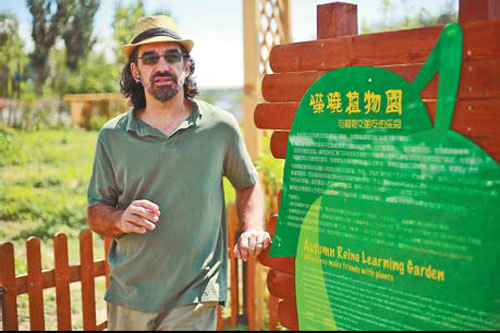
Garran stands at the entrance to his Autumn Reine Learning Garden. |
My China dream | Thomas Garran
An American herbalist has found his own place in the sun in China, and he's doing his best to spread his knowledge among both locals and expatriates. Ye Jun and Matt Erspamer have the story.
Thomas Garran did not plan on making a life for himself in China. He certainly did not plan on uprooting his comfortable white-collar life in Cape Cod, Massachusetts and transplanting it to a small herbal allotment on the outskirts of Beijing.
Most of all, Garran, 43, did not plan on falling in love in China.
Garran first saw China in 2004 for a brief visit. He later returned in 2007 to study and travel for a short while, he thought. All that changed when he met the woman who is now his wife, Wu Jianghong, a PR manager with an international company in Beijing.
The American is a herbalist, a licensed acupuncturist and a herbal medicine practitioner in the United States. He holds a master's degree in traditional oriental medicine from Pacific College of Oriental Medicine, which, however, was not enough for him to get a job as a traditional Chinese medicine practitioner in Beijing. Such a position requires a PhD or MD.
So Garran decided to concentrate more on teaching and studying. He has been holding classes at the Beijing-based China Culture Center for mainly non-professional expatriates. And he also runs the Sylvan Institute of Botanical Medicine, a web-based training course for medical professionals.
He has built a herb garden on the city's outskirts, which has become the focal point of his newfound life in China. It's where he grows his many herbal remedies, and where he brings students of his Chinese medicine classes.
Garran and his wife named the garden the Autumn Reine Learning Garden, in memory of their newborn daughter, who died from Sudden Infant Death Syndrome in February 2011.
"I haven't cut my hair since," Garran says, citing Chinese tradition as the reason. Over the past year, a deep-rooted loving family and friends he has made in the Beijing International Hockey League helped him overcome the tragedy.
Wearing a beard, sunglasses, and a straw hat, Garran describes himself as a "cowboy" type. He has planted more than 70 herbs and vegetables in his garden, and he plans to plant even more.
Many of the herbs in Autumn Reine Learning Garden come from Beijing Medicinal Garden, an institute of medical plant research.
Li Biao, assistant director to the garden, says they have provided around 30 herbs to Garran's garden for free. He has asked Garran to help revise the English signs explaining the source and function of medicinal plants in the garden.
"Garran did a good job using proper medicinal terms and tenses on the English signs," Li says.
It is in the fusion of Garran's American and Chinese cultural identities that he finds true purpose. If he is to be remembered for one thing in his career, he says, it is in the use of Western plants for Chinese herbal remedies.
This idea is not just the thesis of Garran's career but also that of his first book, Western Herbs According to Traditional Chinese Medicine.
Many important herbs are not from China, according to Garran.
"Moyao, a resin made from dried tree sap, is from the Middle East. American ginseng is from the United States. Ruxiang, frankincense, is also from the Middle East," he says.
These herbs may have been brought to China by travelers or traders 1,000 years ago, and became a part of Chinese herbal pharmacology over the ages.
In some cases, Chinese and Western herbs can be very similar. Motherwort, for example, has a similar name, yimucao, or the "mother herb" in China. The use of the two herbs has a lot in common, too. "Yet this arose completely independently in Europe and China," he says.
Garran hopes to integrate more Western herbs into Chinese medicine.
His class, an introduction to Chinese herbal medicine, features a diverse crowd of beginners, from locals to expatriates.
Feng Cheng, director at China Culture Center, says Thomas Garran is a popular lecturer at the center.
"Many people follow his classes. Some stay after class to seek health consultation from him," says Feng.
Garran has been teaching at the center for half a year. He teaches two classes: traditional Chinese medicine theory and herbal medicine. Each courses has eight classes spanned over a month, lasting a total 16 hours.
"I realized the largest impact I could have is by teaching," Garran says.
His teaching is not without applied practice, which is what helps tie everything back to the herbal garden.
He brings students here to help them realize what he concluded more than 20 years ago: Plants form the backbone of human existence.
"We eat plants, we wear plants, we sit on plants - without plants we have nothing," he says.
The function of herbs is more important than it looks.
"According to the World Health Organization, 80 percent of people in the world depend on herbal medicine," Garran says. "Just more than 100 years ago, there were only herbs and no drugs, even more so in China."
In the US, too, there has been a gradual shift back to herbal medicine since the 1960s and 1970s.
"The situation really started to change in the 1990s," he says. "We've been to doctors, had all the pills but were still sick. A lot of patients come to me as last resort."
He believes people are more aware now that there are other options than going to the hospital.
"For 50 years, herbal medicine was chopped off at the root," he says. "There was no herbal medicine education (in the US) until 1980s. Now there are about 50 schools for Chinese herbal medicine, most of them small and private."
Garran's time in China with his garden has only helped reinforce this idea.

"As long as it is not an emergency, such as trauma, I'm going to use herbal medicine every time," he says. "But in the case of an urgent trauma situation, I will use what Western medicine does best, emergency medicine."
To better his knowledge in traditional Chinese literature, he has been studying complicated Chinese characters. He has taken classes with teachers, who have helped him gain a deeper understanding of Chinese medicine. "If I can study here longer, I hope I can somehow be a part of the revival of traditional, not modern, Chinese medicine," he says.
Contact the writers through yejun@chinadaily.com.cn.