The test of time
 |
|
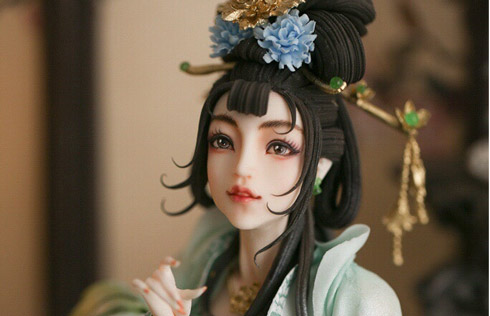
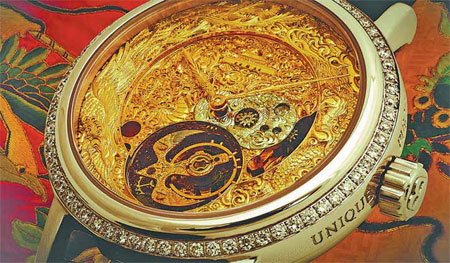
"Playing Dragon and Phoenix" was made by Beijing Watch Factory for the luxury market. Provided to China Daily |
The nation's master watchmakers were late entrants in the luxury market and though they had high hopes of competing with the Swiss, the reality is more mixed. Wang Kaihao reports in Beijing.
The old Soviet-style Beijing Watch Factory was erected in Changping district more than 50 years ago. A giant statue of former chairman Mao Zedong stands at the front gate.
|
|||


"The watch manufacturing industry had just started in China at that time. We all wanted to make a contribution to the country."
China made its first watch, in 1955, in Tianjin. Watch factories mushroomed nationwide in the following years and Beijing Watch Factory was founded in 1958.
In June, China Horologe Association (CHA), the official organization supervising the development of the industry, presented the title of "Chinese Watch and Clock Masters" to 12 people nationwide for the first time in the Great Hall of the People. Xu is one of nine "master watchmakers".
As the son of a clock repairer in his hometown of Wuxi, Jiangsu province, Xu grew up with watch making gadgets, which made him decide to follow in his father's footsteps.
"Everyone in the factory was so disciplined and we had a very ambitious slogan: 'The watch won't leave the factory if it fails to catch up with (those made in) Switzerland."
Xu joined a delegation for a light industry exhibition in Poland, East Germany and Romania in 1964, and was proud to see Chinese watches appreciated by visitors for the first time.
He was a member of a 15-people panel to design a "national unitary watch movement" in 1967. The brass movement with a diameter of 26.5 mm and a thickness of 4.4 mm was put into mass production in 1970s and is still made at some factories today.
A watch was one of the san da jian, or "big three pieces" (the others were a bicycle and sewing machine) that symbolized high living standards for ordinary Chinese families in the late 1970s. A Beijing-brand watch sold then for about 110 yuan, which was about two months salary for Xu at that time.
Xu says there were more than 3,000 employees at the factory in the early 1980s, and the only way you could get a job then was through personal connections.
Miao Hongbo, 47, is the general manager of the factory and says when he arrived in 1986, its heyday had just passed.
"The Japanese quartz watch came in and the whole industry began to go downhill," says Miao, looking sullen. "Mechanical watches were no longer the first choice for timing."
The factory had to rent land to neighboring schools to make ends meet in the following years. Meanwhile, many other manufacturers failed to pass the test of time.
Zhang Yamin, 58, is the former deputy head of Hefei Watch Factory in Anhui province. His factory spent large amounts of money introducing instruments from Switzerland in the mid-1980s but the expansion led to overcapacity and a switch to making quartz watches was made around 1990.
"But we couldn't keep down our costs as low as our Japanese counterparts'. The factory didn't have enough creativity and it got worse and worse."
The factory limped along for another decade and finally disbanded in 2005. Zhang now runs a watch-repair store.
According to CHA Vice-Chairman Zhang Hongguang, the country had 38 mechanical watch factories that could produce their own movements in the 1980s, but the number is just nine now.