Behind the scenic scenes
 |
|
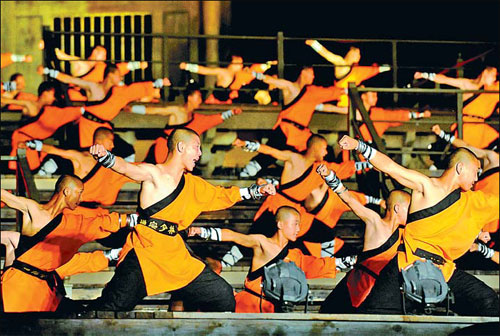
Zen Shaolin is performed in the valley of Songshan Mountain, the birthplace of martial arts. Provided to China Daily |
At the Opening Ceremony of London's Olympic Games, audiences were able to see the daily lives of the British in the past, such as factory workers and farmers in an authentic onstage setting, with chimneys, livestock and spinning wheels.
But it wasn't a unique show, as China has been putting on open-air performances with scenic areas functioning as a natural stage to display local culture and traditions for many years. They're magnificent shows involving hundreds of performers.
The 55-year-old director and producer Mei Shuaiyuan invented the concept of shijing yanchu, or "real scenery shows" a decade ago.
In 2003, he collaborated with director Zhang Yimou to produce Impression Liu Sanjie, which was a huge success. It attracted 1.5 million visitors in 2011.
The inspiration comes from the legend of Liu Sanjie, an outstanding folk artist who sings to defy evil and help poor people living along the Lijiang River in Yangshuo county, Guangxi Zhuang autonomous region.
Zhang went on to produce another four Impression shows, while Mei has done nine. Mei's latest work Buddha Pilgrimages Eastward will premiere in September in Yanzhou, Shandong province.
"The best culture in the prettiest scenery, rather than an artificial stage: they enhance each other's beauty. It's about Chinese philosophy - the harmony between human beings and nature," Mei says.
Mei says it takes more than a year to complete a project that has about 400 to 500 performers and costs about 40-200 million yuan ($6. 28-31.4 million). Funding is mainly from the Scenery Culture Ltd Co he founded and private capital shares.
In 1994, he became president of the Guangxi Zhuang Opera Troupe, but no matter how good the performance was, it lost money as the shows were not market-oriented and its target customer was the government.
"I wanted to make some changes. I'd watched various Broadway shows and I was attracted by the pure commercialization and high box office," he says.
"When I saw the fishermen's boats on Lijiang River in the day and their lights at night, I thought it looked like a performance."
Wang Huiru, 24, an office worker from Beijing who saw the show, says: "It was so fascinating! I was touched by those pretty girls washing their long hair in the Lijiang River, with the moon over the mountains."
Mei also cooperated with many famous artists, such as musician Tan Dun and dancer Huang Doudou in the Zen Shaolin, staged in the valley of Songshan Mountain near the Shaolin Temple, Henan province.
"What we're exploring is the origin of the culture, which, together with the picturesque sceneries, becomes the oneness of human and nature," he says.
"Tourists always want to see local life. This is the principle. A show that lasts forever must become the soul of the mountains and rivers, just like a Chinese ink-and-wash painting," he says. "It's essential to combine arts and the market."
Large-scale tourist areas with 2-3 million tourists a year are priorities, Mei says. Interesting local culture is another factor.
He says improved scenic design, lighting and advanced technology make shows more magnificent than was possible in the past.
In The Love Story of a Weedman and a Fairy Fox, he works with American magician David Copperfield's group to build a wonderland full of magic, based on the folklore of Hunan province and about the forbidden love between a fox-woman and a woodchopper.
He says it's difficult to estimate how long it takes to recoup costs because there are many factors other than ticket sales. For example, the increasing price of buying land and the profits of facilities such as hotels and restaurants need to be taken into account.
Mei says tourist agencies typically account for nearly 90 percent of tickets sales, because the shows are part of a tourism experience.
"It's very convenient. We only have to do our shows well and distribute revenues. Our shows boost their business, too," he says.
He plans to promote the show to Southeast Asian countries, such as Vietnam, Singapore and Malaysia, where there are low labor costs and good weather.
"Someone invited us to demonstrate their culture in our way after watching my productions. It's a good opportunity and I'm talking it over with them."
xulin@chinadaily.com.cn