In the arts, questioning the ability to shock
 |
|
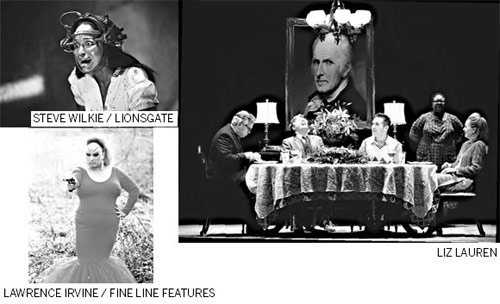
Artists say they have a purpose when they push the boundaries. Clockwise from bottom left: Divine in "Pink Flamingos"; Tanedra Howard in "Saw VI"; "Mary," a play by Thomas Bradshaw in which a contemp-orary white Southern family keeps a slave. |
The morning of the premiere of "Le Sacre du Printemps" ("The Rite of Spring") on May 29, 1913, at the ThEatre des Champs-ElysEes in Paris, the newspaper Le Figaro predicted the ballet would deliver "a new thrill which will surely raise passionate discussion" and "leave all true artists with an unforgettable impression."
That turned out to be one of the greatest understatements of the new artistic century. The passionate discussion began during the first few bars of the music, as derisive laughter rose from the seats, and soon grew into an uproar that sent the composer, Igor Stravinsky, fleeing the hall in disgust.
Stravinsky and his collaborators didn't intend to start a riot. But the premiere helped write a modern cultural script. Artists have been trying to provoke audiences ever since, elevating shock to an artistic value, a sign that they are fighting oppressive tradition and bourgeois morality.
Shock went mainstream long ago, raising a question: Can art still shock today? Nudity and raw language are no longer scandalous, and decades of Modernist assaults on formal constraints have dissolved the boundary between art and not-art, high and low.
Today shock can seem indistinguishable from scandal, less a side effect of artistic innovation than a ploy created by self-promoting artists and public scolds. But many artists say that generating shock remains the duty of anyone who aims to reflect the real world back at itself. Audiences may be more sophisticated, and jaded, but it is still possible to show them something they may not want to see.
The filmmaker John Waters began his 1981 autobiography, "Shock Value," with the declaration that having someone vomit while watching one of his movies was "like getting a standing ovation." But mere shock for shock's sake, he said recently, is "deathly."
"If you're shocking by subject matter alone, it's not enough, and it never was enough," he said. "It's easy to shock, but it's much harder to surprise with wit."
To him the most shocking thing about "Pink Flamingos," his 1972 exploitation classic that depicted the drag queen Divine gleefully eating dog feces, was the fact that people laughed. "It was a commentary on censorship," he said. "It was about what was left once 'Deep Throat' became legal."
To ask if art can still shock is quickly to invite another question: Shock whom, and where? Connoisseurs of the highbrow jolts delivered, say, by European movie directors like Lars von Trier and Gaspar NoE might find themselves shocked at the guilt-free pleasure taken by fans of the torture-porn "Saw" franchise.
When the playwright Thomas Bradshaw's satire "Mary," about a contemporary Southern white couple who keep a slave, was staged at the Goodman Theater in Chicago last year, it prompted a storm of criticism, including a review in The Chicago Sun-Times newspaper wondering if it wasn't "a complete and total hoax designed to see just how much hokum and bunkum today's theater audiences might be willing to tolerate before rebelling."
Mr. Bradshaw's plays, which include "Burning" and "Strom Thurmond Is Not a Racist," have prompted their share of walkouts. But the playwright insisted that at the performances of "Mary" he saw, a good part of the mostly white audience was laughing at the liberal use of racial epithets and comically genial "slave owners" - at least once they looked around the theater to make sure someone else was laughing too.
In "The Art of Cruelty: A Reckoning" (2011), the critic Maggie Nelson questioned the lingering hold of what she called Modernism's "shock doctrine." Not that Ms. Nelson dismisses the value of confrontation. Art still needs to "say things the culture can't allow itself to hear," she said. "But all shock is not created equal," she continued. "Once the original 'ugh' is gone, you've got to look at what the next emotion is."
That next emotion may be nothing more than a hunger for the next, deeper shock. And some of the canniest shock artists say that, these days, refusing to deliver it in the expected ways may be the most shocking move of all.
Mr. Waters, whose most recent movie, "A Dirty Shame," featured semen shooting out of a man's head (and hitting the camera), suggested a homework assignment to a hypothetical young filmmaker out to make a mark.
"If you could think of something that would get an NC-17 rating with no sex or violence," he said, "you would have the most radical movie of the year."
The New York Times