Contagious culture
|
Park Jae-sang, better known by his stage name PSY, performs his signature Gangnam Style at Rehab's Final Party of the Year on Oct 21, in Las Vegas, in the United States. Marcel Thomas / Getty Images / CFP |
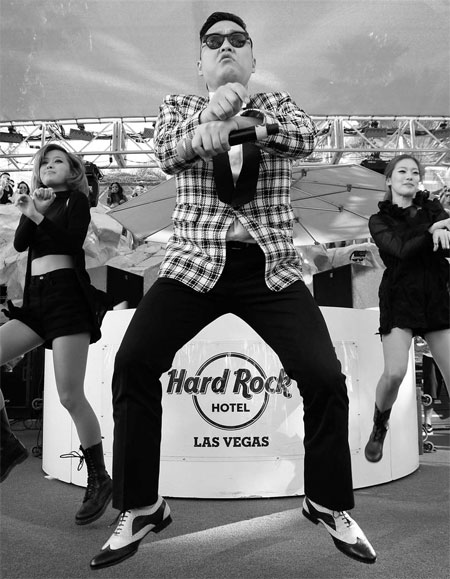
A viral hit from South Korea is a rude wake-up call to aspiring Chinese artists and entertainers that cultural products need spontaneity and diversity.
The immense popularity of Gangnam Style is puzzling to many Chinese, especially those who search for social significance in minutiae. As I count myself as one of the group, here is my two cents about the strange phenomenon of a South Korean rapper who is neither matinee idol, nor Pavarotti or Nureyev reincarnate, but whose number has taken the world by storm.
Gangnam Style is no high art. Yes, it has a catchy tune and dance moves so childish everyone can imitate. Had it used three octaves and polished choreography only trained dancers can pull off, it would never have gained such a wide audience.
Now, China produces its own equivalents of surprise hits that can be explained only by their sheer simplicity in melody or absurdity in style. In the late 1990s, there was My Heart Is Too Soft; the new century saw Mice Love Rice, and most recently it was dance versions of folk-style songs by the duo Phoenix Legend. They are not critical darlings, but they invariably click with the broad public for their endless hummability.
As a matter of fact, it is fairly difficult for a critic to say they are a fad and will vanish before you know it. Such is their penetration into the society that everyone wants to jump on the bandwagon, including politicians who want to be seen as members of the people. Populism dictates that if you don't go along with the mass and what they enjoy, you are isolating yourself into an enclave of cynics and elites who believe themselves to be better than the rest of us.
The Western world certainly has its share of goofy songs accompanied by equally goofy dance steps. In 1994, the US was swept by a Spanish dance song called Macarena. Like Gangnam Style, it was aided by the music video, which featured very simple hand movements. All of a sudden, everyone on TV was doing the same move and humming the same tune.
The funny thing is, the foreign languages in the lyrics do not in any way hamper their prairie-fire dissemination in English-speaking countries. Rather, they form part of the charm. From where I can see, most people simply took it as gibberish and never bothered to find out what the songs were about. The music and the video were enough for them to relate to and partake in what turned out to be collective fun rides.
Chinese artists and entertainers are certainly capable of creating such pieces. What they lack is a sense of spontaneous fun. Those trained in academia tend to take the creative process as one of dissociating from the lighter side of life and focusing on the grave reality. Others with an eye for the market and profits are so eager to pander to their potential audience that they come up with works totally derivative and calculated they are stripped of any sincerity.
Of course, you can create great works by exploring personal anxieties and societal agonies. Mo Yan's books are not fun to read, but they convey something valuable about the Chinese psyche. For light entertainment to work, fun could be the keyword. In Gangnam Style, it is so infectious it does not need translation whatsoever.
Had the hit been made in China, I'm sure there would be an army of pundits who'd pillory it for denigrating the national image. "Does it represent the great strides China has made in the past few decades?" they'll ask. "Sure, the singer looks rich and well-coiffed, but shouldn't he spend his money on more worthwhile things - like charity?"
So, to spruce up the image, the out-of-shape singer would be replaced by one physically fit and technically adroit so the horse-riding dance would be more fluid and "professional". Later, he would give way to an innocent looking young woman fully decked out in folk attire so that foreigners would find the video more appealing. In terms of music, a heavy dose of Chinese characteristic has to be injected - those floating lines that resemble a lark. Another approach is to fit her out with Peking Opera regalia, complete with heavy makeup and delicate hand gestures.
Well, this is not a hypothesis. We have such music videos galore and you cannot avoid them on the tube. They do make up a satisfying part of our performing arts legacy, but they are not all. Most importantly, they are more often unable to capture the gestalt, and the pursuit of merriment so pure that outsiders can easily identify with it.
Art is a full spectrum, from the highest on one end to the lowest on the other. If Beethoven's Ode to Joy is a prime example of art at its most exalted and exultant, Gangnam Style must be at the polar opposite, jovial to the point of silliness. They both exist to satisfy human needs, which are not mutually exclusive. Needless to say, much of the latter do not possess the power to last till the next year, but they keep resurfacing in variations of forms.
Then, there is the satire in Gangnam Style. It is so over-the-top in both music style and production value that you intuitively know he is making fun of somebody or something. Could it be K-pop, or lifestyle of the rich and famous, or himself, or something deeper only the analytical scholar can decipher? We don't know, and we probably do not need a consensus. If you see it as polished pop with earnestness, that's fine, too.
But here lies the greatest hurdle for Chinese imitators. We can invent melodies and dance routines that are simple and joyous, but it is not in our genes to infuse the fun with an attitude, let alone social commentary. Our education discourages that. If a kid tells a joke about an authority figure at the dinner table or in the classroom, he or she will surely not get encouragement from the parents or teachers for being sharp-tongued or quick-minded. More likely, the kid will be met with a stern look or gentle chiding for being naughty. And that is the better scenario.
The fusion of social criticism and entertainment is a powerful tool and by no means Western in nature. Browse China's Internet, and you'll encounter an avalanche of black humor and social satire. But they exist in the so-called underground and rarely surface into the mainstream media or entertainment. (OK, some movies incorporate it in their comical moments.) We have no Jon Stewarts; we don't even have a Jay Leno equivalent. Our standup comics dare only make fun of the unfortunate.
All this forms an invisible obstacle for China to promote its cultural products. Soft power is not equal to tourism-style ads. It is not just about the beautiful sceneries we have and the dense skyscrapers on our horizon. Neither can our ancient sages and young sports stars embody the rich diversity of our civilization.
Soft power exudes from every corner of our society and every strip of our artistic gamut. It includes our ability to laugh and to cry, to be proud of our uniqueness and to find common ground with others. I'm sure Gangnam Style does not encapsulate all the interesting things Korean people are capable of, but it told me one thing: Koreans are fun-loving. That's good enough for one pop sensation.
Contact the writer at raymondzhou@chinadaily.com.cn.