
 Comments
  Print
Print  Mail
Mail  Large Medium Small
 |
|
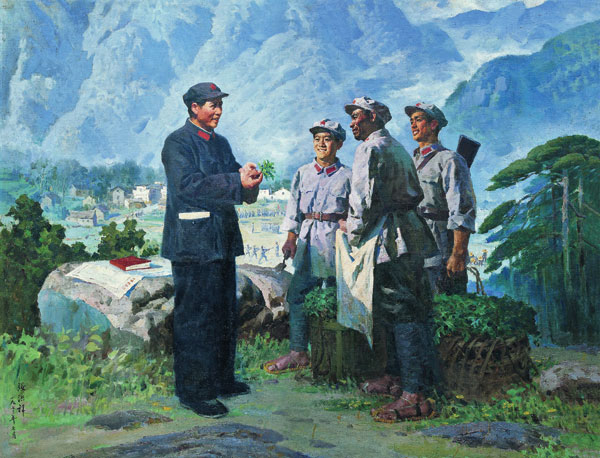
Hard Times (1973), by Zhang Hongxiang, is an oil painting from the Long Museum's "red classics" collection. Photos provided to China Daily |
 |
|
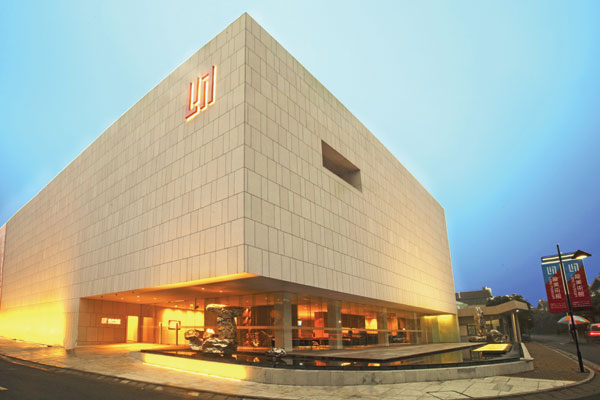
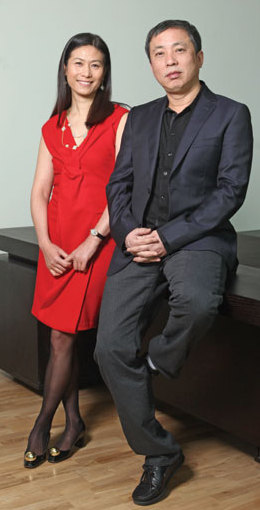
Above and below right: The Long Museum and its owners, Wang Wei and Liu Yiqian. |
Husband and wife art lovers realize their dream and take it to the public, Zhang Kun reports in Shanghai.
Art collectors have to follow their own ideas, Wang Wei believes. Academics and scholars may provide their suggestions and advice, but ultimately you have to find your own direction.
Wang and her husband, Liu Yiqian, are among the most renowned collectors of art in today's China. In June 2012, they were listed in The 2012 ARTnews 200 Top Collectors. This is the first time collectors from the Chinese mainland have been listed.
|
|
Their private establishment, the Long Museum, opened to the public in suburban Shanghai's Luoshan Road on Dec 18.
The museum's debut exhibition largely reflects the outlook of their collection. There are modern and contemporary paintings and sculptures with a special focus on "red classics" - items reflecting the modern Chinese revolutionary events and heroes.
And there are ancient Chinese masterpieces and treasures such as the painted scroll Sketches of Rare Birds by Zhao Ji, an 11th-century emperor of the Song Dynasty (960-1279), and an imperial throne from the 18th century. Liu bought the scroll for more than 61 million yuan ($9.92 million) in 2009 and the throne for HK$85.78 million ($11.06 million).
"We only buy occasionally nowadays, to complement and improve the existing series," Wang says. Her office sits on the third floor of the new museum building located in a cluster of luxurious villa residences, on Luoshan Road, in Pudong New Area of suburban Shanghai.
 |
Liu, 50, made his first "barrel of gold" in China's emerging stock market in the 1980s. The couple's art-collecting dates back more than 20 years.
Wang formerly worked in a Shanghai-based auction company for three years, during which she developed sharp eyes for good art.
Once she saw a painting depicting China's first generation of political leaders in the auction catalog, and found the image familiar. Then she realized it was on her childhood school textbook. "That piece inspired me and I started to buy red classic art," she says.
"These pieces should be kept in national museums. Only because of specific historical situations, they were out in the market. They reflect part of our collective memory, which should be passed on to future generations," she continues.
"Since our financial condition was improving, we started collecting them."
Ambitious plans
About eight years ago, the couple started to consider opening their own museum, where they could share their collection with the public. It cost them 200 million yuan to purchase the land and build it.
The building has four stories, and a total space of more than 10,000 square meters, half of which is for exhibitions. Wang declines to reveal the total number of artworks in their collection, but a new, even larger venue of the Long Museum will be built across the Huangpu River.
With an exhibition space of 16,000 square meters, it's scheduled to open on the west bank of the river in December.
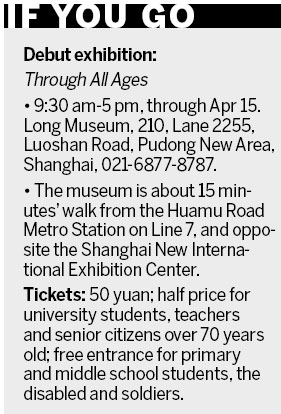
"It's very costly running a museum," Wang says. Electricity alone costs more than 10,000 yuan every day. The admission of 50 yuan per person can only cover a tiny portion of the cost.
"We think a public service initiative like this deserves more support from the government," she says. "They can help us in many ways, such as taxation and electricity pricing."
The museum is so new that her office still smells of fresh paint. A website has just been launched, and a series of educational activities is being presented.
"We really want to provide something meaningful for the local community," Wang says. "As long as we can provide good service continuously, we will be able to ask for more support from the administration sectors."
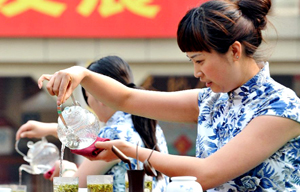
Art lectures, workshops for art lovers and children, and tea parties are all planned for the Long Museum.
The museum chose its name after the Chinese pronunciation of dragon, the mythical creature that has become a widely recognized Chinese totem. Wang also hopes it can go on "long" as the name suggests.
Wang and Liu have four children. One of their daughters is studying art history abroad, and their youngest child, a teenage boy, is showing great interest in art too.
"I'd wish Long Museum will carry on to our next generation," she says. "We are all mortal beings, but spirits, ideas and art survive for thousands of years."
Liu and Wang have acquired most of their treasures at auctions in China. "We no longer buy in Hong Kong, because of the tariff concern," Wang says.
Art bought in Hong Kong is subject to taxation upon entering the mainland. An investigation into widespread tax evasion by transportation and auction companies disrupted the art market in and out of China and largely affected the transfer of art to the mainland since mid-2012.
"Artworks that show up on the auction market are proven to be of considerable quality and authenticity," Wang explains.
Her husband Liu is known as an aggressive buyer ready to pay extremely high price for his chosen pieces. While Liu is focused on ancient Chinese art, Wang has been intentionally building her series of modern and contemporary Chinese art.
Quest for modern art
"Few museums in China have made systematic collections of modern and contemporary Chinese art, which only started since the 1980s," contemporary art critic Lu Peng says.
"A large number of modern Chinese oil paintings created before 1949 went missing because of the continuous wars, political movements and the lack of study of art history.
"Also, even fewer art institutions in the Chinese mainland have systematic collections of contemporary art."
In this context, the Long Museum has filled a huge gap in the official artistic establishments in China, critics agreed.
It's never too late to start collecting art, Wang says. Her collection of contemporary Chinese art has extended to the latest works by artists in their 20s and early 30s. "It may be difficult to start with established artists, but you will have a high sense of fulfillment discovering emerging artists," she says.
Ai Xuan, an oil painter of the realistic style, once asked Wang Wei's opinion of the popular animation style in today's art scene.
"It's a product of the time," she replied. "We may not give it an objective evaluation, but only pick the best of it, and let the future decide its value."
Contact the writer at Zhangkun@chinadaily.com.cn.

Copyright 1995 - 2010 . All rights reserved. The content (including but not limited to text, photo, multimedia information, etc) published in this site belongs to China Daily Information Co (CDIC). Without written authorization from CDIC, such content shall not be republished or used in any form. Note: Browsers with 1024*768 or higher resolution are suggested for this site.
License for publishing multimedia online 0108263 Registration Number: 20100000002731