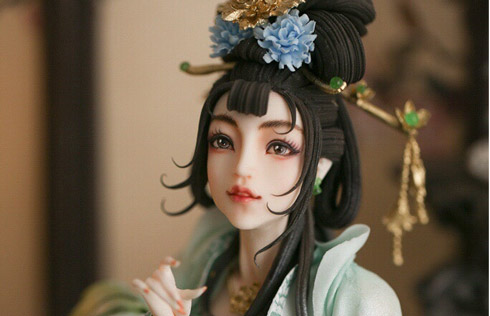
Great snakes!
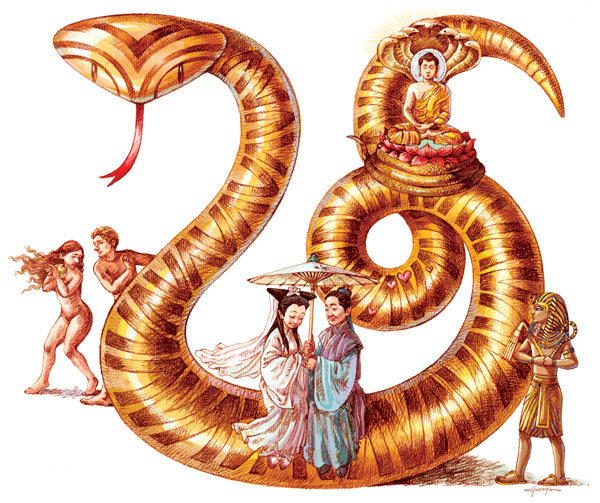
The Chinese have an irrational fear of the snake, yet the representation of the zodiac animal includes a bittersweet tale of vows and hearts broken and love transcending disaster, Raymond Zhou reports.
Let’s face it: The snake has an image problem. In preparation for the Year of the Snake, a mammoth decoration in the form of the elongate, legless, carnivorous reptile was erected at a highway toll plaza in Sichuan province. Somehow, they gave the snake the countenance of a chicken. Onlookers joked that whoever sculpted it must have been born in the Year of the Rooster, and others chimed in that they would no longer be afraid of the snake now that it had taken the shape of a friendlier animal.

On these occasions, Chinese people have traditionally resorted to euphemisms to represent the snake in an auspicious light. The dragon, a symbol of power and majesty, is often used to stand in for its earthbound peer, which is certainly one of the reasons for envisioning the mythical animal; hence the term “the little dragon”.
Still, efforts to distinguish the two have been unceasing, as is evident in such catchphrases as “an assortment of dragons and snakes”, meaning people of different qualities and status sharing one space, and “dragons withdrawing and snakes expanding”, meaning good guys lying low and bad elements strutting their stuff. Obviously, it is futile to pass off snakes as dragons.
In China, snakes are predominantly associated with venom — even though only 65 species out of some 600 in the country are poisonous. Worldwide, there are 725 species of venomous snakes, of which about 250 can kill a human with one bite.
Legend has it that the venom from the bite of a particular viper can cause a human victim to drop dead before he or she could walk more than seven steps. The Chinese name for it is “Seven-Pacer”, or Russell’s Viper in English.
Indeed, if you’re bitten by a snake — presumably not a poisonous one — for the next decade you’ll tremble at the sight of a rope, or anything that vaguely resembles a snake.
|
|

There is an ancient tale of a man who spots a snake in his glass of liquor. It turns out the wriggly thing was the reflection of a bow hanging on the wall. The yarn has since been immortalised as a phrase for unfounded panic.
Contrary to some cultures where the snake is perceived as a steadfast defender, in the Chinese lexicon it is enshrined as a subject and an object of fright.
In calligraphy, however, the snake is not portrayed in a negative light. A serpentine brush stroke is to be marvelled, not quivered, at — and that refers to a snake that’s flying or scurrying away.
Very often, the snake comes with its nobler peer, the dragon, in such descriptions. However, one ancient calligrapher painted a realistic snake on a scroll and, out of a whim, added a foot to the legless species, thus becoming the archetype of redundancy. Never mind that some species indeed have a pair of vestigial claws. But in this story, it’s the painter, not the snake, who is the butt of derision.
For all the snake-related idioms, China does not hold a candle to Indian mythology when it comes to snake references. Likewise, Egyptian, Greek, Christian and many other cultures have images of the snake more colourful than ours.
The Chinese snake is not as rich in connotation and has not spilled over into the visual arts. We do not have a deity sitting on a coiled python; the Buddhist concept of reincarnation has not been compared to the shedding of snake skin; our female monsters do not sport a crop of snakes for hair; and a snake is not the cause for carnal temptation. (The fox is the closest to that symbol, but it epitomises female seduction rather than the lure that brings man and woman together.)