Comments
  Print
Print  Mail
Mail  Large Medium Small
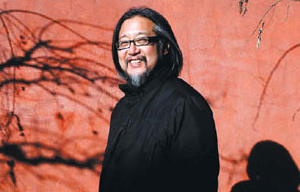
After graduating in 2000 with a master of fine arts degree from the School of Visual Arts in New York, he worked various jobs and became involved in Godzilla, just as that Asian-American artists network was disbanding.
He began curating exhibitions, and landed a job at the Queens Museum of Art. Surrounded by Chinese, Korean and South American communities, the museum was keenly aware of racial and cultural matters. He began thinking more about his own cultural identity and how it might connect to art and ethnicity.
But he shied away from explicitly exploring Chinese culture in his work for a long time. Tam's next curatorial effort was also in Queens, at the Jamaica Center for Arts and Learning, where in 2007 he presented a show about the effects of crack cocaine and hip-hop on the surrounding neighborhood. His work touched on police brutality, the judicial and prison systems, and the cycle of abuse that has ravaged poor communities.
"That show was a huge revelation for me because I realized that art does not need to be in the service of itself and its own limitations. There's a way that art can be used as a social document," he says.
From 2007 to 2011 he worked at Exit Art, a Manhattan gallery with a focus on identity politics. During that time he learned that the nearby MOCA, which Tam had visited often, was moving to a new space designed by architect Maya Lin. Most of the shows he had seen at the original location were historical in nature, with few opportunities for contemporary Chinese artists to showcase their work. He began thinking more seriously about how the museum might move toward a contemporary focus. In 2011, he joined MOCA as its curator.
The museum staff, including executive director Helen Koh, director of education Heather Brady and director of public programs Nancy Bulalacao, are dedicated to expanding MOCA's audience and profile, Tam says. That requires a focus that goes beyond the local, and an awareness of demographic shifts.
Hua Hsu, a professor at Vassar College and contributor to the New York Times, the Atlantic and other publications, points to MOCA's partnership with the Asian American Writers Workshop and similar organizations. (Hsu is on the board of the AAWW.)
"He's building a strong foundation for the future at MOCA," Hsu says. "I think his experiences at the Queens Museum and Exit Art offer him a broader context for his curatorial work. He's able to engage the local community but also understands how MOCA fits within a larger constellation of institutions."
Tam is notable for an unpretentious approach that's uncommon in the art world, Hua says.
|
|
"Instead of chasing trends or viewing alternate spaces as stepping stones to mainstream institutions, Herb's curatorial work is driven by a set of vital, if unpopular, questions around identity politics, globalization and self-expression that might not view itself as 'art'."
Jane DeBevoise, chairwoman of the board at the Asia Art Archive in Hong Kong and a former deputy director of New York's Guggenheim Museum, says MOCA focuses "on the now".
"This embrace of both the past and the present, the underexplored and the well-established, will keep MOCA both vibrant and relevant, not just for the Chinese and Asian-American communities but for the wider art communities in New York and elsewhere," she says.
While understanding that the history of Chinese immigration and discrimination in the US is important, Tam believes the rise of China and Chinese-American culture provides a broad range of contemporary topics for exploration.
Although the ascent of China is inevitably of interest to the museum, the process of determining how to engage with the country is still in flux, according to Tam.
"You can't help but make those connections, because the history of Chinese people here is obviously intertwined with political and economic developments in China. So how can you not talk about what's going on over there, if you're going to relate it to what's going on here?
MOCA serves an important function, the curator says. As New York's ethnic Chinese population grows ever larger, institutions that recognize the diversity of identity and experience in the community are crucial.
"It's important to have a representation of yourself in museums, because it means, 'We've made it as a people.' A museum like MOCA becomes a reflection of people's aspirations and the realities of what it means to be Chinese. It's an important responsibility."
Contact the writer at kdawson@chinadailyusa.com.

Copyright 1995 - 2010 . All rights reserved. The content (including but not limited to text, photo, multimedia information, etc) published in this site belongs to China Daily Information Co (CDIC). Without written authorization from CDIC, such content shall not be republished or used in any form. Note: Browsers with 1024*768 or higher resolution are suggested for this site.
License for publishing multimedia online 0108263 Registration Number: 20100000002731