Translations distort the reality
In the Year of the Dragon, China surpassed the United States as the world's biggest trading nation. In the Year of the Snake, China should rise to the occasion and promote Chinese knowledge.
The main challenge for the Chinese nation is not just to compete with Western countries for resources and trade, the true challenge is to write "world history" in Chinese again; and the only way to do this is by promoting Chinese terminologies.
As Confucius once said: If names are not correct, speech is not in accordance with the truth of things. Yet internationally almost none of the correct names for Chinese thoughts and ideas have survived the onslaught of Western biblical and philosophical translations. Western words for Chinese concepts have distorted the reality of things.
 |
China is not the first nation to rise in modern times, but it is the only one that doesn't have an alphabet. So far China has relied on two Western-introduced Romanization systems, Wade-Giles and Pinyin. Although some Chinese concepts like yin and yang or kung fu have been adopted by Western writers; there still seems to be no policy on behalf of Chinese that actively promotes the use of Chinese terms abroad, certainly not in the sciences. Nor is there popular assertiveness, I think, to use Chinese terms in China's national English-language publications. Yes, China promotes Hanban, the Confucian Institutes, around the world, but these teach the Chinese language; they do not promote Chinese terminologies. They are not even called Hanban abroad.
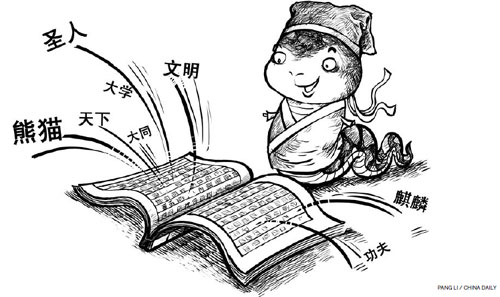
This is the reality: The West invented a lot of things; but not everything. I haven't seen a single buddha, or shengren in the West, so far, yet Chinese students are taught by Western history books that there are "saints" and "philosophers" all over Asia. I am often perplexed by the readiness of many Chinese colleagues who give away literally all Chinese originality to foreign translators: What is this, a qilin? Well, let's call it a unicorn shall we? And what is that, a long? Well, let's just call it a dragon then! The xiongmao only breeds in China, yet for people in the West it's a panda.
Of course, the mythical creatures are "harmless" losses. But China has lost virtually everything in the social sciences: wenming? - a Chinese world for civilization; daxue? - a Chinese word for university; shengren? - a Chinese sage or philosopher. But these are not the same. Chinas has been put into the position where it calls its political theory abroad Socialism with Chinese characteristics. If all Chinese historians hope to appeal to Western authority by simply annotating Chinese to Western ideas - Chinese philosophy for example - then why should foreigners intervene in China's voluntary cultural decline?
China should care about her cultural property rights. Being the inventor of an idea, and the owner of its name, has great advantages. The Germans call this deutungshoheit - having the sovereignty over the definition of thought. Let us make no mistake: The West today knows China only on Western terms, not on Chinese terms.
|
 |
The Islamic world with its ayatollahs and imams, its bazaars and kebabs; and the Hindu world with its dharma and karma, its yoga and avatars and so on, are far ahead of the Chinese world when it comes to enriching English as the international language. But the future global language, of course, is not today's English, it will have to adopt tens of thousands of concepts that are non-European and non-US.
We cannot make all Americans and Europeans learn the Chinese language; but what the Chinese can do is to instruct the Western general public about important Chinese key concepts. Few of even the most educated Westerners have ever heard about ren, datong, tianxia, or tian ren he yi.
Western people are curious like all the people of the world. If someone gave them Chinese taxonomies, they would look them up, familiarize themselves with them, and internalize them. They would stop calling a junzi a "gentleman" or "superior person"; instead they would call a junzi a junzi.
To put "culture" back into a more economical perspective, nations should compete for their terminologies like they compete for everything else.
The author is a research fellow at the Institute for Advanced Humanistic Studies, Peking University.