Comments
  Print
Print  Mail
Mail  Large Medium Small
|
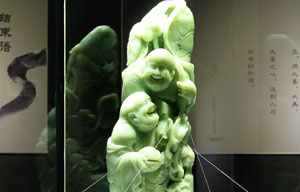
 Chinese buyers are particularly interested in the jade objects and snuff bottles at From Curiosity to Devotion. |
Many of the secular pieces, such as snuff bottles, were often referred to as "curios", and the sacred Buddhist and Taoist artworks were classified as "devotional".
Related stories:
Sotheby's Asian art sale moves into new territory
When art mixes with business
When it comes to taste, there seems to be a large disconnect between the Western and Chinese buyer.
"Western buyers are not picky about the color of the jade or its purity, and American collectors are often attracted to the diversity of jade colors and the carvings," Schiess says.
Chinese buyers "desire purity in jade as it is perceived as perfection, evenness in color, often white or yellow jade", he says.
Buyers at the exhibit from Beijing were mostly preoccupied with jade objects or snuff bottles.
"Most Chinese buyers, with the exception of those interested in archaic bronze, are paying top dollar for Ming and Qing dynasty items from the 14th century to the early 20th century," Schiess says.
"Qianlong items are super-popular and important."
Snuff bottles occupied a large portion of the exhibit, with prices from $1,000 to $50,000.
Snuff, a powdered form of tobacco that's snorted, originally came from the Americas and spread throughout Europe, eventually making its way to China around the 17th century. Chinese nobility exclusively used snuff, and the craftsmanship of older snuff bottles is intricate and artistic.
Snuff became more accessible to other classes in China during the late 19th century, and the bottles' craftsmanship declined, Schiess says.
Snuff bottles, often made of porcelain or glass and sealed with a cork, are not to be confused with European snuffboxes that open on a hinge and lack portability.
Appraising Chinese art has gotten trickier due to fast-rising prices and the proliferation of counterfeits.
Schiess, who studied Asian art history, Chinese language and business at the University of Oregon and later went to Pratt Institute in New York to study art appraisal, says he has been going to auctions since he was 5 years old.
"In the past, forgeries were easy to spot because they were based of photos and the weight and texture would be wrong," Schiess says.
Now, art fabrication in China is done with the highest level of craftsmanship, and fake pieces are fed into legitimate collections to fool buyers, he says.
While many collectors may go to Sotheby's or Christie's, Schiess says that his gallery offers a personal touch not found at big auction houses.
"I sit down with my clients, we have a cup of tea and do research together," he says. "I guarantee all of the items I sell, and there is no pressure."
He says many of his clients are close friends and he often represents them at auctions.
The only problem Schiess has with his Chinese clients is their impatience.
"Chinese buyers, unlike Western buyers, don't like when you just put a red dot", meaning the item has been sold, Schiess says. "They want to wrap it up and take it back to China."
Contact the writer at dbosko@chinadailyusa.com.
(China Daily 04/01/2013 page20)

Copyright 1995 - 2010 . All rights reserved. The content (including but not limited to text, photo, multimedia information, etc) published in this site belongs to China Daily Information Co (CDIC). Without written authorization from CDIC, such content shall not be republished or used in any form. Note: Browsers with 1024*768 or higher resolution are suggested for this site.
License for publishing multimedia online 0108263 Registration Number: 20100000002731