
 Comments
  Print
Print  Mail
Mail  Large Medium Small
 |
|
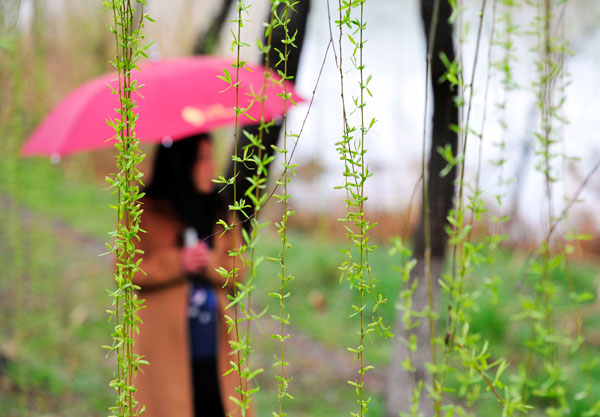
A woman carrying an umbrella shelters from the spring rain under a willow tree in Huai'an, Jiangsu province, on March 17. He Jinghua / For China Daily |
The Qingming Festival is traditionally a time for courtship, making sure the spirits are content and enjoying picnics and other outdoor activities with the coming of the better weather, report Cang Wei and Song Wenwei in Nanjing.
Many people think that Tomb-Sweeping Day, or the Qingming Festival, is for Chinese people to offer remembrances to their ancestors, but in ancient times, it was also a time for people to enjoy the arrival of spring and pray for love.
During the Qingming Festival, young women often tied a red string around the middle finger of their right hand to show they were single and to express their hope for a husband, while the educated young men would write poems on kites and then cut the string.
"If a woman who picked up a kite was touched by the poems, they might find the man and start a romantic relationship," said Shen Ming, who has been researching folk customs in Nanjing, Jiangsu province, for more than 30 years.
Even today, cutting the strings attached to flying kites means to get rid of diseases and bad luck.
"Many ancient people wrote on the kites the names of all the diseases they knew, and then they cut the strings and let the kites fly away with all their worries," said Shen, who has collected more than 1,000 items associated with the folk customs of the Qingming Festival, including postcards, matchboxes and telephone cards showing scenes of young women chasing kites and other traditions associated with the festival.
Just like today, people also liked to fly kites with lights at night. They would fasten strings of tiny, different colored lanterns on the kites that would twinkle like little stars.
Another tradition for the Qingming Festival, one which stretches back more than 1,000 years, is wearing a garland made of willow twigs. People also hung twigs of willow under their roofs and windows to prevent ghosts and evil spirits from entering the house, as it is one of the country's three ghost festivals, a time of year when it was believed ghosts walked the earth. The other two are July 15 and Oct 1 of the lunar Chinese calendar.
Buddhism also contributes to the prevalence of the tradition, as the Goddess of Mercy, or Guanyin, is usually depicted holding a willow twig. Willow trees were also called guibumu, which literally means "the tree which makes ghosts afraid", in ancient China.
The willow twigs were also used to predict the weather. If the twigs remained green, it meant there would be rain, but there would be no rain if they dried out and shriveled up.
"When I was young, many people broke off willow twigs and tied them to the baskets in front of their bicycles after sweeping their ancestors' tombs," said Shen, who is 72 years old. "That scene is still vivid in my memory, though most people nowadays no longer do that."
In China, presenting a twig of willow to another person is also a way of expressing that you want them to stay. The word for willow is liu in mandarin, the same as the word for stay, although they are pronounced with different tones.
South of the Yangtze River, babies born on Tomb Sweeping Day were considered to be the cleverest, as Qingming literally means clear and bright in Chinese, so the babies born on the day were considered to be gifted with intelligence.
Families with small kids would usually ask their neighbors for food during the Qingming Festival, as it was believed this would bring health and good luck to the kids.

Copyright 1995 - 2010 . All rights reserved. The content (including but not limited to text, photo, multimedia information, etc) published in this site belongs to China Daily Information Co (CDIC). Without written authorization from CDIC, such content shall not be republished or used in any form. Note: Browsers with 1024*768 or higher resolution are suggested for this site.
License for publishing multimedia online 0108263 Registration Number: 20100000002731