
 Comments
  Print
Print  Mail
Mail  Large Medium Small
 |
|
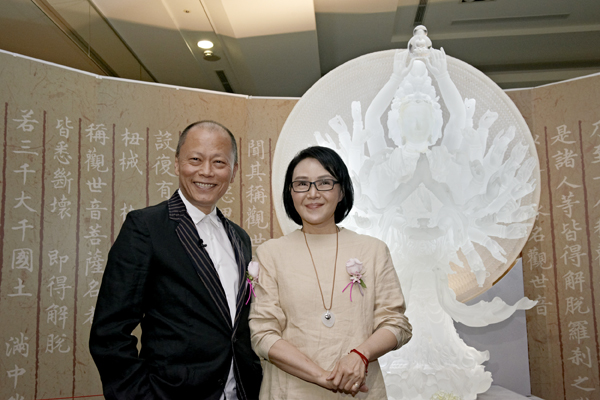
Loretta Hui-shan Yang (R) and Chang Yi. |
Yang believes that everything happens for a reason. The experience in movies prepared her for creating glass art. In their final movie My Love, they borrowed some glass art pieces as props. They were impressed by the material, which they once thought was only used to make cups and vases.
"Glass is transparent. I feel I can see through it, right into the heart. I remember one particular piece a fish in water. The sculptor even had some bubbles in the glass which made the fish look alive," says Yang.
In 1987, seven people from the movie industry including Chang and Yang established Liuligongfang as Asia's first crystal glass workshop.
The hardship was far beyond what they expected.
Initially, they planned to only work on design and get glass factories to produce the product, because some of Liuligongfang's founders were movie setting and props designers. Yang herself is talented in painting.
But soon they found it was impossible to find the right partner to manufacture quality products.
So they invested in a dilapidated factory and learned from scratch the techniques and craftsmanship called pate-de-verre. The process involves casting a wax sculpture in plaster, melting out that wax and adding glass ingredients to the leftover negative space.
For the group who had no knowledge of glass work, it was a tall order. Yang and Chang sold their houses and even refinanced their parents and brothers' houses. In the first three-and-a-half years, they invested some $3 million and "led a life without knowing if there is enough to survive tomorrow".
In 1991, they presented their first exhibition in Japan. They were proud to showcase their pate-de-verre technique, which they thought was invented in Egypt and revived by the French in the 19th century, until a Japanese expert told them Chinese mastery of the technique dates back to the Han Dynasty (206 BC-220 AD). The Japanese told them there was a pair of 11.5-cm liuli ear cups unearthed from the famed tomb of Emperor Liu Sheng in Hebei province.
They were dumbfounded and felt ashamed that as Chinese, they were so oblivious of their own history.
That is why they do not call their works "crystal glass" but "liuli". The term liuli first appeared in the Western Zhou Dynasty (c. 11th century-771 BC) as a reference to the lead-barium glass produced at the time. The term represents their respect for Chinese culture and history, and their commitment to promote the cultural legacy.
When they presented the first exhibition on the mainland, at the Palace Museum in 1993, they had the Han liuli ear cups specially installed together with their works as a form of respect to their predecessors.
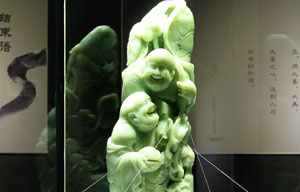
Over the last 25 years, Yang and Chang have spent all their efforts learning, experimenting and creating glass art works, which are richly imbued with a traditional Chinese artistic vocabulary and human philosophy.
In 1996, they visited Dunhuang Mogao Grottoes in Gansu province. While impressed by the beauty of the colorful murals they also found out many of the murals are gradually deteriorating. It prompted Yang to create murals using liuli.
For five months in 1999, Yang and her team worked day and night to sculpt the Guanyin of Thousand Arms and Eyes in Dunhuang's third grotto. In May 2000, a 160-cm liuli Guanyin made its debut in Dunhuang. She also created a 4.4-meter-tall Guanyin to exhibit in Taiwan, Singapore and Shanghai.
"Every great craft has its rise and fall. The brilliant light of liuli has shone through thousands of years of Chinese history," Chang says. "Perhaps we can do more than revive an art. We can also maintain a cultural spirit by learning to respect the tradition. Through liuli sculpture, we tell Chinese stories and convey the message of the significance of inheriting the past and passing the emotion on to future generations."
Related:
Your favorite qualities in a man? Yang: Kindness, tolerance. Your favorite qualities in a woman? Chang: Patience. More...
I've been their friend for some 20 years since they gave first exhibition in Shanghai. Why so long? It is because of their passion and commitment to inherit and promote Chinese cultural legacy. More...

Copyright 1995 - 2010 . All rights reserved. The content (including but not limited to text, photo, multimedia information, etc) published in this site belongs to China Daily Information Co (CDIC). Without written authorization from CDIC, such content shall not be republished or used in any form. Note: Browsers with 1024*768 or higher resolution are suggested for this site.
License for publishing multimedia online 0108263 Registration Number: 20100000002731