Comments
  Print
Print  Mail
Mail  Large Medium Small
 |
|
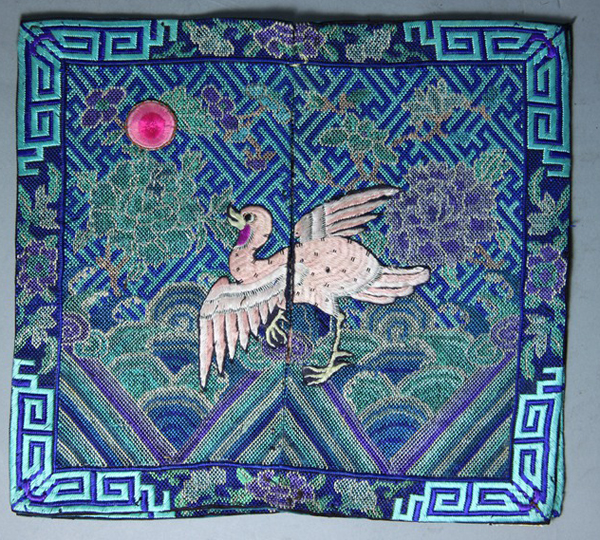
A square patch with a partridge for eighth-rank officials. Provided to China Daily |
Clothing has always been the first thing to change following with the birth of a new Chinese dynasty, says Fang Hongjun, who has studied Qing Dynasty (1644-1911) clothing for 24 years at Palace Museum.
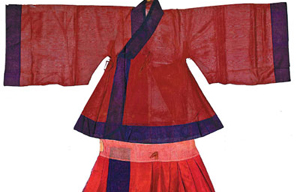
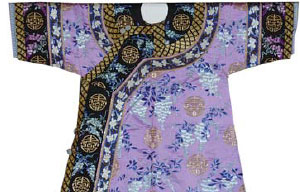
The Qing Dynasty's takeover from the Ming Dynasty (1368-1644) initially replaced the Ming-era's loose and flowing robes with saddle-shaped collars and U-shaped sleeves with semicircular cuffs. The Qing rulers were ethnic Manchu, whose soldiers spent their lives riding horses and hunting, Fang explains at an ongoing Ming and Qing clothing exhibition held at the Shandong Provincial Museum. So this clothing style suited the ruling culture's lifestyle, Fang says.
"The saddle-shaped collar protected their faces and is the prototype of the stand-up collar of the cheongsam (qipao)," Fang says.
"The Qing robes' high cuts developed into the cheongsam's signature style in the 1920s."
But some Ming elements survived into the new era and re-emerged more prominently as the Qing Dynasty went on.
"As the Qing Dynasty became established, women no longer needed protective clothing," Fang says.
"So, they started wearing loose and comfortable dresses during casual occasions. This was also a result of cultural integration."
One element that was passed from the Ming to the Qing was patches on robes. While the patches are said to have originated under Tang Dynasty (AD 618-907) Empress Wuzetian, it was during the Ming and Qing that it was formalized to indicate rank.
Ming Emperor Zhu Yuanzhang (1328-98) decreed in 1391 that officials' garments should be loose gowns with round collars, and square patches were sewn on both the fronts and backs. Civil servants' patches were designed with twin flying birds, while military officers' featured a single animal.
"Qing rulers added new patches," Fang says.
Qing emperors, for instance, developed round patches, that only they could wear, while officials' patches were square.
"We can decode the rigid ranking systems of the two dynasties by the designs of the patches - for instance, by looking at what animals are shown and how many adorn the patches," Fang says.
"Clothing bears cultural information."
This remains true today, Fang believes.
"Our descendants will glean information about our lives from the shirts we wear," Fang says.
|
|
|
| Dressed like nobility |

Copyright 1995 - 2010 . All rights reserved. The content (including but not limited to text, photo, multimedia information, etc) published in this site belongs to China Daily Information Co (CDIC). Without written authorization from CDIC, such content shall not be republished or used in any form. Note: Browsers with 1024*768 or higher resolution are suggested for this site.
License for publishing multimedia online 0108263 Registration Number: 20100000002731