Visit thy parents - it's the law
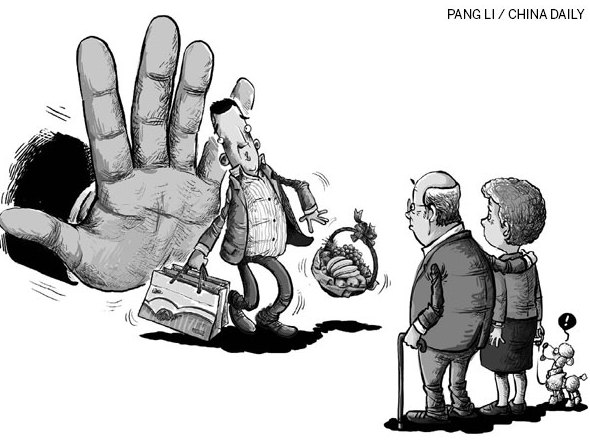
Courts may not be able to melt the heart and make people love their parents, but in China they can force them to fulfill their filial duties.
When law gets into the realm of ethics, it can have unexpected effects - some darkly comical and others downright sad.
On July 1, a woman surnamed Ma was ordered by a court in Wuxi, Jiangsu province, to pay at least one visit to her ageing mother every two months - this on top of at least two visits for all the national holidays including the Dragon Boat, Chongyang and Mid-Autumn festivals.
Ma had previously lived with her mother, but they had fallen out and the elder woman had moved out. The daughter had not seen her mother since and the 77-year-old sued her for filial negligence.
There is a pop song titled Go Home Often, popularized by the omnipotent New Year's Eve gala in 1999. It touched a raw nerve in a nation where hundreds of millions work away from home. Home could refer to a spouse and child, from which tens of millions of migrant workers are separated for long stretches of time; or it could refer to parents. In the latter case, an even larger number of the population, including the middle class, leave their hometowns and go to faraway places to seek better lives.
Of course, you can bring your parents to live with you in your new city if you are fully established, with adequate housing and all. But lots of people are stuck in the middle, with no possibility of having their parents move in nor the financial wherewithal to fly home for quick visits over the weekend. For many of them, "go home often" means joining the largest annual human migration during the Lunar New Year holiday.
For several years, the song title has been used to represent a new bill in deliberation - a bill that requires grown children to visit their parents. On July 1, 2013, it was amended into law, and the Wuxi case was the first to base a verdict on it.
I guess television reporters are going to cover the first visit by Ma, the daughter, who is now legally obligated to call on her mother. How will she go about it? Will she bring her husband and their child and cram their car with gifts, as children usually do on a home visit? Will she wear a grimace to show her displeasure or will she feign a smile for reconciliation? And how will her mother react? Will she open her arms and hug her daughter?
In any scenario, the outcome will most likely be awkward. In Chinese culture, all traces of love have been squeezed clean by the time two sides in a dispute face each other in court. It has reached beyond the point of reconciliation. The most civilized way for future meetings is to pretend they do not know each other.
In olden times, Chinese families were more like clans, with as many as four generations living under one roof. Dominated by the patriarch, the younger generations had little say in big decisions, such as marriages and careers. This resulted in tragedies, as depicted in many a novel produced in the 1930s. Societal change, more than revolutionary ideologies, has splintered the family as a unit. It has become much smaller, usually a pair of spouses and one child. This puts into sharp focus the urgency of caring for the nation's 200 million elderly, a figure forecast for 2013 using 60 and older as a benchmark.
For more X-Ray, click here