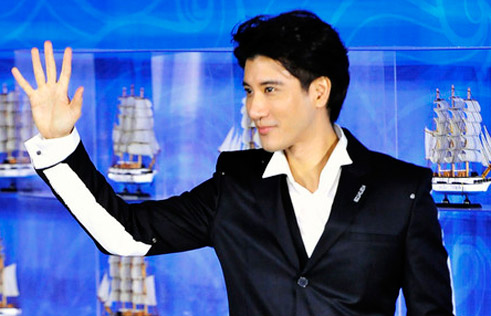
On June 14, 2013, two Chinese superstar musicians staged a little duel — not a duet, but a kind of mock musical duel. Lang Lang and Jay Chou invited three members of the audience at Tsinghua University to each strike a random note on the piano. They then fleshed the notes out into a complete piece. Jay Chou was to go first, and he turned the three notes into something similar to one of his pop songs. When the hapless fans again picked notes, two of them struck keys very close to each other, and Lang, facing away from them, jokingly pleaded: "Please give me some range." He made do with their choice of notes but expanded to cover much of the whole keyboard, finishing with a flourish.
This match of improvisation was, of course, all in good fun, part of a gala nicknamed "Lang Lang and His Friends", to celebrate youthful dreams and, coincidentally, Lang's 31st birthday.
 |
|
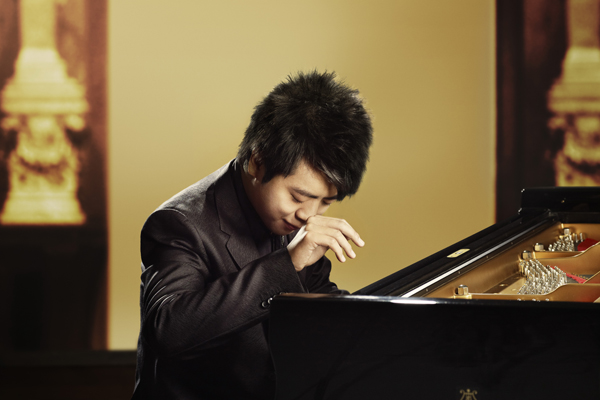
Lang Lang is firmly established as one of the world’s top piano masters. |
Lang and Chou hail from different ends of the musical spectrum, but they share some common roots: Chou started by setting his eyes on becoming a concert pianist, but in the middle of the road "took a swerve" into the pop realm. Lang chimed in, saying he actually desired for this kind of "swerve".
Lang Lang has never shown any serious interest in crossing over to pop music. He has gained an enormous worldwide audience by appearing in high-profile shows ranging from the Opening Ceremony of the Beijing Olympics to the BBC Proms in London. Despite the occasional prerequisite pop tune or patriotic song, he hews pretty closely to the classical canon. This has earned him a lot of respect because his rock star-like stature is built on a solid core base of professional achievements.
However, Lang is open to opportunities that put him on the same stage with pop sensations like Jay Chou or jazz veterans like Herbie Hancock. He is generous to his colleagues and heaps praise on Chou for "his well-rounded talents that include songwriting" and on jazz pianists for their great skills of improvisation.
Lang Lang is at the top of the world — not just the world of classical music, but a wider world where his impact is felt, such as music education. He has received numerous awards, performed with many of the world's top orchestras and appeared in special functions with world leaders and state dignitaries that testify to his stature more clearly in the eyes of those who cannot tell Chopin from a show tune.
Lang has had his share of detractors, though. He has been criticized as "immature" or "lacking sensitivity". But he remains unfazed. "I seek a challenging style," he explains, "the Russian school, with Gary Graffman as my teacher. It's a physically demanding style. When I first started, I played a lot of Tchaikovsky piano concerto No 1 and Rachmaninov piano concerto No 3, fit for a teenager and the audiences loved it."
But Lang understands that he has to expand his repertoire. "You should not lose yourself, but keep growing and never be stagnant." When he switched to a heavily Austro-German repertoire, he changed many minds. A lot of his early critics were won over and morphed into fans.
Lang recounted an incident in 2007 when the top 10 classical music critics in France were gathered to listen to seven different recordings of Beethoven's piano concerto No 1. They were not told which one was by which world-renowned pianist. When they realized they had collectively selected Lang Lang's version, conducted by Christoph Eschenbach, as the most idiomatic, they were taken aback by their own selection.
That changed a lot of opinions that Lang Lang was good only with Russian music. Strange to say, in unpretentious Germany, Lang was embraced most quickly. More music lovers realized that he is not only technically brilliant, but possesses great capability for subtlety and sensitivity.
"People tend to see Asian musicians as technique-oriented but lacking emotions," Lang says. "Now people have accepted me as the proponent of a new style, of an innovative approach fit for the 21st century."
Now that he is firmly established as one of the masters of his art form, he will not rest on his laurels. "Although my style will not change significantly, I'm always able to find room for improvement. With age comes more depth of emotion and a wider range of expressiveness."
That includes a better mastery of the essence of a piece as well as the whole structure. "The more I learn from travel and study and know about the historical background of a work and the customs of the place where it was born, the more I'll be able to get to its inner spirit. And that manifests itself more in the slow movements such as the andante and the largo, which tend to receive less attention when one is younger and bursting with energy," he adds.
"Technically, the way I'll play at 50 will not be too different from the way I play at 30. But the way I approach the music rationally will be somewhat different.
"When I listen to Horowitz's recordings made when he was 30, 40 or 70, there are subtle differences. And old masters like him always inspire me."
Likewise, Lang is inspiring a younger generation. He has a piano school in Shenzhen and knows first-hand his influence on others. "Many youngsters study the way I play and even imitate my body movements and facial expressions. I don't see anything wrong with that. Not many people can play like Vladimir Horowitz," which means, in a seemingly imperturbable way.
Lang feels that when the audience comes to his concert they want "the whole package", not just to shut their eyes and listen. "Unless you have reached an incredible height, it is useful to incorporate physical movements into your playing. A human being is not a machine."
He has been criticized for injecting unrealistic notions into children and their parents that learning the instrument may lead to a career like his. "It is a mistaken notion to think of young piano students as future professionals. Why herd everyone into this circle? There is nothing wrong with every kid learning to play the piano, but not every kid wants to be a professional pianist. It would be too utilitarian to push them onto that road," he says.
Lang takes it upon himself to raise the level of music appreciation, especially in China, where he spends roughly one sixth of his time. "We are in a new age and I'm lucky to come this far," he says. "Many of the performances I dreamed of have come true."
On a recent day he was listening to his new album of Sergei Prokofiev's piano concerto No 3 and Bela Bartok's piano concerto, which he recorded with the Berlin Philharmonic under the baton of Simon Rattle. It will be released later this year. Critics are expected to find new words to heap praise on it. But Lang is clear-headed: "In 10-20 years I may find ways to improve upon it. There is always room for improvement."
By that time, more of his countrymen will be able to find the beauty of the music he plays, and also more will join him on the international stage where he has blazed a trail.
And what a trail. On July 14, exactly one month after his gala with friends at China's Tsinghua University, Lang will become the first Chinese musician to grace the stage of an even bigger gala — the one in Paris celebrating Bastille Day.

|
|
|
|
|
|
|
|

Copyright 1995 - . All rights reserved. The content (including but not limited to text, photo, multimedia information, etc) published in this site belongs to China Daily Information Co (CDIC). Without written authorization from CDIC, such content shall not be republished or used in any form. Note: Browsers with 1024*768 or higher resolution are suggested for this site.
License for publishing multimedia online 0108263 Registration Number: 130349 





















 Raymond Zhou:
 Pauline D Loh:
 Hot Pot
 Eco China
 China Dream
 China Face