New hope for hair growth
Scientists have found a new way to grow hair, one that may lead to better treatments for baldness.
The technique has been tested only in mice, but it has managed to grow hairs on human skin grafted onto the animals. The research could lead to a treatment for hair loss that would be more effective than current remedies like drugs or hair transplants.
Methods now are not much help to women, but a treatment based on the new technique could be.
Currently, transplants move hair follicles from the back of the head to the front. The procedure can take eight hours, and leave a large scar on the back of the head. The new technique would remove a smaller patch of cells, culture them in the laboratory to increase their numbers, and inject them back into the person's head to fill in bald spots. The new approach would actually add hair.
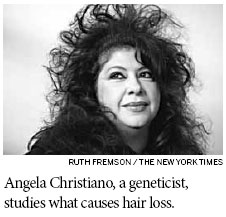
Angela Christiano, a hair geneticist and dermatology professor at Columbia University Medical Center in New York, who herself has had hair loss, who has become known for her creative approach to research, worked with researchers from Durham University in Britain. They focused on dermal papillae, cells at the base of hair follicles that give rise to the follicles. Researchers have known for more than 40 years that papilla cells from rodents could be transplanted and would lead to new hair growth. The cells from the papillae can reprogram the surrounding skin cells to form hair follicles.
But human papilla cells, grown in culture, mysteriously lose the ability to make follicles form. A breakthrough came when the researchers realized they might be growing the cells the wrong way. One of Dr. Christiano's partners from Durham University, Dr. Colin Jahoda, noticed that the rodent papilla cells formed clumps in culture, but the human cells did not. Maybe the clumps were important. So, instead of trying to grow the cells in a flat, one-cell layer on a petri dish, he turned to an older method called the "hanging drop culture." That method involves putting about 3,000 papilla cells - the number in a typical papilla - into a drop of culture medium on the lid of a dish, and flipping the lid over so that the drops are hanging upside down. "The droplets aren't so heavy that they drip off," Dr. Christiano said. "The force of gravity just takes the 3,000 cells and draws them into an aggregate at the bottom of the drop."

The technique made all the difference. The cells seem to need to touch one another in three dimensions rather than two to send and receive the signals they need to induce hair formation.
The success is just a first step, Dr. Christiano cautioned.
One avenue for further research will be to look at why molecular profiling found that only 22 percent of the genes were turned on.
"We were a little surprised by how few," Dr. Christiano said. "We thought more would be needed." Perhaps, Dr. Christiano said, if more genes could be turned on in the transplanted cells, more hairs, or better quality ones, might result.
Several companies are experimenting with papilla cells in people, Dr. Christiano said, but they use the cells to try to restore or rejuvenate existing papillae and follicles - not to make new ones. (She has no commercial interests or ties with any of the companies, she said.)
"Inducing a completely new hair is a different challenge," she said, adding that studies to try doing just that in people are not far off.
The New York Times