Who's being taken for a ride?
Everyone loves low, low prices, but as responsible citizens we should consider the cost of such a pricing policy. If you stretch affordability too thin, you'll run the hidden risk of hindering future investment or cannibalizing other social services.
There is subsidizing and there is excessive subsidizing. Once you are entrenched in the latter, you gain a sense of entitlement that will blind you to the big picture.
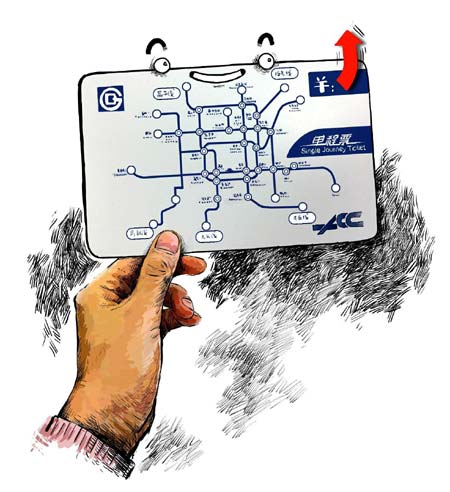
Beijing's metro system is considering raising its price from the current flat fee of 2 yuan ($0.33) a ride to a distance-based fare during the rush hours. This is certainly an unpopular move and I'm surprised only 60 percent of respondents to a survey voiced their objection. Theoretically, all Beijing subway riders would flash a "No" sign, but the remainder could well be non-subway users or people in other cities who are envious of Beijing's ultra-low fares.
 |
|
PANG LI/CHINA DAILY |
Beijing used to charge 3 yuan for a ride and add 2 more for some outlying lines. All this changed in the run up to the 2008 Olympics when bus fares were slashed by 60 percent and subway fares by at least a third. It was supposed to get people out of their cars and onto public transport.
It must have been quite successful because there is rarely an empty seat on a bus or a subway car, not even during off-peak hours. And some lines during the rush hours are so packed you won't forget it soon - if you are not a regular rider, that is.
It is preposterous to suggest that a higher fare will significantly thin rush-hour crowds. A majority of riders are commuters whose hours are determined by their employers. Maybe the retired, who are by nature price-conscious, will change their schedule, but it won't make a visible dent.
The 2007 reduction in fares was well intentioned but misguided. They were already very low, and reducing them further did not achieve the desired result of diverting car riders to the more environmentally friendly mode of traffic. What Beijing should have done at that time, with the installation of smart swiping sensors, was to introduce the distance-based fare, which is currently in use in almost every other Chinese city with metro lines.
Don't get me wrong. I'm not against subsidies for public transport. Unlike the taxi system, buses and subways have to be supported by municipal governments. Their prohibitive start-up cost means no profit-oriented entity would take them on as a regular business. Yet they benefit the majority of the residents, plus domestic and foreign visitors. The London mayor took a subway ride in Beijing and was amazed at how cheap the fare was.
Beijing currently spends 18 billion yuan a year on subsidizing public transport, most of it going to the metro system. With municipal coffers flush with tax money, this does not sound like much. But economies go through cycles. We're living in the boom times, and what if there is a dip in tax money down the road? You cannot adjust bus and subway fares as you can fuel prices, so you'll need some sustainable plan - even for subsidies.
Beijing's fare system is not only out of touch with the cost structure, but way below that of any other city I know of. From my experience, London probably has the most expensive fare, with a subway ride costing more than a Beijing taxi fare.
Two yuan in the current market is virtually negligible, especially for office workers who use it most heavily. I see it as a nominal charge.