Alone together
 |
| Pang Li / China Daily |
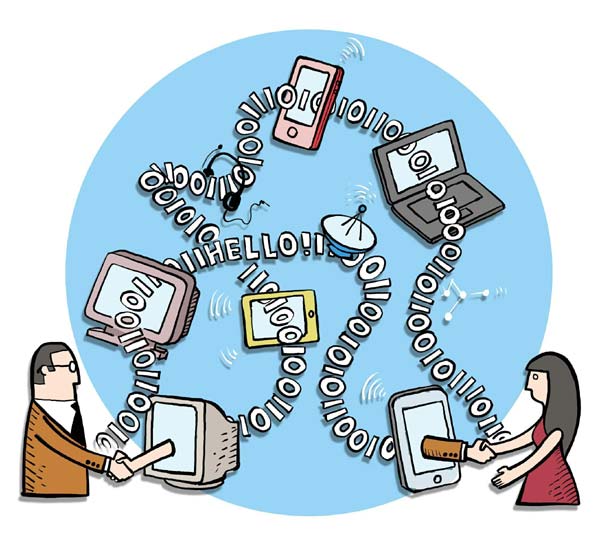
The paradox of having instant communication tools and constant connectivity lies in its subversive function of inserting distances between those near and dear.
|
 |
|
 |
|
 |
A band of friends is celebrating a reunion with a grand luncheon. The food is piled high on the lazy Susan and the room is properly heated.
Yet the warmth of the occasion can be detected only by the two or three engaged in casual chat. Most of the others are buried deep in their iPhones or iPads, only occasionally lifting their heads to acknowledge their presence. One of them would take a photo of a newly arrived dish as if to establish a link between her online activity and her taking part in the event.
This is a scene taken for granted across China, especially among the young. It captures the irony of modern technology and its impact on human interaction. To be blunt, the ability to be always connected with the rest of the world has brought closer those who inhabit disparate spaces, but it has driven apart those who are physically together.
I'm not sure Steve Jobs envisioned this when he conceived these super-smart gadgets. But they are conversation killers. By that I mean face-to-face conversations, not virtual ones.
Of course it would be unfair to put all the blame on one person, dead or alive. All those apps are simply irresistible, and then there is weibo and WeChat. It's no exaggeration that many cannot live without them. Data shows China has 281 million users of micro-blogging services and Tencent's WeChat has surpassed them with some 500 million users.
It is difficult nowadays to go into hiding. Perhaps it's less fashionable to be a recluse than to be a live broadcaster of one's whereabouts, complete with photos and maps.
The addiction to new technologies did not start with this wave. When television first became widely available in China in the late 1970s, I remember a college classmate would watch anything on air - at a time when there was little worth watching. If he skipped an hour of TV he felt he had been cheated out of one hour of his life.
When the Internet was a new thing, there was a joke that people would get up at midnight and press the refresh button to check if any new mail had arrived. Even junk mail could be a sight of comfort.
But that was before you could put the Internet connection in your pocket and turn yourself into a round-the-clock tower of live transmission.
Now, I'm no Luddite. I love progress in science and technology. There are so many things I can do that I could not possibly have done in the days of snail mail. I'll tell you about the very first long-distance phone call I made in my life. It was in 1986 and I placed the call in a Beijing office early in the morning. By the time the operator congratulated me for getting through, which was in the late afternoon, I had forgotten about the call.
However, too much of a good thing can be a bad thing. With constant connectivity, some people have developed an urge to talk to all the people all the time, or it so seems. The sense of empowerment from this newly acquired capability is so high that some may have become delusional.
I know of people who own several widgets and have them tuned to news sites simultaneously. They could be mistaken for news editors, but they are not. They are just news junkies who feel they have to know everything happening in the world - and as soon as the news comes out. They may have regular jobs that have nothing to do with the news. Judging from their torrent of comments and retweets, I would weep for their employers.