Master of safety checks
 |
|
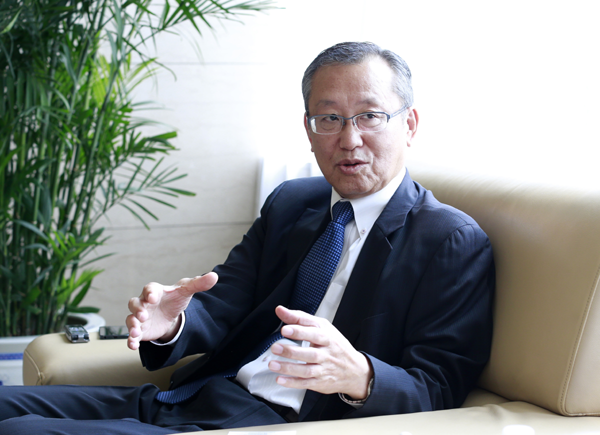
Hiroshi Sano, Japanese technical adviser with Sinopec. [Photo by Feng Yongbin/China Daily] |
Friendship Award
Thanks to such achievements, Sano won the Chinese government's Friendship Award, the top honor for foreigners contributing significantly to China's development, in 2014. But Sano's friendship with China stretches back 30 years. Of the 42 years he worked for Idemitsu, he spent about 30 facilitating exchange of personnel with Chinese colleagues.
In 1981, State-owned oil companies started sending their employees to Japan to learn technical and management skills. And Sano's relationship with Sinopec Maoming began in 1995, when the company established an exchange program with Idemitsu. He led some 30 delegations from Japan to Sinopec Maoming and Sinopec Zhenhai Refining and Chemical Company, and received more than 400 visitors from the Chinese companies before retiring from Idemitsu.
"China has undergone such big changes since I first came here," he says. He first came to China in September 1984 to learn Mandarin at Shandong University for nearly one year.
"Chinese is such a difficult language. You can't master it in one year," he says. But the university stint helped him better understand Chinese people and culture.
Born in 1947, Sano graduated from Hiroshima University in 1970. The university was established in 1949 with the motto "pursuit of peace" and "collaboration with the local, regional and international community" as its guiding principles.
Sano has seen the transformation of China's petrochemical industry, too. Before the reform and opening-up, China relied on its own crude oil, which is low in sulfur. When the country's need for energy grew, China began to import oil in huge volumes from the Middle East.
Middle East oil, says Sano, is mostly "sour" crude, which, if not treated properly, could endanger production safety and the environment. Hence, the importance of high-quality refining.
As China's economy grew more rapidly in the 1990s, it began promulgating stricter rules and regulations to reduce the damage to the environment. It started increasing the capacity of its oil refineries and adjusting the structure of their equipment. Small capacity facilities have given way to big and more advanced sets of equipment, boosting production efficiency. And today, Sinopec Zhenhai boasts of world-level refining capacity, which means the concept of large-scale, high-efficiency production has been well received in China, something Sano admires.
He says technical exchanges in production safety between countries to prevent disasters and protect the environment are important, because such "pragmatic exchanges ... help build a good foundation for bilateral ties". This is the reason why China-Japan economic ties have continued to grow despite political ties going through ups and downs, Sano says.
Life in China
Living in China has been fairly easy for Sano. Having visited the country for three decades he has made quite a few Chinese friends. He says he finds many similarities between the two countries' cultures because the Japanese culture was built on the foundations of Chinese culture, though it absorbed European and American elements later.
He said that because China is so big, people in the north and south have different physical features and social customs. Food is different too. He likes Shanghainese and Cantonese food the most.
"But you will be wrong if you think food in Maoming is typical Cantonese, simply because it is located in Guangdong", he says. He explains that food in the area is of northeastern style because most employees came from Northeast China's Daqing Oilfield when the Maoming Petrochemical was founded in the 1950s. "You can see how a big company's history has influenced the local culture," he adds.
Sano enjoys swimming and walking to keep fit. He works on weekends too, preparing teaching materials and reports. "Working overtime is part of the corporate culture of Idemitsu", he says, adding with a broad smile. "Besides, I've got nothing better to do in China on my weekends."
He lives alone in China. His wife, Yoshie, has taken up social work in Japan after retirement. She works with an organization to help families with newborns and provide young parents with medical aid and consultation.
In fact, the couple talk more than they did when he was living in Japan.
Thanks to modern communication tools, "we chat even more often than we did back in Japan, and our topics are varied and discussions deeper", says Yoshie, sitting beside Sano during the interview in Beijing. Sano agrees with a chuckle.
Sano calls his wife at 6 am every day through Skype and chats with her for at least half an hour. "It was such a happy surprise when he told me of the China Friendship Award," Yoshie says.
"Later on I realized he had gone through a very competitive selection process." She attended the award ceremony with her husband and met Premier Li Keqiang on Sept 30 last year.
Sano later had Chinese reports translated into Japanese for their children to share the news. "The award has elevated his status at home," his wife says in a light vein.