How Taoist ideas brought a Syrian scholar to Beijing
 |
|
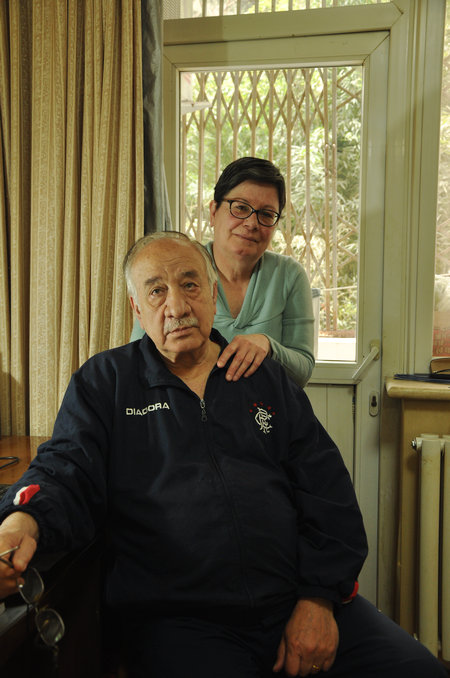
Syrian scholar Firas Sawah and his wife, Wafa, at their home at Beijing Foreign Studies University. [Photo by Liu Xiangrui/China Daily] |
Beijing-based Syrian scholar Firas Sawah cites Tao Te Ching when asked about his romance with China. The book not only brought him here but has also played an important role in his daily life.
Born in Homs, Sawah has been teaching at the department of Arab studies at Beijing Foreign Studies University for the past few years.
As Sawah recalls, he developed an interest in East Asian culture and philosophy in his youth. He read a book in college on Chinese philosophy, which is titled China Wisdom.
He found Taoist ideas especially interesting when he read on. He wanted to introduce Taoism to Arabic readers and eventually translated Tao Te Ching, the famous Taoist book attributed to Lao Zi, a scholar who may have lived in the 6th century.
"I did it (the translation) with love," says the 72-year-old.
In his eyes, the text has wise guidance for both social management and personal life.
"I have read about religious ideas since the Stone Age. But when I came across Tao Te Ching, I thought to myself this is the solution to social problems nowadays. The text is very short and each time I read it, I discover something new."
The book was not only well received by readers in Syria, but also caught the attention of Chinese scholar Xue Qingguo when he traveled to Damascus in 2009 and came across Sawah's translation at a bookstore.
Xue, who also teaches at the department of Arab studies at the same university in Beijing, says he read different Arabic translations of Tao Te Ching earlier but liked Sawah's version best.
"Besides the translation, he has added a long preface and illustrations, which shows his deep understanding of both Tao Te Ching and the Arab world. The book is valuable for scholars."
Xue, who was in charge of the Arabic part of a cultural project named Library of Chinese Classics, was looking for help from established Arab scholars back then.
He was then able to find Sawah with the help of a Syrian publishing house and discussed with him the possibilities of future cooperation.
Xue later invited him to China for symposiums and lectures on topics, including comparing Tao Te Ching to thoughts in the Middle East.
In 2012, when Xue learned of the Syrian conflict, he wrote an email to tell him that a vacancy was available in his department and asked if he would be willing to come to China where he could have a peaceful environment to focus on teaching and research.
Sawah accepted the invitation gladly and has taught both undergraduates and graduates at the university since.
"He's a respected scholar in the Arab world. He maintains high standards of research and teaching," Xue says.
Xue and Sawah have co-authored a Chinese-Arabic book named Lao Zi to introduce Lao Zi and his ideas to Arabic readers. It was published by a Beijing publisher.
In the past couple of years, the two have been working on more books to introduce Chinese culture and philosophy to the Arab world.
Sawah says he became interested in writing when he was young.
He studied economics in college following his father's wish and worked in several organizations before he began to focus on writing and academic research.
Between 1976 and 2016, he published 23 books on topics including mythology and history of religions in the Arab world.
Sawah has been a member of the Syrian Writers' Association and a member of the General Association of Arab Writers and Authors.
He was recognized for his efforts in the fields of history and theology by organizations, including the Syrian Historic Association.
He studied economics for a livelihood, but philosophy and writing have been his lifelong passion, he says.
Although Beijing is very different as compared to Homs, Sawah finds his life rather easy here.
His wife, Wafa, has been teaching composition and reading in Arabic at Beijing Foreign Studies University since 2013.