 |
|
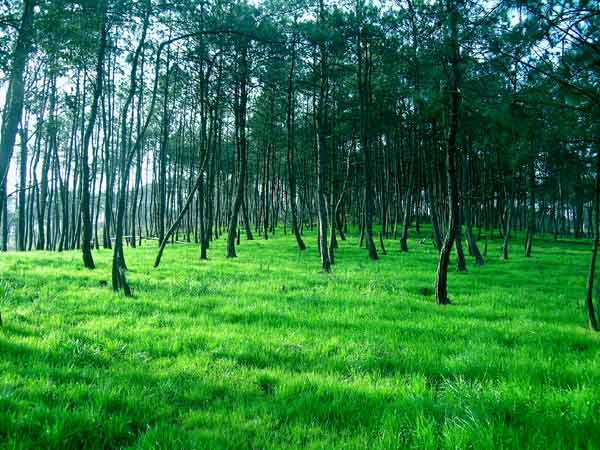
The Dushan farm proves that a barren wasteland can be transformed into forests and pasture. |
Qinglong County Grassland Center, a grazing pasture in southwestern Guizhou, is one of the most successful examples of how Dushan's pasture technologies influenced the surrounding areas. The Qinglong farm is now breeding a hybrid of local and foreign sheep, which has proved feasible to foster the local economy and sustain the environment.
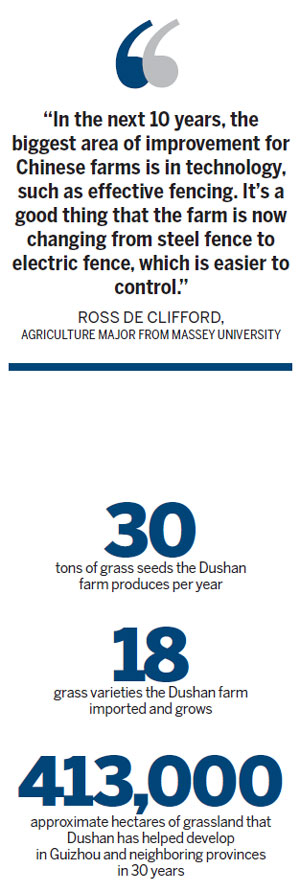
Apart from seeds, the farm is also promoting pasture technologies like the 24-hour pasture model, the making of silage and the processing of grass seeds.
However, when Zhang first came to the farm as a technician, he didn't foresee any of this.
"This whole area was abandoned and covered with rocks and weeds. The trees were no taller than 4 meters," he recalls, looking out of his office window that is now surrounded by towering trees and forage grasses.
It was 1983. The farm had just been set up by the New Zealand and Chinese governments as a joint project to demonstrate New Zealand agronomy to local farmers.
The transformation was far from easy. "For the first few years, we worked from 6 am to 9 pm," Zhang says.
Zhang, with 15 technicians, used all kinds of means that were available, including bulldozer, plow and explosion to transform the steep landscape into one that pasture could survive on. The process lasted for four years from 1983 to 1986.
Another issue is the poor soil fertility. As a local saying goes: for one year's toil, you get one meal. There was no potash on the soil. Plus, the soil pH in Dushan was 4.2, too acidic to grow ryegrass or white clover. A large amount of lime was used to raise the soil pH for the herbages.
From 1984, the farm imported more than 40 kinds of grasses from New Zealand and Australia. By trying them out on paddocks one by one, they selected 18 varieties according to their yields and growth cycles. These include ryegrass, red clover and white clover.
Compared to New Zealand, Guizhou has a dry and hot summer. And the grasses will stop growing once the temperature is over 25 C. To adapt to the climate in Guizhou, the farms mostly develop grasses in cool seasons.
In 1988, the farm also began to import dairy cattle from New Zealand as a way to increase productivity.
The pasture is divided into feeding spaces by fences, depending on the capacity of the animals fed in the area. The animals rotate on the paddocks according to the growth of the grass.
This feeding model from New Zealand allows the cattle to feed on the pastures, and their wastes to nurture the grassland, at the same time, Zhang says.
"Now the soil can produce crops just as well as the normal soil," he says.
In the early days, kiwi plant scientist Phil Rolston and Mid-Canterbury farmer Graham Lill came to Guizhou to teach the Chinese technicians how to grow grass. They were later joined by farm consultant Tim Harvey and farm manager Martin Chesterfield.
Every year, Chinese technicians in Dushan farm are sent to the Massey University in New Zealand to learn farming.
Related: Time line
For more Eco China, here
|
|
|
|
|
|
|
|

Copyright 1995 - . All rights reserved. The content (including but not limited to text, photo, multimedia information, etc) published in this site belongs to China Daily Information Co (CDIC). Without written authorization from CDIC, such content shall not be republished or used in any form. Note: Browsers with 1024*768 or higher resolution are suggested for this site.
License for publishing multimedia online 0108263 Registration Number: 130349 
























 Raymond Zhou:
 Pauline D Loh:
 Hot Pot
 Eco China
 China Dream
 China Face