

From forestry worker to wildlife protector
 Mail
Mail Print
Print Larger
The scientific research and monitoring center of the Hunchun National Siberian Tiger Nature Reserve is located about 550 kilometers southeast of Changchun, capital of Jilin province, near the China-Russia border.
The center's director, Lang Jianmin, is also a big cat expert at the Feline Research Center of the State Forestry Administration. However, 16 years ago he was a forestry worker at the Hunchun reserve with no background in animal protection.
His conversion from forest worker to forest protector occurred in 2002, when he discovered a tiger that had been severely wounded by poachers. For seven days, he watched as the animal died slowly of kidney failure.
"It's excruciating to see a life gradually fade away and know you can do nothing about it," the 49-year-old conservationist said. "I felt bad. Something needed to be done."
Russia granted Siberian tigers full protection in the 1940s when the species was on the brink of extinction, but China's efforts only began in the early 2000s.
For Chinese conservationists, learning from their northern neighbor is a shortcut to experience.
Lang decided to study Russian, and a group of experts taught him the basics of animal protection. In 2006, he spent six months at the Far Eastern Federal University in Vladivostok, Russia, improving his language skills.
"Without a strong background in the language, it would be hard to work on cross-border protection projects and make progress," he said.
In recent years, Lang has spent about 30 percent of his time in the deep mountains patrolling forests, clearing traps and conducting investigations.
The Hunchun forestry bureau oversees about 400,000 hectares, and of those about 300,000 provide habitats for Siberian tigers.
"When walking in the mountains, you constantly find problems and gain new knowledge," Lang said. "Much of my expertise derives from doing the same things repeatedly."
He shadows the tigers to observe their daily activities. Over the years, his knowledge has grown from identifying their footprints, size and gender to assessing their physical condition from the way they walk.
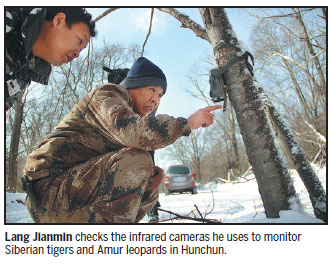
In 2011, Hunchun was one of the first protection zones to install infrared cameras to monitor tigers and Amur leopards.
Lang's team is at the forefront of the battle, but it has only managed to install 200 cameras in about 90,000 hectares. About 100 of them have captured images of tigers and leopards. Since 2012, Lang has photographed about 24 tigers and 16 leopards.
Xue Yangang has worked with Lang for eight years.
"He is strict and requires us to do solid work," the 53-year-old said.
"We always joke around in the mountain, but if I make a mistake, he criticizes me without hesitation."
To improve awareness of wildlife protection, Lang visits local people regularly and raises funds to ease their financial burdens.
"He invested in my beekeeping business. In return, I stopped hunting and now work part-time as a ranger," said Chen Limin, 51, a former hunter who now earns about 130,000 yuan ($19,500) a year.
Chen has known Lang for nearly 20 years: "We spend a lot of time together, drinking and chatting. He respects me and treats me like a brother."
Their efforts have resulted in significant improvements in the environment for wild animals.
According to Lang, when the reserve was founded, his team cleared about 2,000 to 3,000 snares every year. In recent years, the number has fallen to just 300 to 500.
Trekkers in the mountains face a constant threat from wild animals. "You never know what you will meet," Xue said.
In August 2014, when Xue and Lang entered the territory of a Siberian tiger to set up cameras, they noticed the animal walking parallel with them a few meters away.
"It stopped when we stopped, and walked when we walked," Xue recalled.
Despite the tiger's presence, they decided to set up the cameras at the designated spot. Luckily, the tiger didn't attack, and the team got a clear image of it the same night.
Lang has had five close encounters with tigers. He said each meeting was fascinating rather than frightening. Last year, when he whistled at a tiger, it walked out of a bush and simply stared at him.
"The tigers are both curious and vigilant about humans walking upright," he said. "They won't harm you as long as you don't make provocative moves that make them feel threatened."