|
|
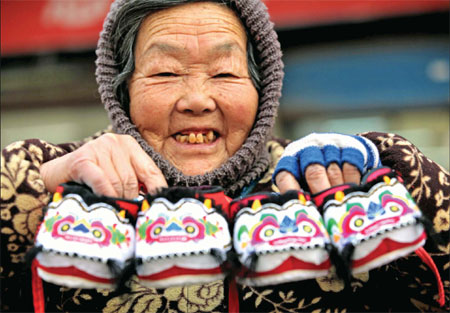
Pictures online of an elderly woman selling tiger-head shoes in Hebei province set off a recent craze for them. The woman shown here is selling the shoes in Bozhou, Anhui province. Liu Qinli / for China Daily
|
Tiger-head shoes hold important cultural significance and stir strong emotions among many Chinese
You don't have to go too far anywhere in China these days to find a shop that sells modern children's clothes, but many young mothers fondly recall and hanker after an item their grandmothers once made for them - tiger-head shoes. These traditional hand-made baby shoes are practical, historical and hold great significance in Chinese culture.
They are also a popular item among tourists, because of their elaborate design.
"Last year I took part in an interesting activity at the China Culture Center in Beijing," says Cathy Gilpin, an American tourist. "The organizers introduced these lovely shoes and taught us to make them."
The toes give the shoes the look of a tiger's head, which is why they are called hutou, she says. "The artisan told me they are both practical and ornamental in function, and at the same time a mascot."
The shoes get their name because they are designed to look like a tiger's head. In ancient China, the tiger was regarded as the king of beasts, one that could ward off bad luck and protect children.
According to Chen Jianguo, a scholar from the Chinese Folk, Literature and Art Society, says: "In fact, tiger-head shoes represent exorcism, but their origins are unknown. It has been a traditional good luck symbol for babies in China, and people thought that it could allow children to grow up to be big and strong."
Images of tigers were often pasted on doorways to ward off evil spirits in ancient China and it is still customary in some rural areas to use tiger images around children - in their room or on their clothes - in order to protect them from evil.
"The tiger is the third of 12 animal symbols in the Chinese Zodiac," Chen says. "Lauded as the king of beasts, the tiger's power and dignity command the respect of humans and animals alike throughout Chinese history."
The appeal of tiger-head shoes is in their colorful design. According to Li Guifen, a craftsman who has been making tiger-head shoes for more than 60 years says: "To make tiger-head shoes requires sophistication, especially the tiger's head, which requires exquisite Chinese embroidery, jacquard fabric and other needlework."
Tiger-head shoes come in a wide variety of colors, red and yellow among them.
The eyes, nose and mouth are given broad, exaggerated outlines, giving them a distinct human air that has a cute touch.
The shoes also have whiskers that flutter in the wind, bringing the tiger to life.
"Nowadays many mothers like to buy their children's shoes from a shop and most think that tiger-head shoes are outdated, but they don't know that tiger-head shoes have great practical value," Li says.
"Due to its spacious interior and wide soles, it is suitable for a one-year-old child to wear. At this age children are eager to walk, but still need help from an adult."
They are good for walking in, have room for growth, are warm and also let in air and absorb perspiration, Li adds.
Tiger-head shoes enjoyed a surge in popularity recently when a man posted photographs online of an 81-year-old woman selling the shoes on the street, on a cold winter day in Baoding, Hebei province.
The picture prompted hundreds of other people to seek out the woman so they could buy her tiger-head shoes.
That in turn prompted others to learn the craft both because they liked the look of the shoes and because they do not want the tradition to die out.
During the recent Spring Festival, tiger-head shoes would have enjoyed another rise in interest as a popular gift on sale at the country's many temple fairs.
yinyin@chinadaily.com.cn
(China Daily 02/22/2013 page18)
|