
Cheers, hopes as Chinese pharmacologist wins landmark Nobel prize
Source: Xinhua
Updated: 2015-10-06


BEIJING, Oct. 5 (Xinhua) -- The landmark success of herbal expert Tu Youyou, the first Chinese woman national to win a Nobel prize in science, has ignited an intense sense of national pride and elevated hopes on the future of traditional Chinese medicine (TCM).
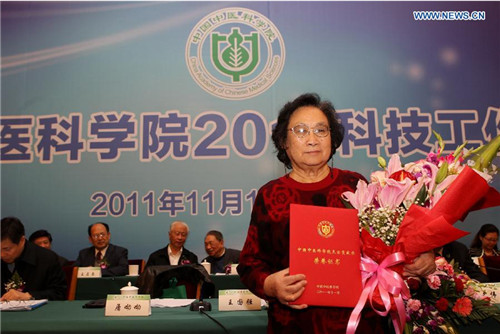
Tu, born in 1930, shared the 2015 Nobel Prize for Physiology or Medicine with Irish-born William Campbell and Japan's Satoshi Omura for her discoveries concerning a novel therapy against malaria, the Nobel Assembly at Sweden's Karolinska Institute announced Monday.
The pharmacologist discovered Artemisinin, a drug that has significantly reduced the mortality rates for patients suffering from malaria.
"Artemisinin is a gift for the world people from the traditional Chinese medicine. It is of great significance for curing malaria and other infectious diseases and for protecting the health of the world people," Tu said in Beijing Monday evening, when officials from authorities concerned paid a visit to her to extend congratulations.
"The discovery of Artemisinin is a successful example of collective research on traditional Chinese medicine. The prize winning is an honor for China's science cause and traditional Chinese medicine in their course of reaching out to the world," she said.
"Tu's winning the prize signifies China's prosperity and progress in scientific and technological field, marks a great contribution of traditional Chinese medicine to the cause of human health, and showcases China's growing strengths and rising international standing," Premier Li Keqiang said in a congratulatory letter Monday evening.
Li praised Chinese scientists, including medical researchers, for their long-term, dedicated work and numerous achievements.
He also encouraged them to implement the national strategy of an innovation-driven economy, and to seek greater progress in the most advanced scientific and technological projects.
Tu was visited Monday evening by officials with the China Association for Science and Technology and the State Administration of Traditional Chinese Medicine, entrusted by Vice Premier Liu Yandong.
The All-China Women's Federation also sent a congratulatory letter to Tu Monday evening, hailing her as the pride of all Chinese women.
In 2011, Tu became the first scientist on the mainland to win America's respected Lasker Award for the anti-malaria therapy. Graduating from the Beijing Medical College (currently the Peking University Health Science Center) in 1955, she is chief researcher and tenured professor at the Beijing-based China Academy of Chinese Medical Sciences.
In an exclusive interview with Xinhua after the announcement, Juleen R. Zierath, chairman of the Nobel Committee for Physiology or Medicine, said that Tu's "inspiration from traditional Chinese medicine" was important.
"But what was really critical was that Tu Youyou identified the active agent in that plant extract," said Zierath, adding "there was a lot of modern chemistry, bio-chemistry attached to this to bring forward this new drug."
On China's Twitter-like Sina Weibo, the breaking news has been forwarded by at least tens of thousands of users and received numerous "thumb-ups."
"The drug saved many lives, especially in Africa. I began to know about it after I came here (Africa). It has little side effects and is not easy to develop resistance," said "Feitianfancao" who was identified as an employee with a trade company by the microblog service.
Netizen "Shengxiaxohuiyi" wrote, "Now I feel truly proud of being a medical student." "At this moment, I cried," wrote another.
Tu's achievement has propped up the public's confidence in the country's scientific development. "So many years we've waited, and finally we see it happen! Is it a signal of a fresh-new age?" user "Zhangguoxun001" said.
CONFIDENCE BOOSTED
China's TCM researchers have been buoyed and inspired by Tu's achievement.
Liu Qingquan, head of Beijing Hospital of Traditional Chinese Medicine, said a learning from Tu's success is that the development of TCM must be combined with science and technology, which could assist in TCM's innovation.
"If we cling to traditions and shun modern technology, all talks about TCM's development will be empty slogans," Liu said.
Professor Zhang Wanbin of Shanghai Jiaotong University and his research team have been dedicated to synthetic Artemisinin for many years. He said Tu gave them "huge hope and encouragement."
Zhang said currently Artemisinin is only extracted from plants, making it unstable in output and expensive. "Hope our work can significantly lower the price of the drugs."
Wang Jian, president of Anhui University of Traditional Chinese Medicine, called for Chinese to cherish the "medical treasure" of TCM. "It comes from the empirical experience as well as wisdom of the Chinese nation distilled over thousands of years."
Wang also expressed his hope that TCM can be promoted and innovated so as to make greater contributions to the health of people all over the world.
According to the Nobel Assembly at Sweden's Karolinska Institute, Tu won half of the prize while Campbell and Omura were jointly awarded the other half of the prize "for their discoveries concerning a novel therapy against infections caused by roundworm parasites."
The last time a Chinese national won a Nobel prize was in 2012, when Mo Yan got the literature award.


World Family Summit
The World Family Organization was founded in Europe in 1947 and headquartered in Paris.


Link: / World Health Organization / United Nations Population Fund / UNICEF in China
Copyright 2014 National Health and Family Planning Commission of the PRC All rights reserved
