 |
|
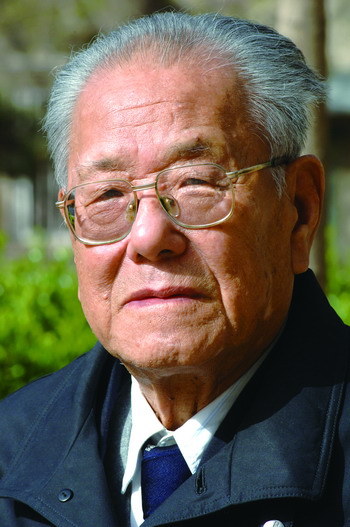
Guo Shoukang
|
Never could I have imagined such “difficulty” in getting an interview with Professor Guo Shoukang! The 85-year-old Guo has a tight and almost a full schedule this month. Earlier, he attended oral examinations on doctoral dissertations for several days and stayed awake nightly to correct doctoral dissertations. Next week, he will fly to South Korea to attend academic seminars and will return to lecture to international exchange scholars from the United States ... Nevertheless, Mr. Guo has managed to find precious time for the interview and share his life experiences and academic insights.
Mr. Guo, born in Tianjin in 1926, graduated from Peking University Law Department and Law Institute, and later studied at Columbia University, Georgetown University, the University Of California Los Angeles School Of Law, and the Max Planck Institute for Industrial Property (IP), Copyright and Competition Law. He is currently a professor at Renmin University of China Law School (IP Institute) and a PhD supervisor.
If we listed all the titles held by Mr. Guo, one sheet of paper would not be enough. In the field of IP, few people are ignorant of Mr. Guo’s name, and nobody can match his seniority, extensiveness and voluminousness in the teaching and research of IP law.
Mr. Guo is one of China’s first experts to touch upon IP. In the early 1970s, he became engaged in IP research. He is also the sole expert having participated in drafting the three important IP laws, Patent Law, Trademark Law and Copyright Law, and is widely acclaimed as one of the founders of IP legal system of new China.
A witness to the whole process of IP legislation
As a participant and witness to China’s IP legislation, Mr. Guo has a profound understanding of the process of China’s IP laws starting from scratch. He said: “according to my personal experience, when I graduated from Peking University Law Department 60 years ago, there were no IP courses at that time. We took dozens of legal courses, but there was no Patent Law, Trademark Law, or Copyright Law, and we even had never heard of the IP term. In terms of Patent Law, though we started to introduce the idea in the late Qing Dynasty and promulgated some regulations, these regulations were not seriously implemented. The Kuomintang government made a draft patent law at the end of the war against the Japanese invasion, but it remained as a draft and not officially approved. The law entered into force later in Taiwan after the Kuomintang government retreated to Taiwan. Therefore, it can be said that the Chinese Mainland did not have a formal and modern patent system before liberation. But we did have some provisions on Trademark Law, which was drafted by Englishman Hart, then general inspector of China's Imperial Maritime Custom Service. The reason for the drafting of the law was concern of protection of foreign trademarks in import and export trade. Therefore, the law was mainly applicable to foreign trade and had little effect on domestic trademarks. As for copyright law, we had several. In 1910, one year before the Xinhai Revolution, Copyright Law of Great Qing was promulgated. The law was a result of careful consideration but failed to be implemented eventually. Later, the warlord Beiyang Government re-promulgated Copyright Law, identical with the Copyright Law of Great Qing. In 1928, the Kuomintang government promulgated again Copyright Law. The law was still effective at the time of my schooling, but it did not have much influence. At that time we did not accede to international conventions and rights in this area were not implemented.”
“After the founding of New China, we had got some new regulations. In 1950 China promulgated Provisional Regulations on Protection of Inventions and Patents (“Regulations”) drafted by the Central Financial and Economic Commission under the Government Administration Council. After passage, the Regulations went slowly and only four patents were approved till the 1960s. ” Mr. Guo added, “There had been some pamphlet regulations at that time. But after the Great Leap Forward, the protection was also played down and there was an absence of protection in author's personal rights and property rights. Later on, due to the widely known reasons, the laws regarding patents were not promulgated. The situation persisted till the reform and opening-up.”