|

Fu Shuangjian (right), vice-minister of the State Administration for Industry and Commerce, talks about trademark management during an inspection of Silk Street, a popular market in Beijing. Provided to China Daily
|
Industry official notes that less than 20 percent of the nation's exports carry Chinese branding
The nation's first International Golden Trademark Awards are scheduled to be handed out next year in Chengdu as industry regulators continue to encourage homegrown products to move onto the world market.
Part of the China Trademark Festival, the awards will be presented in the name of the World Intellectual Property Organization (WIPO), Fu Shuangjian, vice-minister of the State Administration for Industry and Commerce (SAIC), told China Daily in an exclusive interview.
As the top national trademark administration, SAIC is in charge of designing the event, collecting entries and recommending candidates.
It will become the third ongoing national intellectual property awards presented by WIPO in China. Annual patent and biennial copyright awards are now presented in cooperation with the State Intellectual Property Office and National Copyright Administration.
"The honor will help winners promote their brands and increase competitiveness in international markets," Fu said.
Less than 20 percent of China's exports actually carry Chinese brand names. Most are outsourced work done for foreign brands - the most vulnerable to recent worldwide economic turmoil, he noted.
"So we need to improve exports and increase the proportion of proprietary brands," he said.
Fu added that registration is crucial to overseas trademark protection.
"Without registration, you may be able to sell or promote your brand, but if you encounter infringements, you will not have legal remedy in some countries."
To help domestic companies know more about the Madrid system of international trademark registration, the SAIC conducted training across the country over the past two years.
To date, Chinese applicants have registered some 11,000 trademarks abroad through the Madrid system, ranking China eighth globally.
But the international total is much higher, Fu said, because three times as many Chinese companies now file in separate countries rather than using the Madrid system.
Domestic filings through the Madrid registration system were clustered in garments, handbags, food, farm products, telecommunication equipment and auto parts in the first half of 2010.
Trademark applications from abroad centered around telecommunications and computers, garments and shoes, technological services, advertising, business management, makeup and machinery.
China continued to be biggest destination country for international trademark applications in 2010, according to WIPO statistics.
In addition to promoting use of the Madrid system, SAIC has also signed bilateral agreements on trademark cooperation with nearly 28 countries, regions and international organization.
This year, SAIC also increased exchanges with Africa's regional trademark organizations as increasing numbers of Chinese companies are doing business on the continent.
About 20 Chinese trademarks have been registered in Africa by local firms - which "shows the urgent need for cooperation with trademark organizations", Fu said.
Surging applications
In contrast to the handful of trailblazing efforts by Chinese companies building brands overseas, registrations at home are booming.
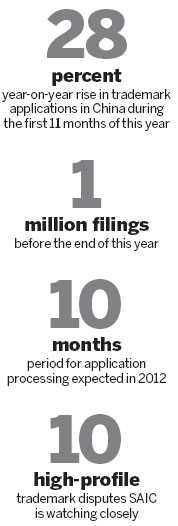
While other countries saw a drop in trademark registration, partly due to the global economic downturn, China received 958,000 filings in the first 11 months of this year, an increase of 28 percent over the same period of last year.
The figure surpassed 2009's full-year total of 830,500 and is expected to exceed 1 million by the end of this year, a new record high, Fu said.
Increased efficiency in administrative services is a contributing factor to the boom. By the end of November, more than 8 million trademark applications had been filed since the process began in 1978. Nearly 1.4 million were processed this year.
Fu said when he took his current post in 2008, the processing period was three years.
"Yet back then an average Chinese business lasted just 2.5 years," Fu said. He knows well because he was in charge of commerce and industry as vice-governor of Hebei, a neighboring province to Beijing.
The vice-minister has paid close attention to addressing the common concerns of both domestic and foreign companies, in part using high-tech means.
Following SAIC's inception of online registration services, 525,000 applications were filed online from January to November, about 55 percent of the total.
With the average processing period now reduced to a year, a tremendous backlog has been cleared. More than 5.5 million trademarks had been approved by the end of last month.
"Our goal is to further improve efficiency and shorten the period to 10 months by 2012, meeting the advanced international level," Fu said.
"Now our processing capacity is slightly bigger than the application volume," he said, so the pressure from backlogs has been cleared. "The challenge before us now is how to do better work."
Firm standing
The national intellectual property strategy speaks for itself to show the government's firm position on protection, Fu said.
In early November, the State Council mounted a nationwide campaign to fight counterfeits and privacy.
In response, SAIC placed a priority on infringements of foreign trademarks and well-known brands, Fu said.
Ten high-profile disputes are now being closely watched by SAIC. Three involve foreign companies and one is over a Taiwan trademark.
"We are also increasing supervision on printing businesses and will crack down on illegal printing and use of trademarks to check counterfeits at the source," he said.
The administration is also on the move to prevent "malicious registrations", particularly attempts to register famous brands and forestall registration by rightful owners, the vice-minister said.
Fu said SAIC has suggested changes in the Trademark Law draft under consideration by the State Council to deal with the problem.
Fu said trademark owners should themselves increase awareness and pay attention to monitoring to use remedy procedures and dispute malicious registrations in time.
"IPR protection is a common challenge worldwide," Fu said, who recalled he bought a T-shirt with a logo during his visit to the United States in 1995, only to find it was a fake.
"After I returned to China, my friends told me a spear on the T-shirt should aim downwards if it is a real one."
"With growing awareness by the government, companies and public, China's intellectual property environment is getting better and better."
China Daily

(China Daily 12/22/2010 page17)