|
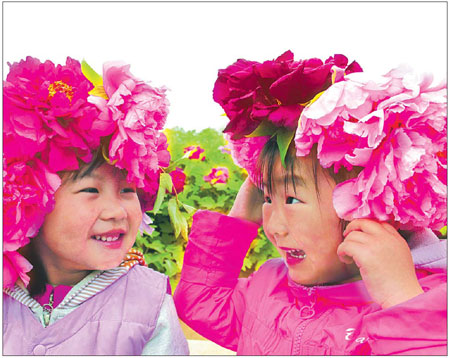
Two girls wear peony chaplets at Caozhou Peony Garden, Heze, Shandong province. Wang Qibo / for China Daily
|
Growers of nation's unofficial national flower are reaching out to Europe for help. Liu Lu reports.
During the glory days of the Tang Dynasty (AD 618-907), people were enthralled by the beauty and fragrance of the peony flower. "Only the peony is worthy of being called the 'Beauty of the Empire??a verse from a famous poem of the time proudly proclaimed. More than 1,000 years later, peonies are still adored in the Middle Kingdom and are grown for their large, fragrant blossoms.
It is known as fuguihua, or the flower of "riches and honor", and is regarded as China's unofficial national flower.
There are about 1,800 cultivated species of peony in the world and more than 1,000 come from China.
The Italians first introduced Chinese peony seeds to Europe some 1,200 years ago and European growers have developed some unique species by crossbreeding these imported varieties.
According to Chinese botanical experts, there are concerns China may lose its dominant position as the world's largest peony exporter, putting national floral pride at stake.
Some Chinese peony flower companies are even importing seeds from Europe in an effort to improve the quality of their plants.
"People in Europe refer to peonies as 'the rose without thorns'," says Chen Fangyun, a botany professor with Beijing Forestry University.
Chen says the peony has become a very popular decorative plant with Europeans and is appearing more frequently in gardens and floral arrangements.
"I can easily find fresh cut and potted peonies on sale in supermarkets in the Netherlands, reflecting the high popularity of the flower among locals," he says.
Italy is the largest peony-growing nation on the continent, Chen says.
Although the exports of Chinese peony flowers have been rising every year and the nation is still the world's No 1 exporter, there is also concern about quality.
Chen says Chinese peonies are only export winners because they are cheap.
"The shortcomings of peony breeding technology used by Chinese farmers are obvious when compared with their EU counterparts," he says.
"Instead of blindly pursuing short-term economic interests, European countries - while persevering with traditional varieties - have invested plenty of money and manpower in cultivating new peony types, as well as focusing on the protection of intellectual property rights.
"In contrast, most domestic flower growers mainly rely on traditional cultivation techniques and devote too little to expanding their planting catalogs. In the long run, the low-price strategy will no longer give China a competitive edge in the international market."
Chen says although European growers are still busy supplying their domestic markets and have not fully developed an export industry, it is only a matter of time before they do.
"It will ultimately threaten China's flower exports and put tremendous pressure on Chinese peony gardeners," Chen asserts. "We cannot gain a stable foothold in the international market by only expanding the scale of production without making any innovations to our products."
In light of the emerging threat, some Chinese botanical research institutions and large flower-growing enterprises are seeking ways to cope with the challenge.
"We must sharpen our competitiveness by speeding up the process of cultivating new varieties," says Liu Zheng'an, professor with the Institute of Botany of the Chinese Academy of Sciences.
Liu and his co-workers are building a peony gene bank to guarantee the cultivation of new species.
"We should make good use of the vast traditional varieties at hand, at the same time, we also need to encourage farmers to plant new flower types by offering them financial and technical aid," he says.
Liu, who is deputy secretary general of the Peony Association of China, says the traditional peonies bloom in spring and have short flowering periods.
But there are now improved species that look more beautiful, bloom regardless of climate and have a longer flowering period.
"From 2000, flower breeding technology has matured but we still meet constant difficulties when promoting new techniques to farmers," he says.
"The situation has been improved since the government allocated more funds to support our project in recent years."
Liu says in the past, farmers just followed the trend of growing the most popular peonies without taking into account local soil and climatic conditions.
"In a bid to reap high-quality products, we are instructing them to abandon this practice and to cultivate flowers that are adapted to local conditions," he says.
At the same time, some forward-thinking export-oriented enterprises have begun to introduce rare peony flowers from Europe in an effort to cultivate new flower types and to diversify their products.
"We have imported 40 kinds of peonies from European countries, including the Netherlands, Germany, Ukraine, Russia, Belgium and Sweden, for research purposes," says Wang Shaotao, chief executive of Caozhou Flowers Gardening Co Ltd in Heze of Shandong province.
Wang's company boasts the largest peony cultivation center in China and grows more than 820 varieties. More than 80 percent of its revenue comes from exports to Europe.
The company has also created a "space peony" that literally comes from out of this world. In 2002, the unmanned Shenzhou III spaceship orbited Earth and onboard were 200 selected peony seeds. Upon the spacecraft's return, the seeds were planted and according to Wang are growing "more vigorously and with thicker stems".
In addition to research and development of new varieties, the company also holds major peony flower shows from March to April every year, boosting its revenue and reaching out to more wholesale customers.
Wang says peony cultivation is a very promising industry, with a variety of offshoots.
"Extracts of peony petals can be used in cosmetics, perfume or essential oil, its seeds can be extracted to distill cooking oil, and its root is a good Chinese herbal medicine, nothing will be wasted," he says. "So I believe more business people will see the enormous financial rewards."
Despite the increasing competition from overseas competitors, Wang is confident of his company's own products.
"No doubt, the low-price tactic will expire some day, but I'm convinced by the concerted efforts of responsible Chinese enterprises," he says. "China is sure to build its own peony flower brand in the global flower market."
(China Daily 03/31/2011 page18)