|
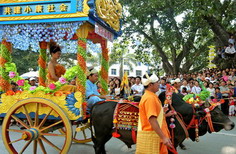
Zhu Juyuan, 65, belongs to the Yi ethnic group, who considers the sun a goddess.

This combo photo shows the process of the eclipse taken on Jan. 15 in China's Henan Province. (Xinhua photo)
When it became a black orb encircled by a fiery ring on Friday, he ran out of his home in southwest China's Yunan Province to see the event.
Hundreds of thousands of Chinese turned skyward in the afternoon, attracted by the planet's longest annular solar eclipse in 1,000 years, as it crossed China.
It was visible in parts of Yunnan, Sichuan, Guizhou, Shaanxi, Hunan, Hubei, Henan, Anhui, Jiangsu and Shandong provinces as wellas Chongqing municipality.
A crowd of more than 700 people cheered at 4:45 p.m. at Erhai Lake in Yunnan's Dali City, which was thought to be the best location for observation.
"Too beautiful. I'm lost for words," said Dong Liang, a 27-year-old college student from Kunming, capital of Yunnan.
"The sky turned a kind of mysterious blue. A round shadow was moving fast into the bright disk and later a white ring appeared, just like a ring on someone's finger," said Yang Chunjin, a local resident.
Amateur astronomers with professional equipment from Beijing, Shanghai, Hong Kong, Macao, and the provinces of Hunan, Hubei and Sichuan, had swarmed to the romantic ancient city of Dali days before, filling the hotels.
Zhu Juyuan looked into water to see the reflection of the darkened sun as his Yi ancestors did to show respect.
"The eclipse was considered to be the sky tiger eating the sun. When the eclipse occurred, elderly people always said something evil would happen, so they would beat drums and gongs to scare the sky tiger away," said Zhu.
The days when people feared an eclipse had long gone, he said. "It's common knowledge here that the moon has blocked the sunlight."
The eclipse started at 3 p.m. in Ruili City, Dehong Autonomous Prefecture in Yunnan, which saw the longest duration of the eclipse in China at 8 minutes and 17 seconds. The ring occurred at4:37 p.m.. The phenomenon ended in east China's Jiaodong Peninsula, Shandong Province, where a sunset eclipse was supposed to occur.
Although Shandong was the last stop, amateur astronomers had set up their equipment at the best observation sites in the morning.
Hundreds of people who gathered in Hongdao, a scenic spot in Qingdao, a coastal city of Shandong, were on tenterhooks as the sun appeared and disappeared behind the clouds.
They finally obtained a glance at the sunset eclipse, but missed out on seeing the eclipsed sun setting into the sea.
"I guess it's another kind of spectacle to see the sun setting into the clouds instead of the sea," said Tan Yiqing, who came from Jinan, capital of Shandong, with his wife.
Experts consider the event as a chance for the public to learn more about astronomy as the images and descriptions of the eclipse had been spreading on-line and on television.
Ordinary people in ancient China were forbidden to study solar eclipses, which were believed to be able to foretell the fate of emperors, said Liu Ciyuan, researcher of National Time Service, of the Chinese Academy of Sciences, in Xi'an, capital of Shaanxi Province.
"Ancient Chinese believed solar eclipses were warnings given bythe heaven to its son, the emperor," Liu said. However, centuries later, people watched the eclipse in the ancient city, which had been the capital of 13 dynasties over more than 1,200 years.
Chinese astronomers had carefully recorded solar eclipses as important heavenly signs for thousands of years, he said.
The earliest known solar eclipse was recorded in the Book of Documents, China's first official history book written more than 2,000 years ago. The eclipse took place 4,000 years ago, when people performed rituals -- sounding gongs and beating basins -- to drive away the "celestial dog," whom they believed was eating the sun, he said.
"It is a chance for Chinese people to look up into the sky again, for beauty, for science, or simply out of curiosity," said Bian Yulin, 67, executive director of the Chinese Astronomical Society.
China had experienced many recent astronomical events, including last year's eclipse and meteor shower, and the nation's space exploration had raised public awareness of the stars, Bian, 67, said.
"The boundless cosmos and the changing astronomical phenomena are helping Chinese people to escape from the daily grind and are stimulating their curiosity to learn and explore," said Bian.
|