|
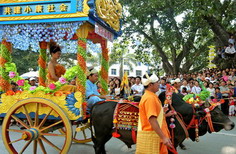
The Dai ethnic group, with a population of about 1.2 million, mainly lives in the Dehong Dai-Jingpo Autonomous Prefecture in Xishuangbanna in the southern part of Yunnan province.
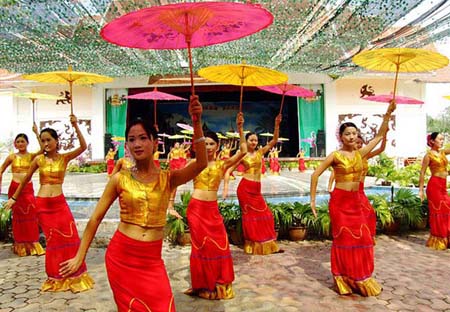 |
| Dai people are dancing. |
The Dai ethnic group has its own language that belongs to the Zhuang-Dai branch of Zhuang-Dong Austronesian of Chinese-Tibetan Phylum, and it is written in an alphabetic script. Traditionally, the Dai ethnic group has four forms of written language, but now they use only the standardized characters of the Xishuangbanna and Dehong scripts.
Descendants of the same ancestors as the ancient "Baiyue" people, the Dai ethnic group has strong connections with nationalities such as Zhuang, Dong, Shui, Bouyei, and Li. The earliest records about the Dai ethnic group can be traced back to the Han Dynasty in the first century, when it was named "Dianyue" or "Shan". It was named Jingchi, Huaman or Baiyi during the Tang and Song dynasties (618-1279), and Baiyi or Boyi during the Yuan and Ming periods (1271-1644). The local people call themselves Dai, to show their devotion to freedom and peace.
For a long time the Dais has grown rice as their main crop, and they has developed a rather complete, intensive farming system and gained rich experience in irrigation. Local products include rice, sugar cane, coffee, hemp, rubber, camphor and a wide variety of fruits. Xishuangbanna is the home of China's famous Pu'er tea. The dense forests produce large amounts of teak, sandalwood and medicinal plants, and are home to wild animals including elephants, tigers and peacocks.
Generally the Dais are followers of Hinayana, a sect of Buddhism, while retaining remnants of shamanism. There were many Buddhist temples in the countryside, and it was a common practice, especially in Xishuangbanna, to send young boys to the temples to learn to read and write and chant scriptures, as a form of schooling. Some of them became monks, while most of them returned to secular life.
The Dais have a rich and colorful culture. They have their own calendar, which started in 638AD. There are books in Dai script for calculating solar and lunar eclipses. Dai historical documents carry a rich variety of literary works covering poetry, legends, stories, fables and children's tales. They love singing and dancing, accompanied by their native musical instruments.
Dai festivals, closely related to religious activities, included the Door-Closing Festival in mid-June by the lunar calendar, the Door-Opening Festival in mid-September, and the Water-Splashing Festival in spring. The Door-Closing Festival starts three months of intensive religious activities, marking the beginning of normal life. The Water-Splashing Festival, still held every year, is the most important festival, during which the Dais splash water on one another, and hold dragon-boat races in the hope of chasing away all the illnesses and bad fortune of the past year and bringing about good weather and bumper harvests.
|