We have launched E-mail Alert service,subscribers can receive the latest catalogues free of charge

IPR Development Enters Stage of Strategic Transformation in China
2007-12-10


Lü Wei
I. State of Development of IPR System in China
Since 1978 when the policy of reform and opening-up was implemented, China has developed, step by step, a comparatively complete IPR-related legal system and a system for IPR management, and achieved marked progress in IPR management and protection. Having managed to complete a course in just 20 years, as compared to hundreds of years it has taken in the case of Western countries, China has won wide acknowledgement from the international community.
Generally speaking, China is comparatively advanced in terms of IPR legislation. What it lacks, however, is the experience in and the capacity of execution and application of the IPR system. There is also much to be desired for its IPR-related management and law-enforcing efforts. In addition, IPR development in different regions and sectors is unbalanced, and greater efforts are badly needed for coordination between policies and working bodies.
1. A fairly complete IPR-related legal system dovetailing with international practice has been developed, and IPR management and law-enforcing systems with Chinese characteristics have been created, although some supplementary laws and regulations have not been worked out yet and the management and law-enforcing systems call for further improvement
So far, China has developed a comparatively complete system of basic IPR laws, although some supplementary laws and regulations still wait to be formulated. China has not promulgated yet, for instance, any anti-monopoly laws, or written any anti-monopoly clauses into its law on IPR protection. Some laws that have already been promulgated also call for perfection and modification, and formulation of some new IPR laws has to be stepped up.
China has installed a double-track law-enforcing system. Under this system particular to China, laws are enforced by both judicial and administrative departments and IPR management systems operate at both the central and local levels. Since IPR management and protection is a business covering almost all trades and sectors and lots of departments in China are involved in the undertaking in one way or another, the current system of management characterized by isolated operations cannot provide sufficient channels for communication and mechanisms for coordination between different departments. As a result, the coordinating role of policies cannot be brought into due play, and isolated exercise of management at multiple levels often leads to legislative conflicts, overstepping of management power, or missing of management. Lack of qualified talents and shortages of funds also retard management and law-enforcing efforts.
2. Although IPR has become an important tool in industrial competition, the Chinese society as a whole has not yet become fully aware of IPR protection or capable of taking advantage of the IPR system
Chinese enterprises and industries are presently exposed to stern challenges from new technologies and intellectual property rights. Only by integrating advanced technologies and resources with their advantages in labor force and devoting constant efforts to innovation can these enterprises and industries develop and keep their cutting edges in competition. Since China has a late start in development of the IPR system, neither have its enterprises nor its society as a whole developed any due capacity to take advantage of the system. On the one hand, its enterprises have not yet become duly capable of innovation and remained at the initial stage of IPR creation. So far, 98-99 per cent of Chinese enterprises have never applied for any patents, and more than three quarters of them have not registered any trademarks. On the other hand, most enterprise and institutional units in China have not yet completed their IPR management systems, and are not capable of flexible application of the IPR system or pertinent international rules. On one occasion, they may infringe upon the intellectual property rights of others at will or unconscientiously, and on the other, they do not know how to protect their legitimate rights and interests with the IPR system. Moreover, Chinese enterprises stay at a comparatively low level in terms of execution of IPR strategies. When they apply for patents, for instance, their chief purpose is to protect their technologies or gain market shares. Few Chinese enterprises know how to implement their patent strategies in competition as flexibly as multinational corporations do.
3. Although China has attained the same level of countries with moderate and big incomes in terms of IPR protection, it remains at a low level in terms of enforcement of IPR laws and regulations and clings to local protectionism to some extent
(1) China has approaching the level of developed countries when rated according to the internationally acknowledged index of patent protection levels. According to calculations by Chinese scholars, China stood around the 20th among the 110 countries in the world in 1993 in terms of its index of patent protection levels, compared to those of these countries for the 30 years from 1960 to 1990. In 2001, China came near to Germany, the Republic of Korea and Japan in this field (Table 1). Although what is covered in the index are mainly contents of the legal system the range of protection and the law-enforcing mechanism and they cannot fully reflect the IPR protection capacity of a country, they have reflected the focus of attention put by the international community on IPR protection.
Table 1 Comparison of Index of Patent Protection Levels
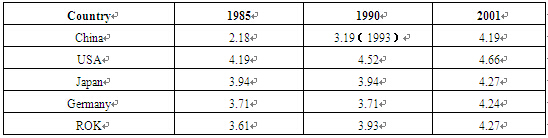
Source: Yang Zhongkai and Chai Yue: Development and Appraisal of China’s System of Indexes of Patent Protection Levels, Forum on Science and Technology in China, 2005
A qualitative analysis of the composition of the index of patent protection levels has come out with three results: First, China has basically reached the world level in terms of participation in international conventions on IPR protection and the cycle of protection. Second, China is even more lenient than developed market economies in terms of restriction of IP rights. China has not promulgated, for instance, any operable laws or regulations to ban usurpation of IP rights, and has set few limits on the range of claims when a patent application is reviewed and the patent is finally granted. And third, some foreign enterprises complain that the legislative procedures in China are not transparent enough, that the punishment of IPR infringers is not severe enough, that the law-enforcing procedures are too complicated, and that law-enforcing efforts are often retarded to some extent due to local protectionist concerns.
...
If you need the full context, please leave a message on the website.