We have launched E-mail Alert service,subscribers can receive the latest catalogues free of charge

Evaluation and Analysis of Scientific Development in Various Regions of China
2008-08-12


Zhang Junkuo, Hou Yongzhi, Xuan Xiaowei & Liu Peilin, Department of Development Strategy and Regional Economy of DRC
Research Report No.038, 2008
I. Basic Content of Index of Regional Scientific Development1
Index of regional scientific development is a quantitative instrument for the comprehensive evaluation of economic and social development in various regions of China in the previous year in accordance with requirements of implementing scientific development approach, comprising (1) rate and performance of economic growth (economic growth index); (2) environment-friendliness and resource saving (environment-friendliness index); (3) coordination between economic growth and social development (coordinated development index); and (4) potential of future economic growth (growth potential index). General index of regional scientific development is the integration of aforesaid four indices.
Specifically, economic growth index is supposed to reflect three aspects, namely, (1) growth rate of regional GDP (regional GDP growth index); (2) given that the extent of difficulty in enhancing 1 percentage point of GDP of economies in various development stages varies, the absolute level of per capita regional GDP shall also be taken into consideration to reflect the extent of difficulty in economic growth ( per capita GDP index); (3) apart from study of economic growth from quantitative perspective, economic growth shall also be studied from qualitative perspective, namely, benefits of economic growth. Therefore, the proportion of the value-added tax, business tax, personal and enterprise income taxes arising from all economic activities in regional GDP are also studied (index of proportion of tax in GDP).
Environment-friendliness index in particular reflects two aspects, namely, (1) how much energy and water are consumed and how much land is occupied for economic growth, namely, resource-consumption of per unit GDP (material-consumption index); (2) how much pollution resulting from economic growth is emitted, including water pollution, air pollution and solid waste pollution, namely, pollutant emission of per unit GDP (pollution index).
Coordinated development index is supposed to mirror five aspects, namely, (1) whether the residents' income growth in various places is in line with economic growth (index of coordination between residents' income and GDP); (2) whether the growth in employment in various places is consistent with local economic growth (employment growth index); (3) whether the public services enjoyed by residents in various places are coordinated with local economic growth (public service expenditure index); (4) whether social security for local residents are accordant to local economic growth (social security index) and (5) whether the income gap between urban and rural residents are narrowed and whether the benefits from GDP growth are harmonized both at home and abroad (income distribution index).
Growth potential index is supposed to indicate consitions in five aspects, namely, (1) intensity of input in sci-tech innovation and amount of sci-tech innovation achievements (sci-tech innovation index); (2) accumulation of material capital (material capital index); (3) technology and management experiences, etc. brought by foreign capital (index of proportion of foreign captial in fixed assets investment); (4) improvement of infrastructure (infrastructure index) and (5) improvement of labor force quality (index of labor force quality).
II. Results of Evaluation of Regional Scientific Development2
1 Scientific development in four regions
(1) General index of regional scientific development
General index and four sub-indices of regional scientific development are indicated in Table 1.
In terms of general index of regional scientific development, the eastern region ranks the first place, scoring 6.18, followed by the northeastern region, scoring 4.31. The central region and the western region rank respectively the third and the fourth places, scoring 3.95 and 3.44 respectively.
Specifically, the general index of the eastern region is obviously higher than the average general index nationwide and has conspicous advantages over other regions in terms of economic growth, environment-friendliness and growth potential, but in terms of coordinated development index, it lags behind the northeastern region and the central region, which indicates that it should pay more attention to harmony between economic growth and social development.
The general index of the northeastern region roughly equals nationwide average general index. It ranks the first place in terms of coordinated development index and the second place in terms of economic growth and environment-friendiness, but its growth potential index is the lowest, implying that it needs to attach more importance to promoting the economic growth potential.
Table 1 Regional Scientific Development Indices of Four Regions3 (2006)
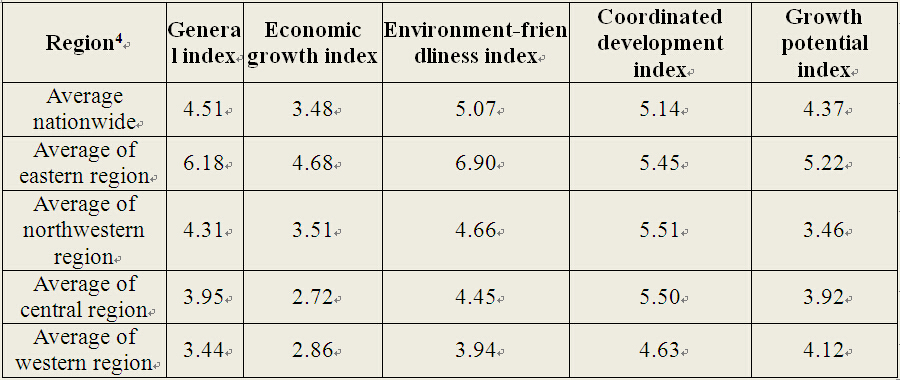
The general index of the central region lags behind the nationwide average level. Its coordinated development index and growth potential index rank relatively in the front while environment-friendliness index and economic growth index are backward. Its economic growth index is the lowest in the four regions. Hence, it should focus on economic growth and environmental protection.
A substantial gap exists between the general index of the western region and nationwide average. It ranks high in terms of growth potential index, but is backward in other three indices. Its environment-friendliness index and coordinated development index are the lowest in the four regions, showing that it lags behind other regions in respect of implementing scientific approach to development and promoting comprehensive development. Therefore, this region has to reinforce the protection of ecological environment and harmonious economic and social development, while continuously stepping up its economic growth at the same time.
…
If you need the full text, please leave a message on the website.
1Department of Development Strategy and Regional Economy of DRC formulated the "Regional Scientific Development Index" in 2006 and conducted evaluation on economic and social development in various places according to 2005 data, the results of which are indicated in Research on Regional Scientific Development in China (China Development Publishing House, April 2007). Based on changes related to situations and data, we update and adjust the system of "Regional Scientific Development Index" and predict the latest "Regional Scientific Development Index" according to 2006 data, which are the research findings in this report.
2Given that the regional scientific development index needs to be calculated on the basis of comprehensive and systematic data and the latest data of each province currently available primarily are from China Statistical Yearbook 2007 (2006 data), the evaluation of scientific development in 2006, therefore, is the latest evaluation based on data available.
3Given that each index is obtained after the sub-indices are standardized and weighted,, comparison in absolute sense, therefore, cannot be conducted among different indices (for example, the environment-friendliness index is higher than economic growth index in eastern region, but that does not mean environment-friendly status is better than economic growth status in this region.).
4National data and data of four large regions are obtained through arithmetic averaging of data of each individual province. Eastern region comprises Beijing, Tianjin, Hebei, Shanghai, Jiangsu, Zhejiang, Fujian, Shandong, Guangdong and Hainan; northeastern region comprises Liaoning, Jilin and Heilongjiang; central region comprises Shanxi, Jiangxi, Henan, Hubei, Hunan and Anhui and western region comprises Inner Mongolia, Guangxi, Chongqing, Sichuan, Guizhou, Yunnan, Tibet, Shaanxi, Gansu, Qinghai, Ningxia and Xinjiang.