We have launched E-mail Alert service,subscribers can receive the latest catalogues free of charge

Breaking through Fund Dilemma and Rebuilding a New Market Order
By Chen Daofu 2015-07-23


By Chen Daofu, Research Institute of Finance of DRC
Research Report, No. 72 2014 (Total 4571)
The capital market has remained in a state of confusion in recent two years. Recently, people have noticed the following incidents that RMB depreciated against US dollar, various domestic capital prices fell quickly, credit default risk escalated, and market expectations became unstable. The confusion of the capital market is the outward manifestation of the economic and financial performance, and it has profound internal reasons. China is at the critical stage of economic and financial transformation, and expects to give better play to the role of the market mechanism. However, the confusion of capital market shows that the market's function in optimization of resources allocation under the current environment has been greatly restrained, making it impossible to create a virtuous cycle. China needs to create a necessary system and policy environment as early as possible in a bid to allow the market to function properly.
I. Increasingly Fragile Capital Market
China's capital market has shown pronounced fragility since June 2013.
1. Link between capital market and real economy was weakened and there was resources misallocation
On the one hand, more and more institutions, links and chains ranging from capital sources to capital users are involved, making fund circulation become increasingly nontransparent and complex with more off-balance-sheet business. In other words, a growing amount of capital in China is pooled, converted and finally shepherded to the real economy through shadow banking system. In China, a host of administrative control and supervision measures are still in place, and regulation of formal finance is relatively strict. In response to the transformation pressure, financial institutions have escaped various financial controls (which actually reflects China's deepening liberalization in informal financial system) and inputted capital into the areas discouraged or even prohibited by industrial policy but with reasonable risk returns. As a result, more and more financial institutions and quasi-financial institutions need to be incorporated into the capital chain, and the designed projects have become increasingly complex. According to the proportion of RMB loans, bonds and stocks with a relatively short chain in the total social financing, it was above 80% before 2009, but dropped to over 70% in 2010-2012 and further dropped to around 60% in 2013. A large amount of capital was inputted into the real economy through entrusted loans and trust loans (Figure 1).
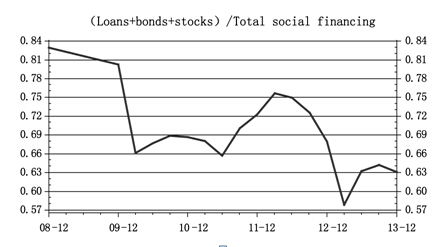
Fig. 1 Changes in the Short Chain of Social Financing
Source: Wind.
On the other hand, the higher the leverage ratio of the real economy, the weaker the relationship between the allocation of financial resources and the actual solvency of the real economy. According to the statistics of the central bank, the debt-to-asset ratio of industrial enterprises increased by four percentage points from 58% at the end of 2007 to around 62% at present. The proportion of various loans, enterprise debts and accounts receivable in GDP also kept going up in recent years. What is more important is that the profitability of the real economy was declining, increasingly contrary to the capital price required by the financial sector. Take industrial enterprises for example. Their return on assets (ROA) of principal operations was around 7.5% in recent years, approaching to the weighted loan rate of banks. Given the fact that the proportion of bank loans in enterprises' external capital is going down gradually, and the cost of other capital sources is generally higher than interest rate of bank loans (the actual cost of capital obtained by enterprises from banks is far more than the benchmark interest rate of loans), ROA of principal operations, in fact, has become lower than enterprises' capital cost. Despite the liability expansion of enterprises in recent years, such an act has been no longer reasonable economically (Figure 2).
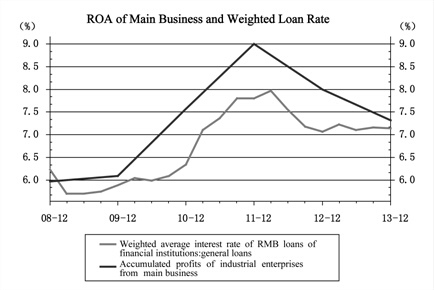
Fig. 2 Relationship between ROA of Industrial Enterprises and Weighted Loan Rate
Source: Wind.
2. Capital market fluctuated drastically and was highly sensitive toward various signals
Since the incidence of "cash crunch" in June 2013, capital market prices have been on the rise as a whole. During this period, however, there were still "drastic fluctuations" in the market, which is reflected by the capital needs of each credit rating. Three rounds of relatively obvious fluctuations have taken place to date. That, coupled with changes in cross-border capital flows, particularly the flow of arbitrage speculative capital, have further amplified the volatility of China's capital market. The market has become highly sensitive to various signals, including the central bank's operations and the rumors on the market credit default. Both financial institutions and the real economy have gradually raised the real leverage ratio to the maximum limit, which, together with the widespread implicit guarantee in the market, has caused the financial market operation to be highly dependent on the fragile government guarantee assumption.
3. Lack of capital market segmentation
Credit spread of different credit ratings is continuously narrowing. As viewed from the five-year debenture bonds with a credit rating of AA- and AA that are comparatively important in the market, the interest spread has dropped from a peak of 1.8 percentage points to around 0.6 percentage points currently. And more importantly, a large amount of wealth management products of banks, which were supposed to be risk-free assets, were actually invested in risk assets. The confusion of risk assets and risk-free assets led to the confusion of the interest rate in the most important risk-free market and the risk market rate, which raised risk-free interest rate, and reduced, to a certain degree, the interest rate of part of risk assets (Figure 3).
4. Credits grew rapidly but at a slower pace
Viewing from the absolute quantity, China's credits still expanded quickly, but at a slower pace. In 2013, M2 and RMB loans grew by 13.6% and 14.1% respectively; newly increased RMB loans reached RMB8.89 trillion yuan, and social financing increased by RMB17.29 trillion yuan accumulatively. However, the growth of total social financing had dropped from 22.87% in 2012 to 9.69% in 2013. Debt growth rate of industrial enterprises has decreased from previously more than 20% to 13%-14% in recent years. It indicates the normal and marginal contraction has started and lasted for 1-2 years following the credit boom.
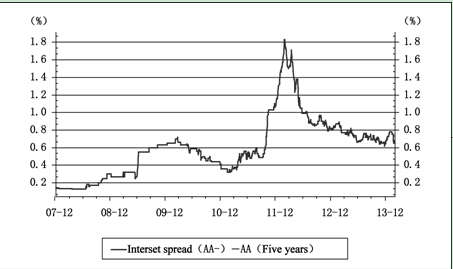
Fig. 3 Changes in Credit Spread
Source: Wind.
…
If you need the full text, please leave a message on the website.