We have launched E-mail Alert service,subscribers can receive the latest catalogues free of charge

Great Importance Should Be Attached to the Prevention and Control of PM2.5 Pollution in China
2015-08-07


By Zhou Hongchun, Research Department of Social Development of DRC
Research Report No 184, 2012 (Total 4186)
In recent years, due to a growing number of pollutants running riot in some cities, such as the "smog" weather, PM2.5 has become the focus of major environmental concerns among the public and of the public opinion. Effective measures are needed to conscientiously deal with it.
I. China Is One of the Countries Worst Hit by PM2.5 Pollution
PM10 is a particulate matter smaller than or equal to 10 micrometers, while PM2.5 is smaller than or equal to 2.5 micrometers, which can go directly to the alveoli of the lungs. PM10 and PM2.5 reflect the particulate composition of the dust pollution. The digit stands for the level of air pollution. The bigger the digit, the more serious the pollution is. PM2.5 is about the size of the particulate matter. Some also call it aerosol according to its chemical components. The chemical components of PM2.5 are complicated, including particulate matter let out from coal combustion and automobile exhaust (primary pollutants) as well as secondary pollutants formed from the photochemical reaction of particles spread in the air. Researches by institutes at home and abroad have revealed features of PM2.5 pollution in China as below.
1. China's urban air quality ranks behind WHO countries
PM2.5 concentrations in some cities of China are notably higher than those in Western countries. In September 2011, the World Health Organization (WHO) published the air qualities and rankings of 1,100 cities of 91 countries, of which 32 were cities of China, whose PM10 concentrations ranged between 38~150μg/m3, ranking 812th~1058th. Beijing ranked 1035th, even Haikou, capital of China's Hainan Province where air quality was better, also ranked behind Paris among WHO rankings (Figure 1).
2. PM2.5 pollution is worsening on the whole and such pollution turns out worse in China's northern cities than in the southern cities of the country
Environmental quality bulletins in recent years show that the urban air quality in China remains relatively stable, and that some indicators are taking a turn for a slight better. For example, the proportion of the cities where air quality lived up to the secondary standard increased from 35% in 1999 to more than 70% in 2009. Of 113 cities monitored by China in 2009, about 71.43% were up to the standard with PM10 of those cities reaching an annual average of 80μg/m3 or above.
The PM2.5 pollution in Beijing has shown a downward trend since 2007. Measures, such as relocation of pollution-incurring enterprises out of Beijing to give way to the "Green Olympics" (i.e. reducing secondary industries while developing tertiary industries), readjustment of the structure of energy consumption including changing coal consumption to gas and electricity consumption, enhancement of the motor vehicle exhaust emission standard and increase of investment for pollution abatement, have been the main reasons. See Figure 2 for changes in PM2.5 concentrations in Beijing.
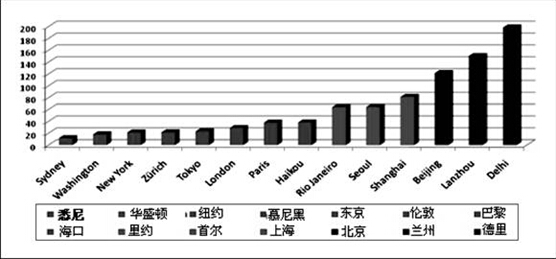
Figure 1 PM2.5 Pollutions in World Major Cities and the Pollution Rankings Published by WHO in 2011
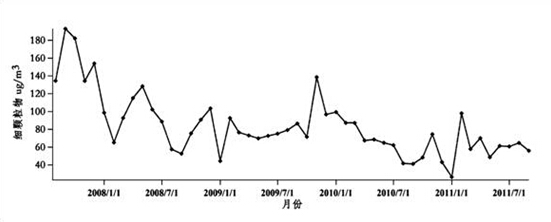
Figure 2 Downward PM2.5 Pollutions in Beijing since 2008
細(xì)顆粒物:fine particulate matter
PM2.5 and the limiting value of ozone concentration have been added to Ambient Air Quality Standard(AAQS) (GB3095-2012) newly revised by China, and AAQS has lifted the annual average concentration of PM10 of secondary standard from 0.1mg/m3 to 0.07mg/m3. The air qualification rate will reduce significantly if the urban air and environmental qualities are evaluated according to the new standard, that is, based on the new secondary standard (70μg/m3), the proportion of cities that are up to the standard will reach 20.54%, down 51 percentage points.
PM2.5 concentration has exceeded the standard in every city of China, and the overproof PM2.5 concentrations in China's northern cities are higher than those in the country's southern cities. According to the pilot monitoring of Tianjin, Shanghai, Chongqing, Guangdong, Shenzhen, Guangzhou, Suzhou and Nanjing conducted by China National Environmental Monitoring Center, PM2.5 concentrations in these cities have even seriously exceeded WHO's first-stage standard and are worsening.
During the pilot monitoring, the proportion of China's urban PM2.5 concentrations in PM10 has reached 65.8% on an average, and this percentage does not differ too much in China's southern or northern cities. It suggests that the size of the particulate matter in dust pollution is dwindling and that only controlling PM10 has not been able to satisfy the need for controlling dust pollution, but that importance should be gradually transferred on the control of PM2.5.
3. PM2.5 pollution will become the hidden peril against social stability if proper attention is not paid
Some influences have turned up. The increase of the smoggy days features PM2.5 pollution directly. In 2010, the frequency at which smoggy weather happened in China's urban areas varied between 20.5%~52.3%, and such weather conditions have been worsening. The worsening smoggy weather will trigger a number of problems, such as people wearing face masks to go outside, children in urban areas unable to see stars in the sky and increased number of traffic accidents and so on. Worse still, the smoggy weather caused by the burning of crop stalks in rural areas will even affect the takeoff or landing of aeroplanes, yet no good solutions have been found to this problem to date.
Appearance of some influences defers. PM2.5 contains toxic and hazardous substances like polycyclic aromatic hydrocarbon (PAH), which are quite harmful to human health. PM2.5 can penetrate through nasal cilium to incur respiratory diseases and has been the precipitating factor for asthma and chronic bronchitis. In 2005, in its Air Quality Criteria, WHO pointed out that persons inhaling an annual average of 35μg/m3 of PM2.5 saw an increase of mortality risk by 15% as compared to those inhaling an annual average of 10μg/m3 of PM2.5. According to estimates by American Heart Association (AHA), PM2.5 pollution causes about 60,000 mortalities each year. A contrast through smoggy weather and lung cancer mortality curves made out after 1960s has found out that high incidence of lung caner will turn up in the 7th year since the occurrence of severe smoggy weather conditions.
The increase of the smoggy days can produce non-negligible influence on people's mood and psychology. For example, some people published the US embassy PM2.5 data on the internet and the data drew high attention from the mass media. Without scientific explanations of those PM2.5 data, not only will the authority of the data of the environmental protection system be affected, but the data will even become the hidden peril for mass disturbances. In other words, we cannot lower our guard against the PM2.5-induced environmental public sentiment.
…
If you need the full text, please leave a message on the website.